


Modders have found ways to lift software-imposed limits on certain AI and matrix-compute operations in NVIDIA’s GeForce RTX 20-, 30- and 40-series graphics cards. Reported peak throughput nearly doubles in some tests, including on the RTX 4090. The changes target compute workloads rather than gaming, and support remains unofficial and hardware- and software-dependent.
Key takeaways
- Separate community projects report unlocks for Turing, Ampere and Ada GeForce cards.
- Peak Tensor Core results include 331.6 TFLOPS on an unlocked RTX 4090 and 157.4 TFLOPS BF16 on an RTX 3090 Ti.
- Real-world gains vary; local LLM token generation and gaming generally do not get comparable speedups.
- The modifications are unofficial, largely Linux-focused, and carry compatibility and hardware risks.
What the unlock changes
The projects target limits on the rate at which select matrix instructions can be issued. They do not add CUDA cores, memory capacity or bandwidth, and reports describe software or low-level configuration changes rather than a physical alteration or VBIOS flash. Methods differ across projects and GPU generations, with some working before NVIDIA’s driver initializes.
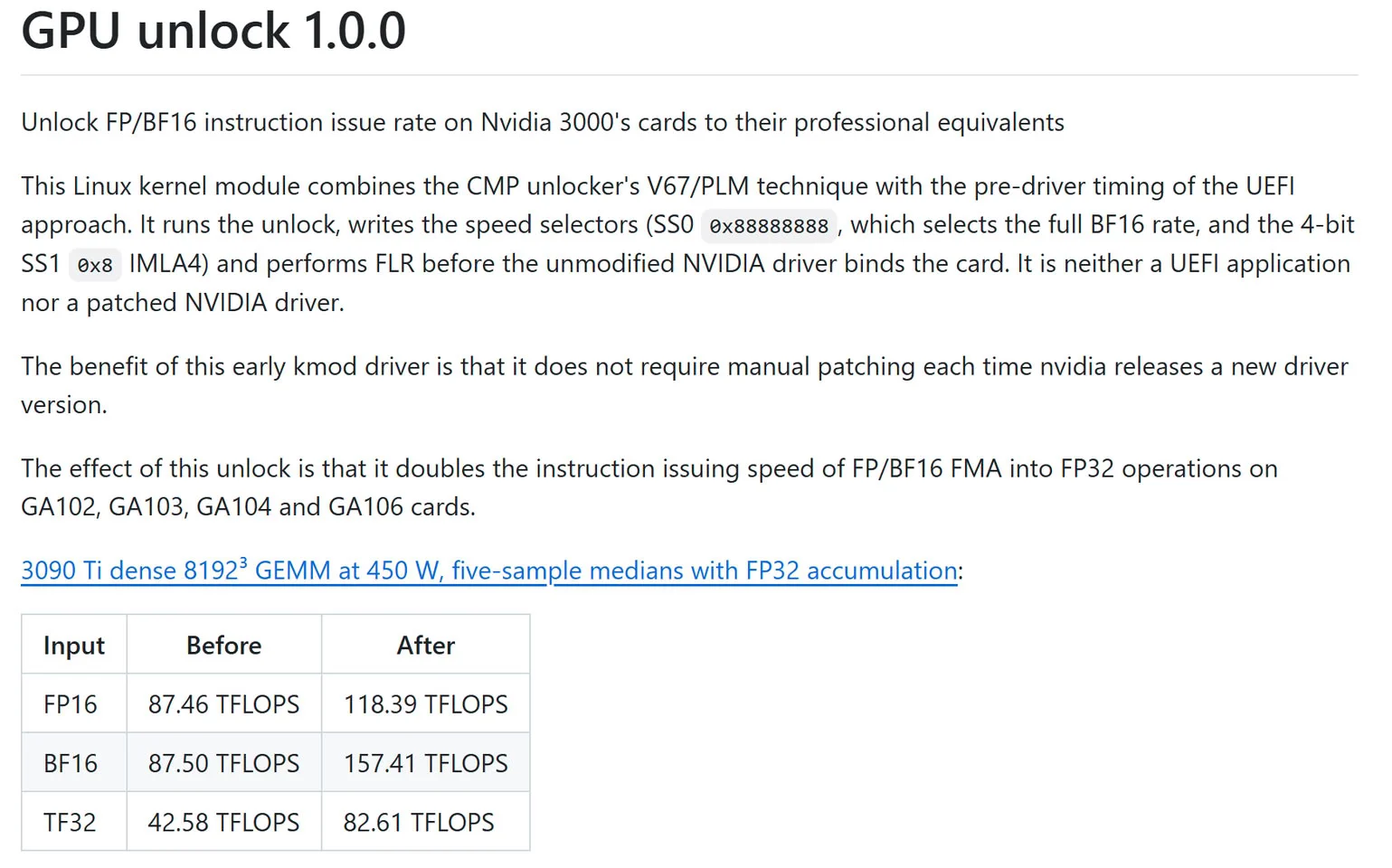
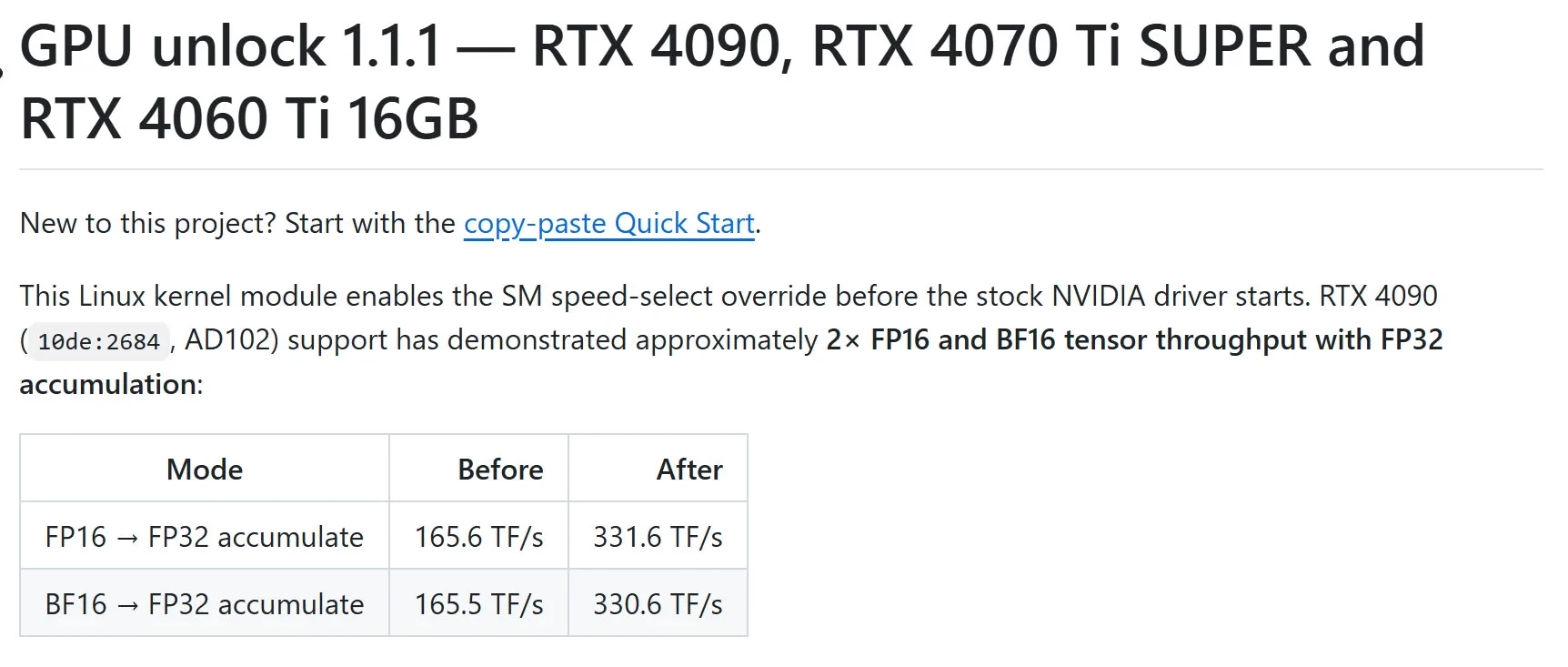
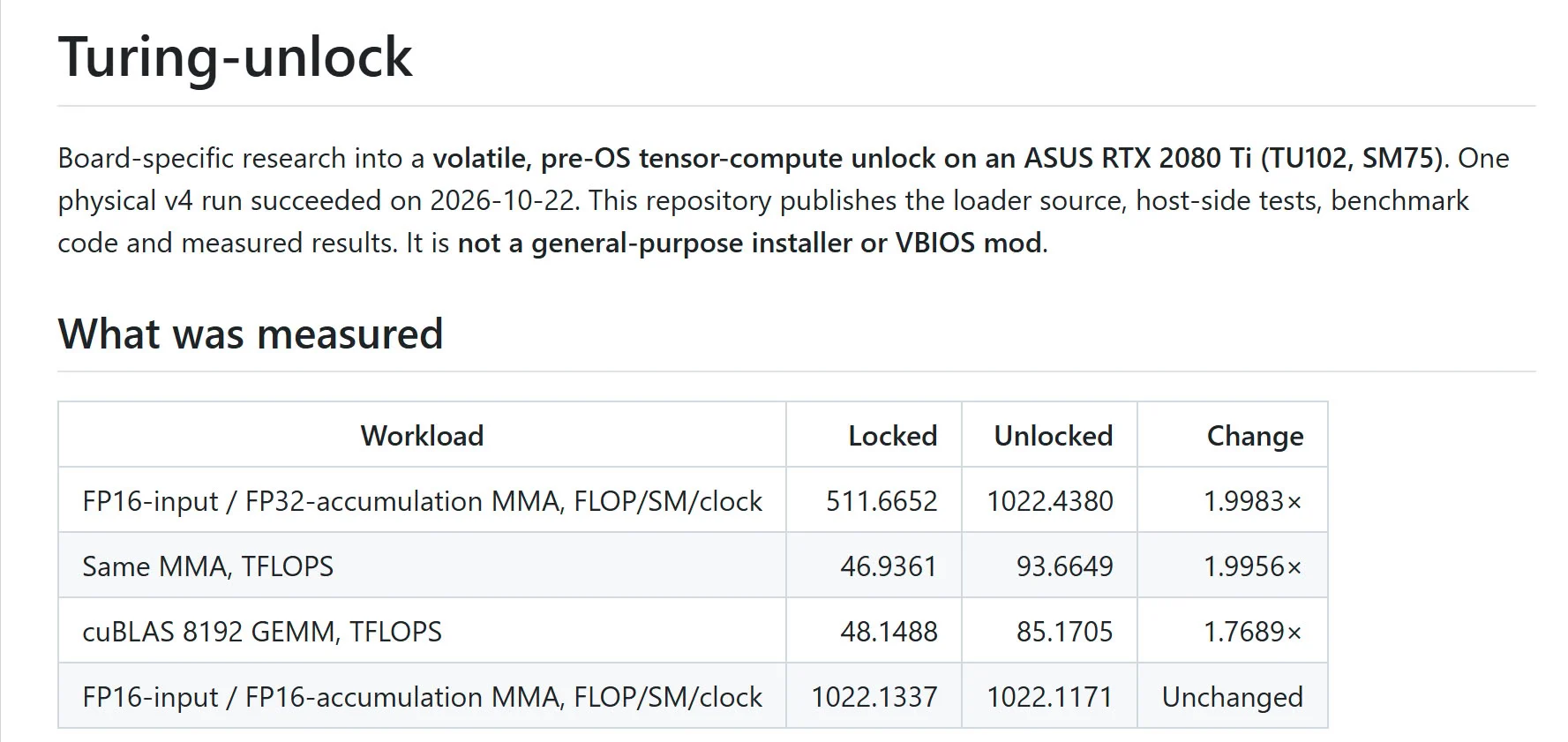
The reported peak figures are substantial: an RTX 4090 rose from 165.6 to 331.6 TFLOPS in FP16 tensor throughput, while an RTX 3090 Ti reached 157.4 TFLOPS in BF16, up from 87.5. An RTX 2080 Ti test reported FP16 performance increasing from 59.9 to 111 TFLOPS. These are specific benchmark results, not guaranteed performance for every card or application.
Workloads benefit differently
The biggest potential gains are in compute-heavy AI tasks, including matrix multiplication, image generation and processing long prompts in local large language models. Reported RTX 3090 Ti tests show prompt-processing improvements of roughly 14% to 36%, while image-model throughput also increased in some tests.
The peak compute gains do not translate directly to application speed. LLM token generation is often constrained by memory bandwidth, which the unlock does not improve, and reports found decode performance largely unchanged. The modifications are not expected to raise ordinary gaming frame rates; there is also no established evidence that they improve DLSS performance.
Compatibility and risks
Support varies by project and card. Linux is the main target, though experimental Windows builds have been reported. Some GPU models remain untested, and at least one RTX 3080 Ti report showed no BF16 improvement. The RTX 50-series has no confirmed unlock in the reports, and compatibility with one card should not be assumed for another with the same GPU generation.
These are community modifications, not NVIDIA-supported features. Project documentation warns of possible instability, failed boots, data corruption or hardware damage; using them may also void a card’s warranty. For PC builders and local-AI users, the results are promising, but they are best treated as experimental rather than a dependable, risk-free upgrade.