The global AI compute shortage is not slowing down. NVIDIA’s latest GPUs remain backordered, hyperscaler pricing continues to climb, and smaller AI teams are increasingly locked out of the hardware they need. Against this backdrop, one EU-based platform has been quietly scaling an alternative.
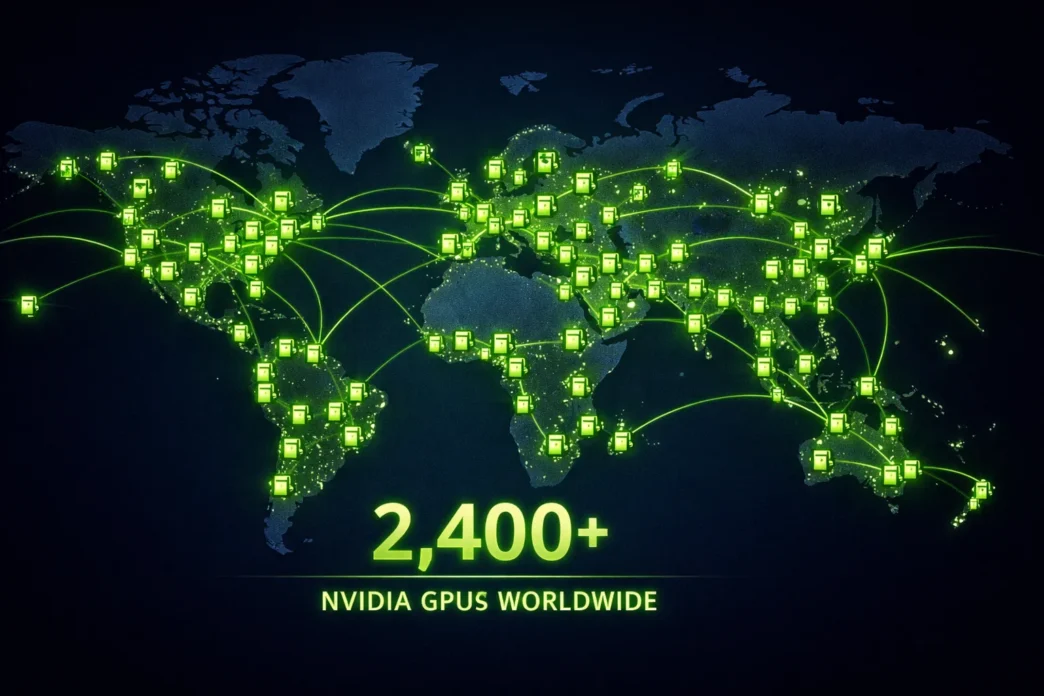
GPUnex, a GPU compute marketplace founded in 2024, has crossed 2,400 active NVIDIA GPUs deployed across more than 150 verified data centers worldwide. That represents a 24x expansion from the company’s initial network of 100 providers — growth that tracks closely with the accelerating demand for AI compute across every industry.
A Growing Network of Verified Infrastructure
The scale of GPUnex’s data center network is notable. The platform lists infrastructure partnerships with eight tier-1 data center operators:
- Equinix — 270+ facilities across 36 countries, NVIDIA DGX-Ready colocation
- Digital Realty — 310+ facilities across 25+ countries, 99.999% uptime SLA
- OVHcloud — 40+ data centers on 6 continents
- Hetzner — European operations across Germany and Finland
- CyrusOne — 55+ data centers globally, enterprise-grade colocation
- QTS Realty Trust — Hyperscale facilities in the US and Europe
- CoreSite — 28 data centers across 8 US metro areas
- Switch — Purpose-built AI-ready facilities in Las Vegas, Reno, Grand Rapids, and Atlanta
The GPU fleet spans NVIDIA’s current enterprise lineup: H100 80GB SXM, A100 80GB, A100 40GB, L40S, and L4 accelerators. The platform operates under a 99.9% uptime SLA with per-second billing — a granularity that reduces waste for short or bursty AI workloads.
Why It Matters: The AI Compute Supply Gap
The numbers behind the current GPU shortage are staggering.
AI compute demand is growing 4–5x per year, according to Deloitte’s TMT Predictions 2026. Hyperscaler capital expenditure on AI infrastructure is projected to exceed $600 billion in 2026, per IEEE ComSoc. The global GPU market is expanding at 32.6% annually, according to Precedence Research. And NVIDIA’s chip shortage is expected to persist through 2027 and beyond, as reported by CNBC.
Goldman Sachs estimates that total AI infrastructure spending could top $500 billion in 2026 alone. The bulk of this spending flows to a handful of hyperscalers — Amazon, Microsoft, Google, and Meta — who are locking up GPU supply through multi-billion-dollar procurement deals with NVIDIA.
That leaves a widening gap. Startups, research labs, and mid-sized enterprises need GPU access for training, fine-tuning, and inference — but they lack the procurement power or capital to compete at hyperscaler scale. GPU marketplaces like GPUnex exist to fill this gap by aggregating distributed supply from verified data center providers and making it available on demand at marketplace pricing, which typically runs 3–6x lower than hyperscaler on-demand rates.
How the Platform Works
GPUnex operates as a two-sided marketplace connecting GPU hardware providers with AI developers and enterprises. Providers list available GPUs, renters select hardware and deploy workloads via Docker containers, and the platform handles billing, monitoring, and transaction security.
The company is GDPR-compliant and EU-based, which matters for organizations subject to European data protection requirements or operating under the EU AI Act. All transactions on the platform are escrow-protected — payments are held until services are delivered and verified, adding a layer of financial security that is uncommon in the GPU marketplace space.
GPUnex also offers what it calls GPU revenue packages, allowing participants to fund the deployment of GPU infrastructure across verified data centers and earn daily returns from enterprise rental operations. According to the platform, every GPU in the program is physically deployed, benchmarked, and serving real workloads.
What Comes Next
The company’s 2026 roadmap includes multi-GPU cluster offerings with NVLink and InfiniBand interconnects — a capability required for large-scale distributed training jobs that single GPUs cannot handle. Regional expansion is also planned, with the goal of reducing latency for AI teams in underserved markets.
Whether GPUnex can maintain this growth trajectory alongside larger, better-funded competitors remains an open question. But the underlying demand signals are unambiguous: the world needs more GPU compute, it needs it now, and the current supply infrastructure is not keeping up. Platforms that can aggregate and verify distributed GPU capacity — and make it accessible at reasonable cost — are positioned to capture a meaningful share of what is becoming one of the largest infrastructure markets in history.
More information is available at gpunex.com.