


AMD is reportedly developing a neural rendering feature for its next-generation RDNA 5 graphics architecture. The technology, described by leaker Kepler_L2 as “Neural Lighting,” could give future Radeon GPUs a DLSS 5-like method for improving lighting and surface detail with artificial intelligence. AMD has not confirmed the feature or RDNA 5 itself.
Key takeaways
- AMD is rumored to be developing a DLSS 5-style “Neural Lighting” feature for RDNA 5.
- The technology could use game-engine data such as geometry, materials, depth buffers, and ray information.
- It may require dedicated neural-processing hardware and be exclusive to future Radeon GPUs.
- RDNA 5 launch timing remains unconfirmed, with rumors pointing to late 2027 or early 2028.
AMD’s rumored neural rendering approach
Kepler_L2’s claim appeared in the AnandTech forums and describes AMD’s technology as a neural-rendering solution comparable to NVIDIA’s DLSS 5. Neural rendering uses trained models to replace or enhance portions of traditional shader work, potentially improving lighting, shading, and material appearance in real time.
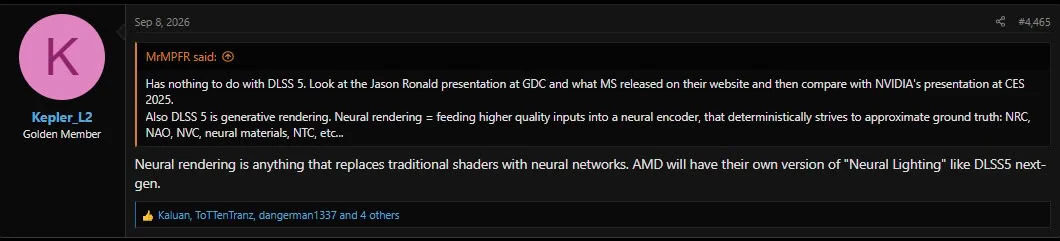
The leaker did not provide confirmed technical specifications or state that AMD will use a particular implementation. However, related reporting suggests AMD may be investigating a more engine-integrated design rather than relying primarily on the final rendered image.
Direct access to game data could reduce artifacts
According to the reports, AMD’s potential advantage would be access to information normally available inside the game engine. This could include geometry, bounding-volume data, depth buffers, material properties, and ray-tracing data. With that information, a model would not need to infer the identity and lighting behavior of objects from a two-dimensional frame alone.
Kepler_L2 suggested that AMD could separate lighting improvements from complex-surface shading and avoid an additional color-grading step. That proposed design is the leaker’s preference, not evidence of AMD’s actual architecture, but it highlights the central debate around neural rendering: image quality must improve without overriding the artistic direction of a game.
RDNA 5 hardware may be required
The reported feature could be limited to RDNA 5 because neural-rendering workloads are expected to be demanding. Rumors point to expanded AI capabilities and specialized hardware designed to accelerate low-precision matrix operations, although AMD has not disclosed any RDNA 5 specifications.
That limitation would resemble the way NVIDIA ties its newest AI features to particular GeForce generations. It could also leave existing Radeon owners dependent on less advanced versions of FSR or software-based alternatives. Modded implementations of DLSS 5 on current Radeon hardware reportedly suffer from significant performance losses, illustrating the likely cost of running complex models without purpose-built acceleration.
Launch timing and Radeon outlook
AMD has not officially announced the RDNA 5 name, Radeon RX 10000 branding, or a release schedule. Current rumors variously suggest a late-2027 or early-2028 arrival, leaving substantial time for the company to change its plans.
For PC builders and gamers, the important question will be whether AMD can deliver competitive image quality, performance, and developer support—not simply whether it matches NVIDIA’s feature list. If the report proves accurate, neural rendering could become a major differentiator for future Radeon cards and potentially extend into AMD-powered console hardware. For now, the technology remains unconfirmed speculation.