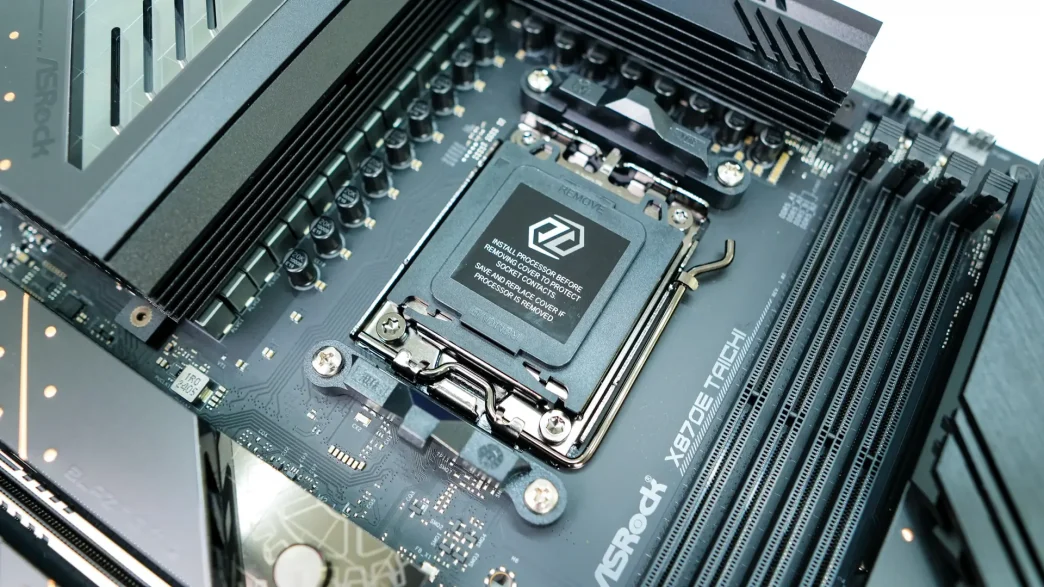
ASRock has officially acknowledged that aggressive BIOS settings, specifically within Precision Boost Overdrive (PBO), were responsible for the failures of some AMD Ryzen 9000 CPUs on their motherboards. The company has released BIOS updates to address the issue and is offering warranty support for affected motherboards, though the process for CPU replacement remains less clear for users.
ASRock Confirms BIOS Settings Caused Ryzen CPU Failures
ASRock has gone on record, following investigations and reports from tech YouTubers like Tech YES City and Gamers Nexus, to confirm that its BIOS settings were indeed linked to the premature failure of some AMD Ryzen 9000 series CPUs. Initially, ASRock had attributed issues to memory compatibility or even debris in CPU sockets, but they have now pinpointed the root cause.
- The problem specifically relates to the Precision Boost Overdrive (PBO) settings, particularly the Electrical Design Current (EDC) and Thermal Design Current (TDC) parameters.
- ASRock’s original values for these settings were found to be excessively high, leading to undue stress on the CPUs.
- This issue primarily affected ASRock’s mid-range and high-end motherboards, which were configured to run Ryzen 9000 CPUs at their maximum PBO settings out of the box.

The Role of Precision Boost Overdrive (PBO)
Precision Boost Overdrive is an AMD feature designed to enhance CPU performance by allowing it to exceed standard power and thermal limits. However, ASRock’s implementation of these settings proved to be too aggressive.
- The high EDC and TDC limits, exceeding AMD’s recommendations, subjected the CPUs to excessive electrical stress.
- Concerns have also been raised about “shadow voltages” and the automatic activation of PBO through AMD’s Ryzen Master software, which could further complicate debugging and performance adjustments.
ASRock’s Response and Warranty Support
ASRock has released BIOS version 3.25 and subsequent updates to address the issue by lowering the PBO values, specifically the EDC and TDC settings. They have also optimized “shadow voltages” for increased stability.
- ASRock is committed to fixing any damaged motherboards and will cover shipping costs for RMA (Return Merchandise Authorization).
- However, ASRock has not reported any damaged motherboards themselves, and the process for users to get their potentially faulty CPUs replaced remains ambiguous, often directing users to retailers or AMD for CPU warranty claims.
- New motherboards manufactured by ASRock will include these fixes pre-installed.
Ongoing Concerns and Transparency
Despite ASRock’s efforts, some users have reported CPU failures even after updating to BIOS version 3.25, and in cases where PBO was not explicitly enabled. ASRock has also faced criticism for its lack of transparency and delayed public statements regarding the issue.
- The company’s Vice President of the motherboard division, Chris Lee, apologized for the delay in identifying the root cause.
- ASRock has been urged to be more transparent with its customers about such critical issues.
- Neither ASRock nor AMD has provided a comprehensive official statement on their websites, leaving many users reliant on third-party tech media for information.
Via Tom’s Hardware