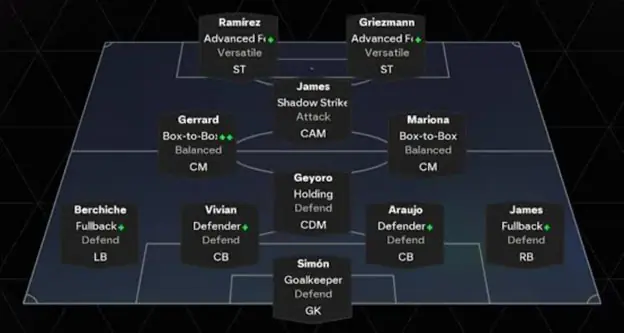
I have been messing around with different setups in FC 26 for a good while now, and somehow I keep coming back to the narrow 4-1-2-1-2 (2). It is funny because the formation does not look impressive at first glance. It looks like something people used years ago and forgot about.
This year’s gameplay is strange. Some matches turn into full speed counterattacks every thirty seconds. Other games force you to slow everything down and build patiently. Because FC 26 swings so much between those two extremes, anything flexible becomes valuable. The narrow 4-1-2-1-2 (2) happens to shine here. Everything is close together. The passing lanes show up on their own. The strikers move into weird little pockets that defenders hate to deal with. It just works better than it looks.
And to be clear, this is not some perfect tactical lecture. All of this is based on real matches, testing different cards, swapping roles back and forth, and noticing what breaks and what does not. If it looks good on paper but collapses in Div 1, I am not including it here. Sometimes, especially when trying to climb divisions quickly, players even look into things like EA FC 26 boosting to smooth out the grind — but having the right setup already does half the job.
Why This Formation Still Holds Its Ground

The narrow setup works because it keeps your entire team connected. There is no waiting for a winger who stands twenty yards away doing absolutely nothing. The midfield stays compact, which makes passing easier, and your forwards float around in little gaps that make defenders panic. Once you get the timing of the short passes down, you start noticing that you pretty much always have a safe option.
Even with how wild the counter meta is, the formation can still survive. You just need players who understand how to fill space. When one striker drops, the other runs. When your CAM gets the ball, both forwards give him an angle. It is not a formation built on sprinting. It is built on movement, and FC 26 happens to reward that more than people think.
The Players Who Make This Formation Come Alive
The whole thing depends on the midfield. No exaggeration. If you get the midfield wrong, the formation looks awful.
You need center mids who can turn quickly and handle small touches without bouncing the ball away. Cards with Tiki Taka change the entire feel of the formation. Bernardo Silva, for example, feels like he was made for this role. Light on the ball, easy touches, clean turns. He links play so smoothly that the entire team feels quicker because of him.
Strikers also matter a lot more than usual. False Nine Attack is one of the most underrated roles right now. The update made these players smarter. They drop only when needed. They make forward runs when the gap is right. Messi in this role feels ridiculous. He pops up everywhere and still finishes chances like normal.
Busquets is another example. He is not fast, obviously, but he has the right style for this system. Tiki Taka makes him keep the play moving at the speed the formation needs.
The Tactics That Actually Work
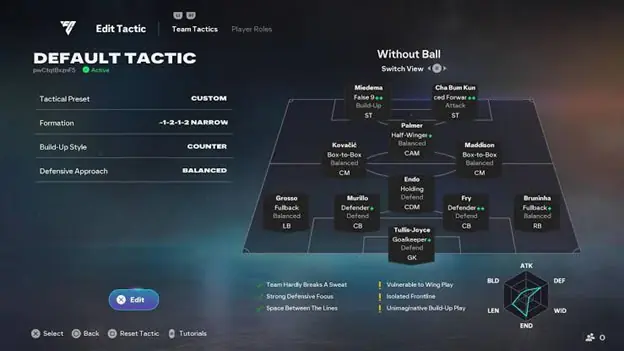
Here is the same setup I ended up using the most:
Goalkeeper: Sweeper Keeper on balanced.
Fullbacks: Both inverted wing backs on buildup.
CDM: Holding Roaming. Preferably the plus version.
CMs: Playmaker Roaming.
CAM: Playmaker Balanced.
Strikers: False Nine Attack on both.
It is not a secret formula, but the roles matter more here than in most formations. When you combine the correct playstyles with these instructions, everything feels cleaner.
How the Movement Works During Real Games
This is where the formation starts to feel special. Instead of your forwards charging in straight lines, you get this rotating triangle effect. One striker drops into midfield, the other sneaks wide or makes a diagonal. The CAM moves into the space they leave behind. Defenders keep getting pulled around without realizing it.
Your center mids behave like two different players depending on the moment. One stays deeper, ready to recycle the ball. The other sneaks forward with delayed runs that catch people off guard. If your midfield has Playmaker, they will move into the perfect passing lane almost every time.
The downside is obvious. The wings can be extremely open if you lose the ball cheaply. And if your CDM is not the plus version, the transitions will feel shaky. Not broken, just inconsistent. This formation does not protect you from your own mistakes.
When a Player Just Does Not Fit
You will know very quickly when someone does not belong in this setup. If their touches are slow, the whole thing becomes stiff. If they turn slowly, the buildup dies. FC 26 exposes heavy players brutally inside tight systems.
I tried an expensive midfielder who should have been insane. His stats looked perfect. But in the game, he felt clumsy. He slowed everything down. The flow of the formation depends on smooth players, not just high rated ones.
What It Feels Like When It Finally Clicks

When you get the rhythm right, this formation creates chances in a way that feels very natural. You are not forcing anything. The passes come quickly. Runs happen automatically. You get moments that look like proper football instead of meta abuse.
You will score through quick passing triangles, finesse shots around the box, and sharp driven finishes. And it feels good because it does not rely on cheap goals. It feels earned.
Final Thoughts
The narrow 4-1-2-1-2 (2) is not perfect, and it is not for everyone. It needs specific players and a bit of patience to learn the rhythm. But once you understand how it breathes, it becomes one of the most enjoyable and creative formations in FC 26.
If you want a formation that rewards tight control, clever movement, and sharp passing, this one is absolutely worth trying out.