NVIDIA’s recent GeForce v595.71 WHQL drivers, intended to fix issues from the previous version, are now reportedly causing voltage restrictions on RTX 50 series GPUs. Users are experiencing performance degradation, with boost frequencies dropping below 3.0GHz and lower voltage ranges, even with manual overclocks applied. This unexpected change has led to user frustration and speculation about NVIDIA’s intentions.
Key Takeaways
- NVIDIA’s GeForce v595.71 drivers are reportedly limiting voltage on RTX 50 series GPUs.
- Users are observing reduced boost clock speeds and lower voltage ranges compared to previous drivers.
- This change impacts performance, particularly for overclockers.
- The exact reason for the voltage cap remains unconfirmed by NVIDIA.
Driver Rollout and User Reports
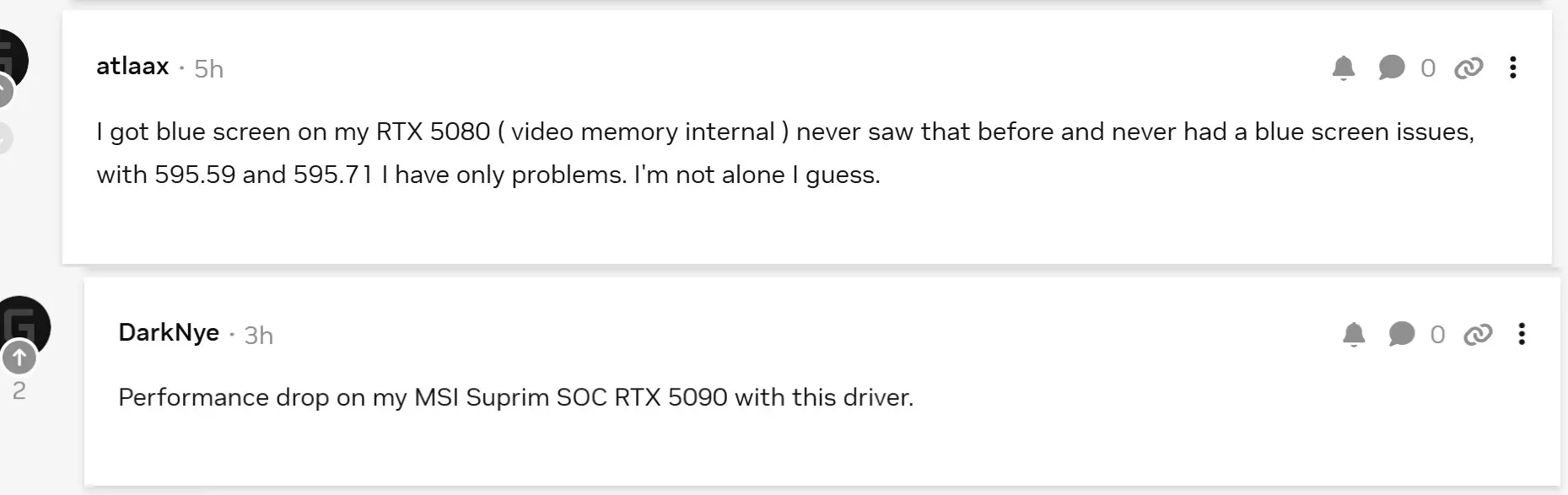
The v595.71 drivers were released to address problems with the v595.59 drivers, which had caused issues like non-spinning fans and performance drops. However, shortly after the release of v595.71, reports emerged on forums and tech sites detailing a new problem: restricted GPU core voltages. Users have noted that their RTX 50 series cards, including the RTX 5090, are now operating at lower voltages and consequently lower boost frequencies, even when manual overclocking settings are applied. For instance, one user reported their RTX 5080 Vanguard’s overclock being “wrecked,” with peak frequencies dropping from 3230MHz at 1.03V to 3000MHz at 0.950V.
Performance Impact and Potential Reasons
Testing by various outlets has confirmed these user reports. An MSI GeForce RTX 5090 SUPRIM X, previously running at around 1.020-1.030V and achieving 3015-3030MHz in stress tests with older drivers and a manual overclock, now operates between 1.005V and 1.010V, with boost clocks falling below 3000MHz on the v595.71 drivers. While this might lower power consumption, it significantly impacts performance for enthusiasts and overclockers. The underlying cause for this voltage capping is not officially stated by NVIDIA. Speculation suggests it could be a measure to prevent overheating of the 12V-2×6 power connectors, which have been linked to melting incidents in some extreme overclocking scenarios. Alternatively, it could be an unintended consequence of the driver updates or a deliberate move to manage power draw and ensure longevity.
NVIDIA’s Silence and User Concerns
NVIDIA’s release notes for the v595.71 driver mention fixes for fan issues but do not address the voltage restrictions or any potential changes to boost policies. The company has yet to issue an official statement regarding these reports. This lack of communication has fueled user concerns, with many questioning whether this is an intentional limitation or a significant oversight. The situation leaves users waiting for clarification from NVIDIA, while some are considering rolling back to older, more stable driver versions.
Via WCCFTech