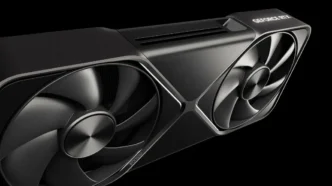

NVIDIA is once again adapting its high-performance GPU strategy for the Chinese market, renaming the previously rumored GeForce RTX 5090DD to the RTX 5090D v2. This move is a direct response to evolving U.S. export regulations, aiming to provide a compliant yet powerful graphics card for Chinese consumers.
NVIDIA’s Regulatory Dance Continues
NVIDIA’s latest iteration, the RTX 5090D v2, marks the third variant in the 5090 series designed for China. The initial RTX 5090D was engineered to meet previous U.S. Department of Commerce rules, offering performance nearly identical to its unrestricted counterpart in gaming and synthetic benchmarks. However, new regulations led to the original RTX 5090D’s disappearance from the Chinese market, prompting NVIDIA to develop a new, more compliant version.

Key Takeaways
- Renaming: The GeForce RTX 5090DD is now officially the RTX 5090D v2.
- Target Market: Exclusively for the Chinese market to comply with U.S. export regulations.
- Launch: Expected to launch in August 2025.
- Core Specifications: Retains 21,760 CUDA cores and a 575W TDP, similar to the original RTX 5090 and 5090D.
- Memory Configuration: Features 24 GB of GDDR7 VRAM on a 384-bit bus, a reduction from the 32 GB on a 512-bit bus of its predecessors.
- GPU: Utilizes the GB202-240 GPU, a change from the GB202-250 (RTX 5090D) and GB202-300 (RTX 5090).
- PCB Design: Employs a new PG145 SKU 40 PCB due to VRAM and GPU layout changes.
Technical Adjustments and Performance Expectations
The most significant change in the RTX 5090D v2 is the reduction in VRAM from 32 GB to 24 GB and a narrower 384-bit memory bus. Despite these changes, the card maintains the full 21,760 CUDA cores and a 575W TDP, suggesting that NVIDIA aims to preserve core Blackwell architecture performance. For most gaming scenarios, the 24 GB VRAM is unlikely to be a bottleneck, as few titles currently demand more.
Industry insiders, including leaker kopite7kimi, hint at an undisclosed “surprise” with the v2 model. This could potentially involve firmware modifications to prevent the card from being used for AI workloads, a common target of U.S. export restrictions.
Market Implications and Naming Strategy
The decision to name this new variant “RTX 5090D v2” rather than a completely new model like the previously rumored “RTX 5090DD” or even an “RTX 5080 Ti” (which some suggest would be more fitting given the VRAM reduction) highlights NVIDIA’s strategy to maintain brand consistency within the high-end 5090 series for the Chinese market. The success of the RTX 5090D v2 will largely depend on its pricing and how it is received by Chinese gamers, who have seen multiple adjustments to NVIDIA’s flagship offerings due to geopolitical factors.
Via HKEPC