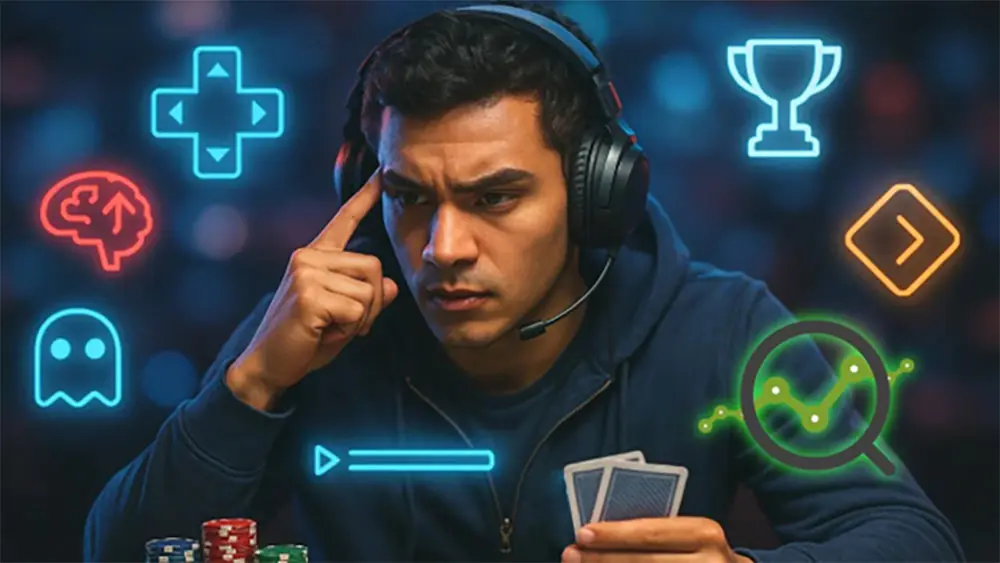
Most poker articles talk like the game lives in a totally different universe from video games. It doesn’t.
If you’ve spent years sweating ranked queues, raid nights or scrims, you’ve already trained a lot of the muscles poker needs. Here’s where your gaming brain quietly lines up with good poker habits.
From HUDs to Hand Histories: Reading the Screen Fast
Modern games throw a lot at your eyes. Cooldowns, minimaps, HP bars, ult trackers, objective timers… It’s all there, all at once. Over time, you learn to glance, filter, and act without thinking about every icon.
Poker is basically a stripped-down HUD. Stack sizes, positions, pot size, board texture, bet sizing… It’s the same idea, only with less neon.
Gamers tend to get faster at visual attention and decision-making than non-players. That skill carries over when you sit down at a table. You’re used to taking one quick look, spotting who’s short, who covers you, and how big the pot is.
Thinking in Bets, Not Just Rounds
Ranked matches teach you to act without ever having full info. You make calls based on partial vision, sound cues, timing, and experience. Good or bad, you see the result, adjust, and queue again.
Poker is that mindset with chips. You rarely know exactly what someone holds. You estimate, pick a line, and live with it. A lot of current research on poker and decision-making treats the game as a training ground for handling uncertainty, not just “cards plus luck.”
Once real money gets involved, the stakes go up. Offshore sites add another layer of risk, such as different licensing, different rules, and different protections. That’s why any good site like ReadWrite explains how to choose safe offshore poker sites instead of just listing bonuses. They walk through where sites are licensed, how payments work, and what red flags to avoid if you ever decide to play outside your home market.
The same brain that learned not to insta-lock bad fights in your favourite game is useful here. You get used to asking, “What am I risking? What do I actually gain? Is this spot even worth taking?” That’s poker logic in plain language.
Tilt Control: From Ranked Rage to Bad Beats
Anyone who’s spent a weekend in low-Elo hell already knows what tilt feels like. You lose a lead, someone trolls, the chat goes nuclear, and suddenly you’re playing worse than you did three hours ago.
Poker has its own version: you take a brutal beat, feel your blood pressure spike, and start forcing marginal hands just to “win it back.” Long-term poker results aren’t only about math. Studies keep pointing at emotion control as a big part of why some players last, and others burn out.
Gamers have a head start:
- They know what it feels like to be tilted.
- They know that re-queueing while angry usually makes things worse.
- They’ve probably already built small habits like taking a break after a bad streak.
At a poker table, the same rules apply. Close the client. Stand up. Breathe. Come back when your head isn’t trying to punt an entire stack out of spite.
Pattern Recognition: Meta Reads and Player Types
Games are full of patterns. Like the Jett who dashes the same lane every round. Or the jungler who never ganks bot. Or the raid boss that always phases at 60%. You clock it, exploit it, and suddenly things get easier.
Poker players talk about “population tendencies” and “player types.” It’s the same idea:
- This player uses continuation bets every flop.
- That one only 3-bets with monsters.
- Another always slow-plays strong hands.
Academic work on online poker keeps landing on the same point. Big samples, skill, and adaptation matter a lot. That’s just pattern reading with a bankroll attached.
Math Without the Math Degree
You don’t need to love algebra to be good at games, but you do end up doing a lot of quiet math. Think crit chances, armor values, and DPS check for a raid.
Poker uses the same “back-of-the-head” calculations. Pot odds, implied odds, and equity all sound heavy, but in practice, it’s just questions like:
- How often do I need to be right for this call to be OK?
- If I miss, do I lose too much here?
Meta-analyses on games and cognition show that regular players often score better on tasks involving attention and flexible thinking. That doesn’t magically make you a winning poker player. It does, however, make it easier to get comfortable with basic odds and “good vs bad” prices.
Online Safety Habits Carry Over
Most online games force you to care about security eventually. You get hit with phishing links in chat, weird DMs, and scammy “free skins” sites. So either learn to harden your setup or suffer.
Poker sites are just as sensitive. We cannot stress the importance of digital safety when gaming online. The same logic applies when your account balance isn’t just cosmetic skins.
Good habits here are boring but vital:
- Use strong, unique passwords and proper 2FA.
- Don’t reuse logins across random launchers and gambling clients.
- Treat account recovery and KYC (ID checks) as serious, not “annoying pop-ups.”
Sure, those habits don’t win you any pots. But they do protect your bankroll and personal info, which is just as crucial in the long run.
Grind Mindset and Long Game Thinking
Some people think poker is all about “big hands” and hero calls. Anyone who’s climbed a ranked ladder knows better. Progress comes from volume and small improvements. One more VOD review. One more aim routine. One more scrim.
Poker is the same slow grind. You don’t judge yourself in one session. You look at months of hands and see whether the overall line is going up or down. In fact, repeated play can sharpen attention, memory, and decision-making when it’s structured, not just mindless.
So when you fold a pretty hand because you know it’s trash in that spot? That’s the same discipline as skipping a bad fight in ranked.
Conclusion
On the surface, poker and video games look nothing alike. One has cards and chips. The other has guns, dragons, or neon cyberpunk cities. Under the hood, they’re both about:
- Reading messy information quickly.
- Making decisions with incomplete data.
- Managing tilt.
- Spotting patterns and adapting.
- Playing the long game instead of chasing one big moment.
If you ever decide to sit at a poker table, a lot of what you’ve learned from games will irrefutably help you. So keep calm, read the room, and make that call when the clock is ticking.