


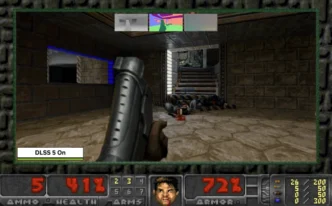
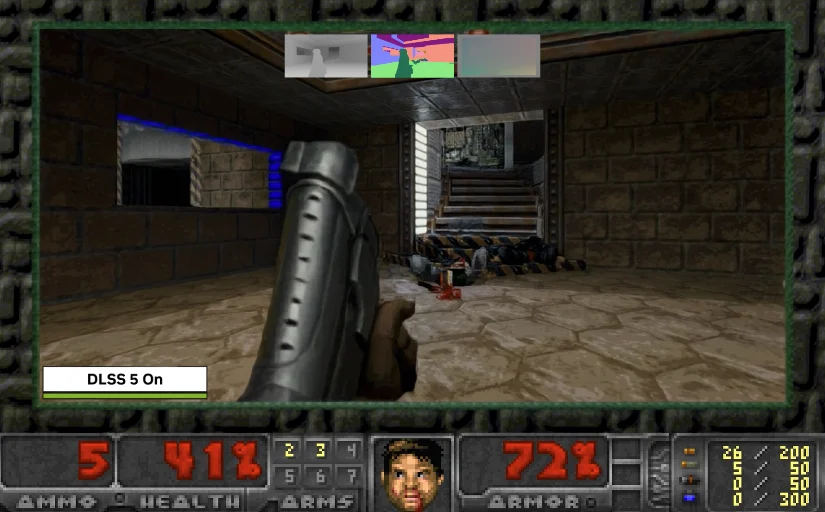
A developer has demonstrated NVIDIA DLSS 5 neural rendering with the original DOOM’s game data, bringing an early-1990s classic into a modern graphics experiment. The setup does not run DLSS 5 on the original DOS executable: it uses a custom Windows port with a DirectX 12 rendering path and additional frame data the technology requires.
Key takeaways
The demonstration is a modding experiment, not official support for DOS games. Its main significance is showing how a classic game can be adapted to supply data needed by newer rendering technologies.
- Developer Nikolai Zhivotenko’s custom build is based on Linux DOOM source code.
- The game still renders internally at 320×200, then presents through a 1280×800 DirectX 12 window.
- The build provides depth, normal and motion data absent from the original renderer.
- Standard Steam versions of DOOM and DOOM 64 did not work with the same injection method.
A custom rendering path makes the demo possible
The project replaces DOOM’s original graphics presentation with a modern Windows x64 and DirectX 12 implementation. It generates the buffers neural rendering needs, including depth, surface normals and motion information. In the experimental DLSS 5 mode, the image first goes through a DLSS 4.5 path before DLSS 5 Neural Rendering is applied through DLSS Swapper.
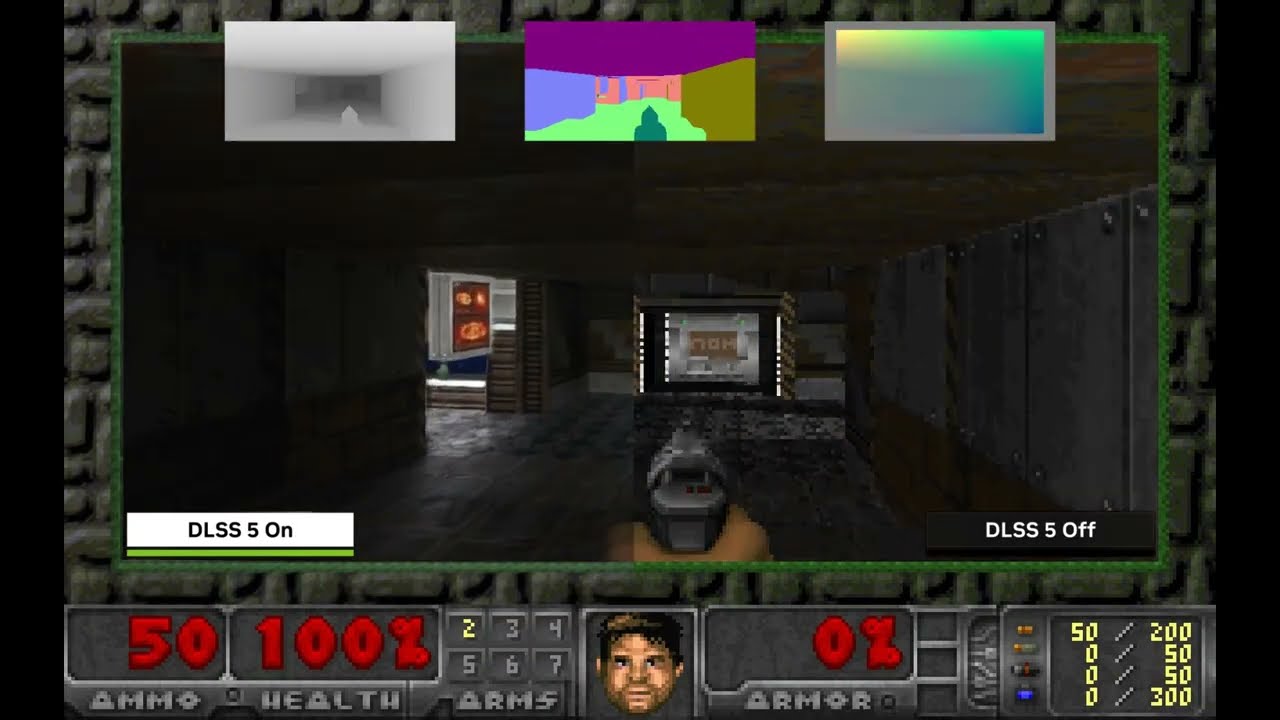
The build also offers other options, including nearest-neighbor scaling, DLSS Ray Reconstruction, DLSS 4, DLSS 4.5, Anime4K and AMD FSR 2.2. The source code is publicly available on GitHub and is based on id Software’s original DOOM source release.
This is not DLSS 5 running on DOS
The distinction matters: the demonstration uses DOOM’s original game data and source lineage, but not the unmodified 1993 MS-DOS program. The custom engine supplies a contemporary graphics interface and the extra frame information required by the neural-rendering pipeline. Tests reported with the standard Steam release and DOOM 64 did not work using the same DLSS Swapper injection method.
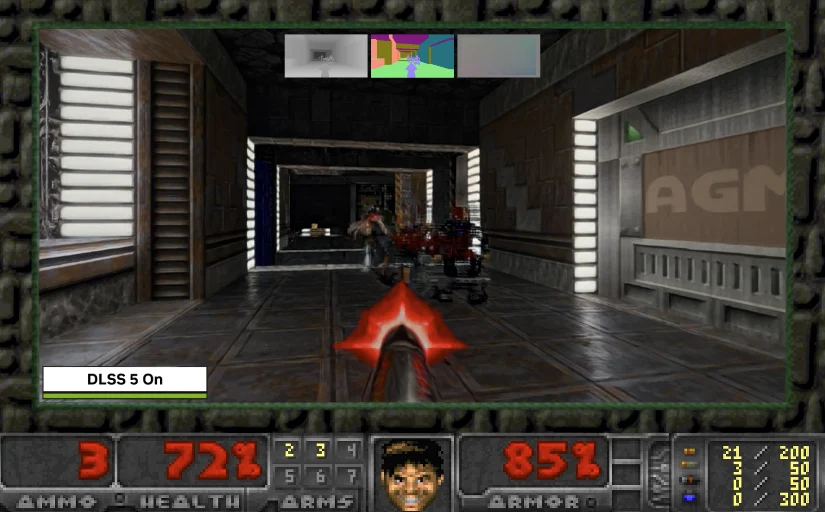
DLSS 5 has not been officially released, and this setup is an unofficial experiment rather than a supported feature for either game. Results from it should not be taken as a preview of final performance or compatibility.
Visual results remain a work in progress
Reports on the experiment describe sharper output and some changes to textures and HUD elements, but not a full remaster. One account also noted blur and temporal instability during motion, alongside inconsistent performance and substantial CPU impact. Those limitations are especially noticeable in a fast-moving shooter such as DOOM, where enemies and scenery quickly cross the screen.
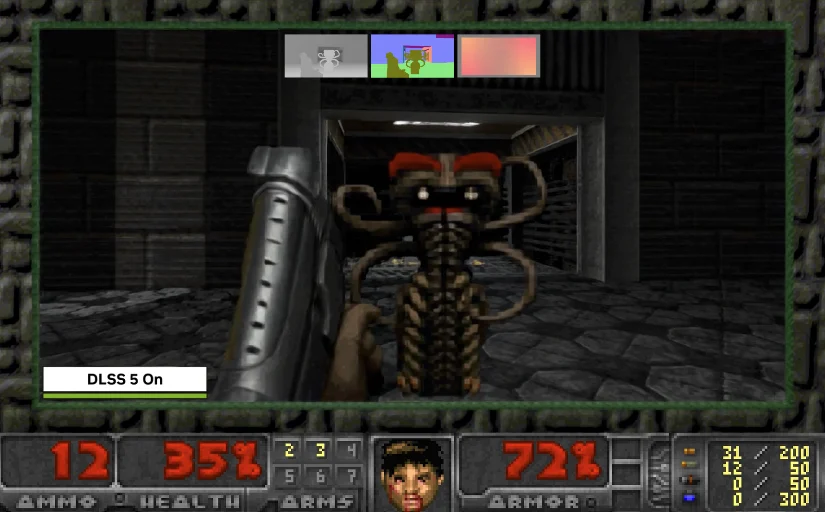
For PC enthusiasts, the more notable result is technical: even a renderer designed for a 1993 game can be adapted to feed modern neural graphics features when developers rebuild its presentation path. Whether that approach can deliver convincing, stable remasters will depend on the software, hardware and developer support behind future implementations.
Via DOOM-DLSS-5