


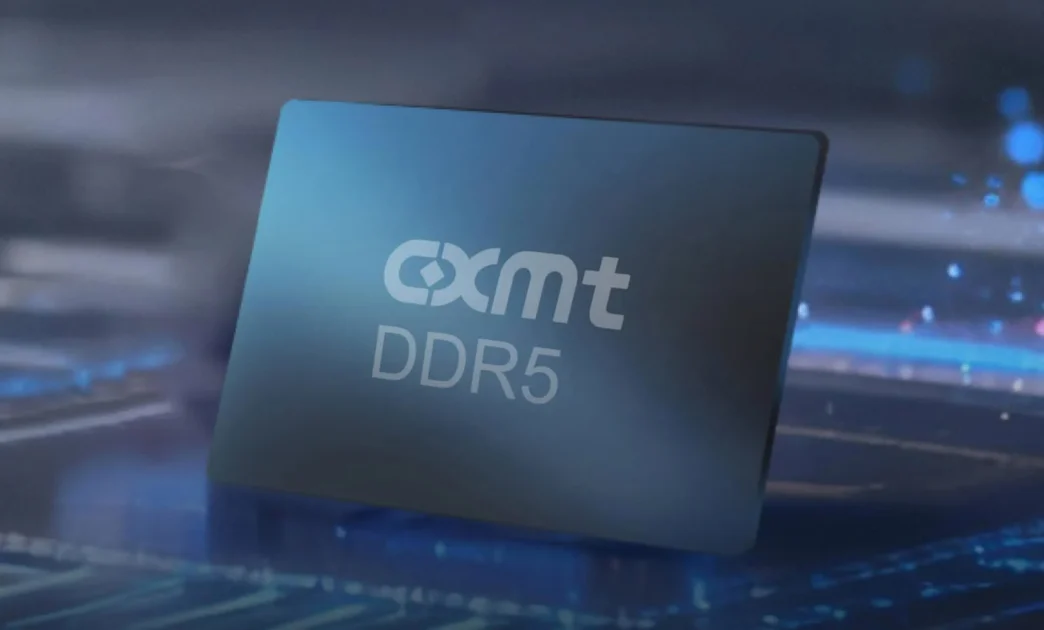
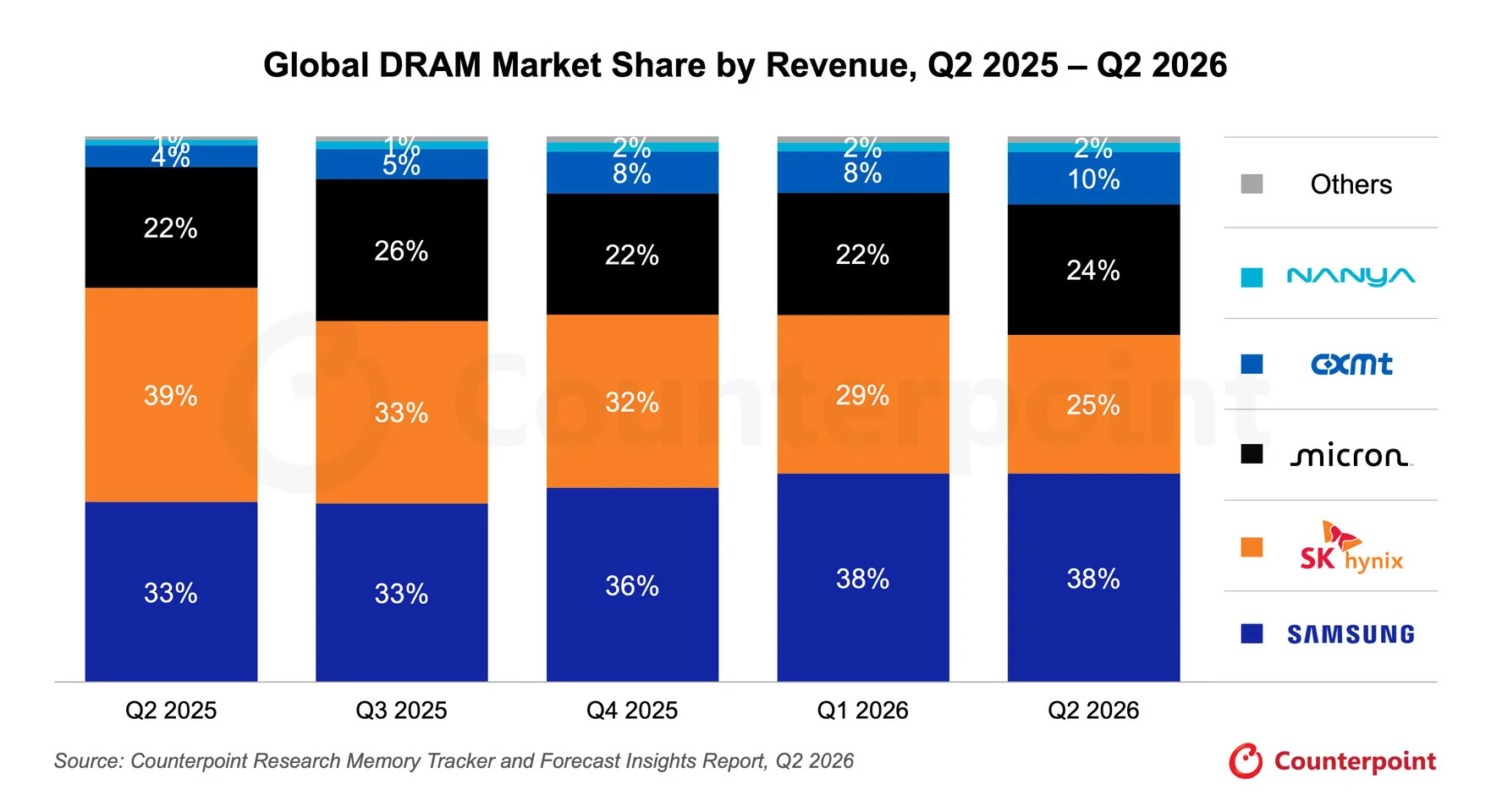
China’s ChangXin Memory Technologies (CXMT) has captured 10% of global DRAM revenue in the second quarter of 2026, according to Counterpoint Research data. The milestone marks the first time a Chinese DRAM manufacturer has reached double-digit global share, reducing Samsung, SK hynix, and Micron’s combined dominance to 87%.
Key takeaways
- CXMT’s DRAM revenue share rose from 4% a year ago to 10% in Q2 2026.
- Samsung led with 38%, followed by SK hynix at 25% and Micron at 24%.
- CXMT benefited from strong demand for commodity DDR5 and mobile memory.
- The company is expanding into LPDDR6 and HBM3E as it targets further growth.
A rapidly changing DRAM market
CXMT’s rise comes as the traditional DRAM leaders redirect manufacturing capacity toward high-bandwidth memory (HBM) for AI accelerators. That shift has tightened supplies of standard memory used in gaming PCs, laptops, smartphones, and servers, creating an opening for CXMT’s DDR5 and LPDDR5X products.
Global DRAM revenue also surged during the quarter, meaning CXMT’s 10% share reflects both increased shipments and unusually high memory pricing. Its share climbed from below 1% in 2023 to 4% in Q2 2025, 8% in Q1 2026, and 10% three months later.
Samsung, SK hynix, and Micron face new pressure
Samsung remains the market leader, but SK hynix experienced the sharpest decline, falling from 39% a year earlier to 25%. Micron held approximately 24%, while smaller supplier Nanya Technology reached about 2%.
The shift gives PC builders and server manufacturers another significant DRAM supplier, although it does not yet mean CXMT matches the leading companies technologically. Industry analysis indicates that CXMT’s reliance on deep-ultraviolet lithography creates a meaningful cost and yield disadvantage compared with competitors using more advanced production methods.
CXMT is moving beyond conventional DRAM
CXMT has used recent funding to expand production and develop higher-end products. Its Shanghai initial public offering raised approximately $8.6 billion, providing capital for new manufacturing capacity and research and development.
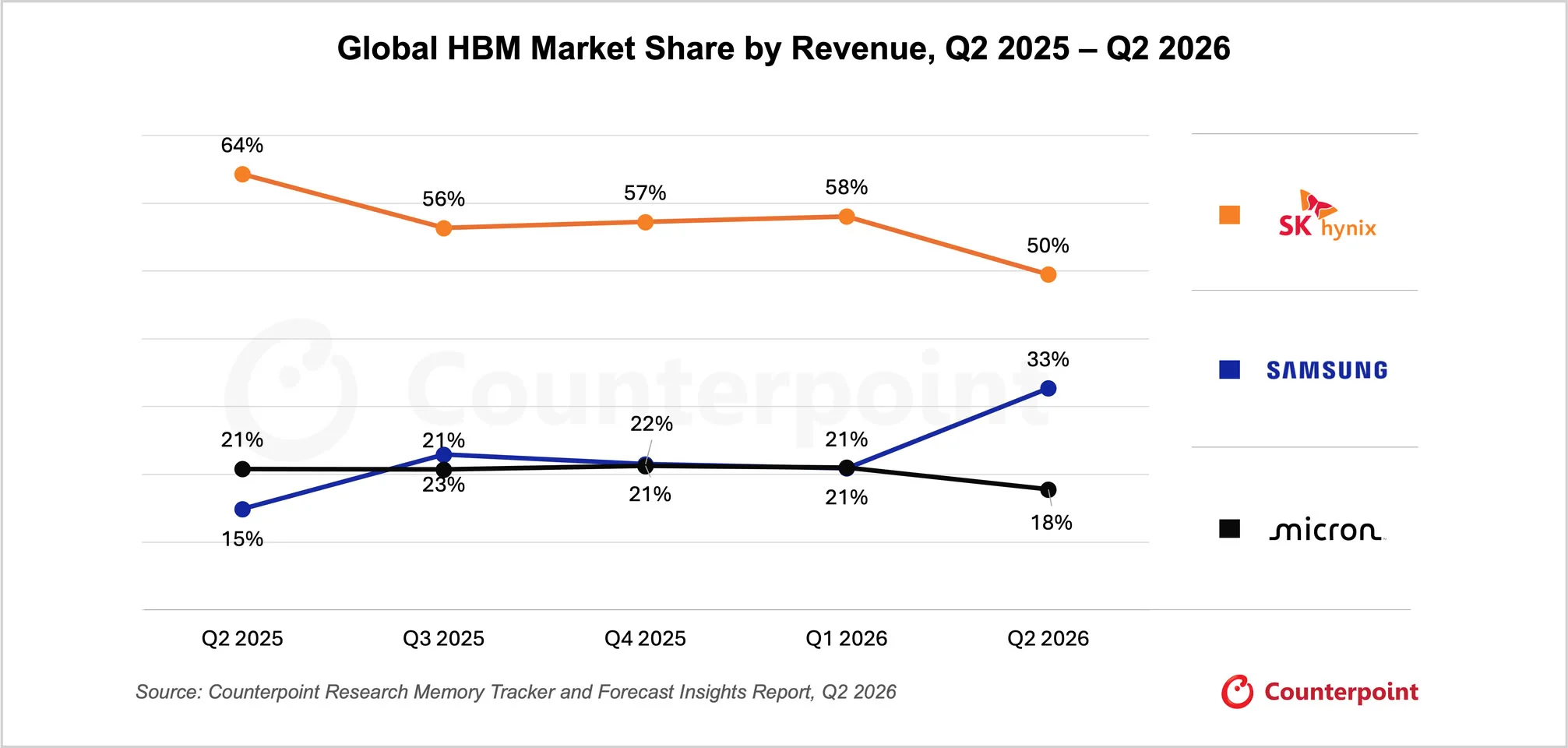
The company is reportedly mass-producing DDR5 and LPDDR5X while preparing LPDDR6 products for devices such as Xiaomi’s upcoming 18 Fold. CXMT has also begun risk production of HBM3E, with Chinese chip designers Alibaba’s T-Head and Cambricon testing the memory with their processors. Commercial HBM shipments remain unconfirmed, and the company still trails Samsung and SK hynix in HBM production experience and yields.
The market-share test is still ahead
CXMT’s gains may be difficult to sustain if DRAM prices normalize. Samsung, SK hynix, and Micron could eventually redirect additional capacity from HBM to commodity memory, increasing competition in the segment CXMT currently serves. Its manufacturing cost disadvantage would then become more important.
Counterpoint analysts have identified 15% share as an important threshold for CXMT. Reaching it could provide the scale needed to fund future fabs and process upgrades. For ThinkComputers readers, the result could eventually affect DDR5 pricing, laptop component availability, and the range of memory brands used in gaming and workstation hardware.
For now, CXMT’s 10% milestone confirms that the long-standing DRAM oligopoly is weakening—but whether the company becomes a permanent member of the industry’s leading group will depend on its ability to scale advanced products and compete through the next memory downturn.