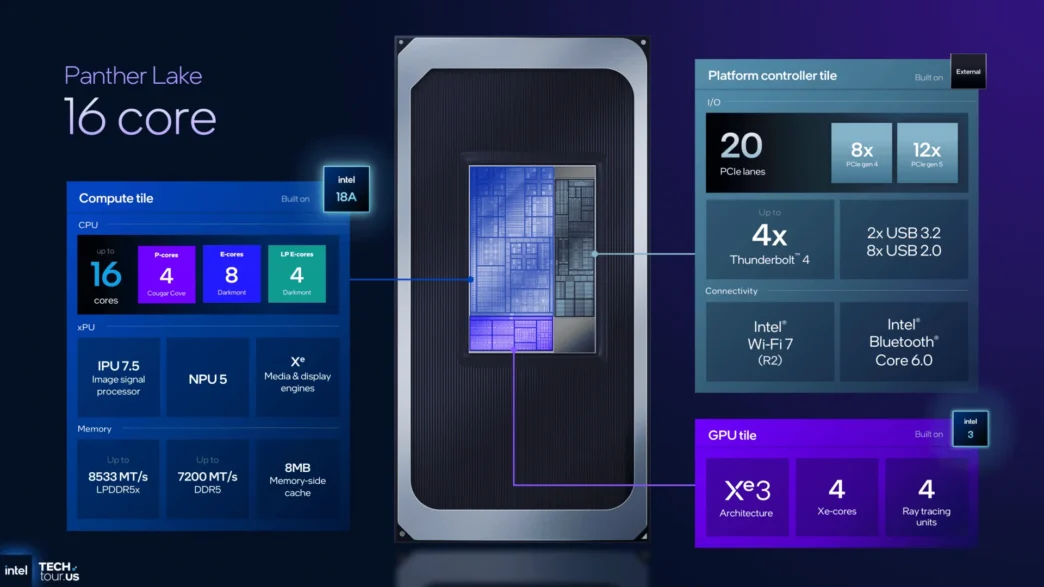
Early benchmarks for Intel’s upcoming Core Ultra X7 358H processor, codenamed “Panther Lake,” have surfaced, offering a glimpse into the performance of its new Xe3 Arc integrated graphics. The leaks suggest a substantial leap in graphical capabilities for Intel’s mobile offerings, potentially challenging discrete GPU performance in certain scenarios.
Key Takeaways
- The Intel Core Ultra X7 358H “Panther Lake” CPU has been spotted in Geekbench.
- It features a new Xe3 Arc integrated GPU with 12 compute units.
- Performance in OpenCL benchmarks shows significant gains over previous Intel iGPUs.
- The integrated graphics performance is nearing that of entry-level discrete mobile GPUs like the NVIDIA RTX 3050.
Panther Lake Architecture and Specs
The Core Ultra X7 358H, part of the “Panther Lake” series, is expected to be a premium SoC variant. Leaked specifications indicate a 16-core CPU configuration comprising 4 Performance-cores (P-cores), 8 Efficient-cores (E-cores), and 4 Low Power Efficient-cores (LP-E cores). The CPU can boost up to 4.8 GHz. Crucially, the integrated graphics boast 12 Xe3 cores, translating to 96 Compute Units. The GPU will have access to up to 16 GB of shared system memory, with reported memory speeds of 9600 MT/s.
Integrated Graphics Performance
Initial Geekbench OpenCL benchmark results for the Core Ultra X7 358H’s Xe3 iGPU show scores around 51,000 to 53,000 points. This performance level places it in close competition with NVIDIA’s GeForce RTX 3050 Laptop GPU, which typically scores around 54,000 points in similar tests. Compared to Intel’s previous generation “Arrow Lake-H” Arc 140T iGPU, the Xe3 GPU shows an improvement of approximately 25%.
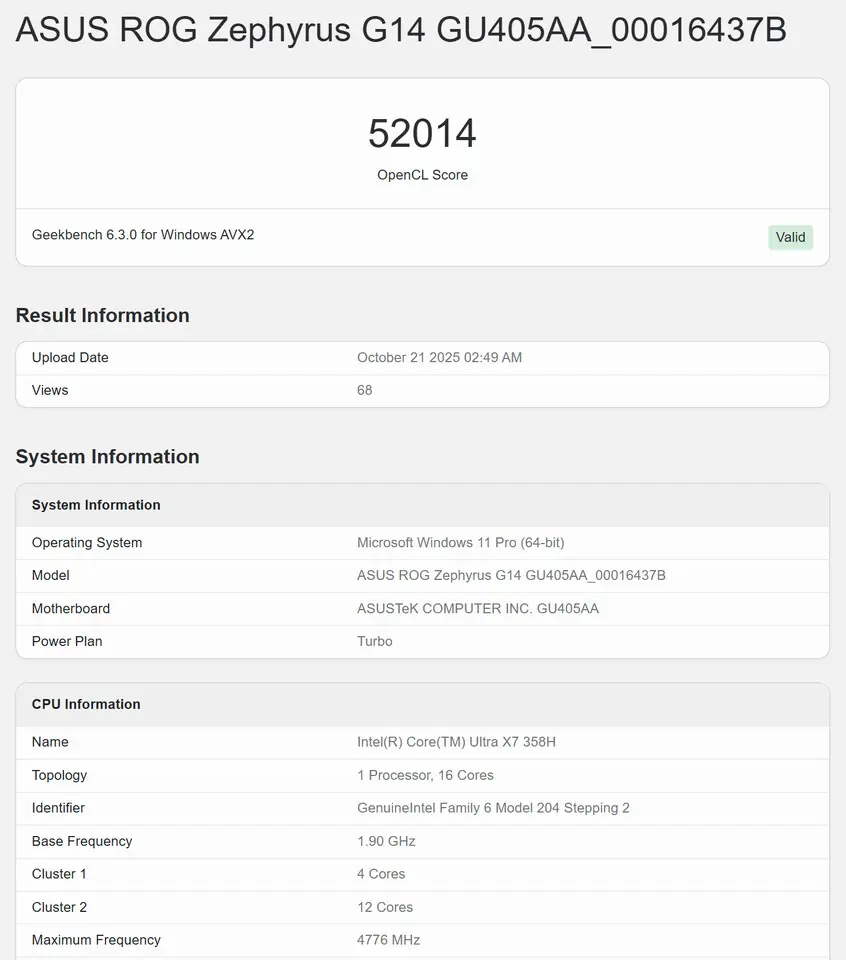
Furthermore, the new integrated graphics are reported to perform comparably to Intel’s own Arc A550M discrete GPU, which features 16 Xe cores. While OpenCL is not always the best indicator of real-world gaming performance, and early drivers or engineering samples might influence results, these figures are promising.
Performance Gains and Future Prospects
Intel has previously touted up to a 50% performance uplift for its Xe3 architecture compared to the Xe2 generation found in Lunar Lake. The increased core count and architectural improvements in the Xe3 GPU are expected to deliver better gaming, content creation, and AI workloads. The Panther Lake chips are also built on Intel’s advanced 18A process node, promising enhanced energy efficiency with improved performance-per-watt.
While official release dates are still some time away, with some reports suggesting late 2025 or early 2026, these leaks indicate that Intel is making significant strides in integrated graphics. The Core Ultra X7 358H and its Xe3 Arc GPU could offer a compelling alternative for users seeking strong graphical performance without the need for a dedicated discrete GPU in their laptops.
Via Geekbench