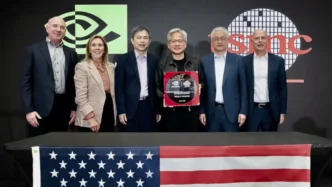
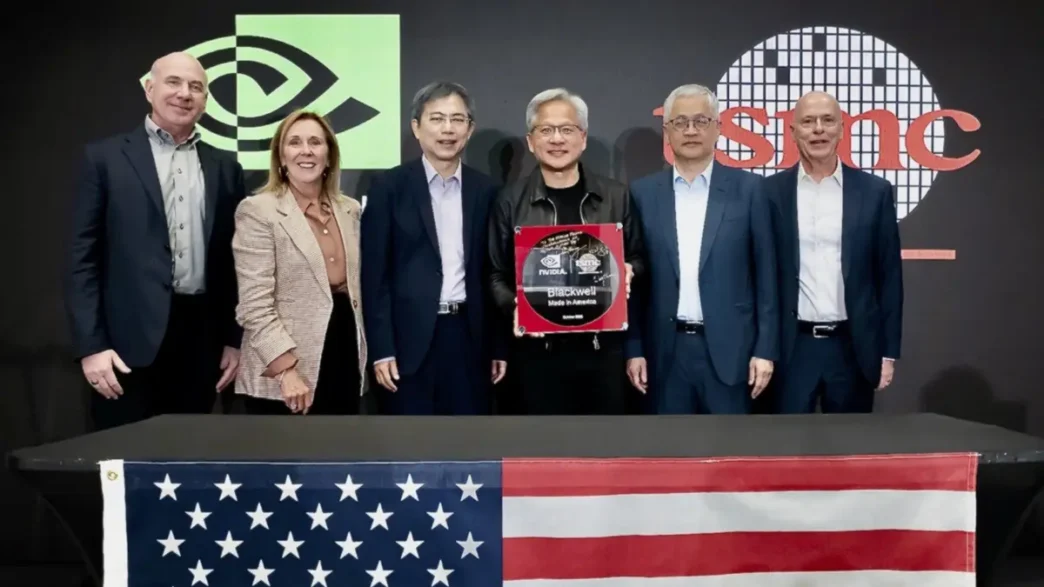
NVIDIA and TSMC have achieved a significant milestone by completing the first Blackwell AI chip wafer manufactured in the United States. The announcement was made at TSMC’s facility in Phoenix, Arizona, marking a crucial step in the U.S.’s efforts to bolster domestic high-tech manufacturing and reduce reliance on overseas production.
Key Takeaways
- Nvidia and TSMC have produced the first Blackwell AI chip wafer in the U.S.
- The milestone occurred at TSMC’s facility in Phoenix, Arizona.
- This development is seen as a win for U.S. industrial policy and efforts to re-shore chip manufacturing.
- While a significant step, the chips still require further processing in Taiwan.
A Historic Manufacturing Achievement
Nvidia founder and CEO Jensen Huang celebrated the accomplishment at the Phoenix facility, calling it a “historic moment.” He emphasized that this marks the first time a single, most important chip for artificial intelligence is being manufactured in the U.S. by TSMC, utilizing advanced fabrication processes. This achievement is viewed as a tangible outcome of years of U.S. government incentives and policies aimed at strengthening the domestic semiconductor industry.

Strategic and Political Implications
The production of Blackwell wafers in the U.S. holds significant strategic and political importance. It aligns with the U.S. government’s goal of bringing advanced semiconductor manufacturing back to American soil, thereby bolstering the national supply chain and reducing dependence on regions with potential geopolitical risks. For Nvidia, an American company, producing its most critical AI chips domestically offers greater insulation from potential tariffs and global supply chain disruptions.
The Road Ahead
While the completion of the U.S.-made wafer is a crucial first step, it’s important to note that the chips are not yet fully finished products. The wafers will need to be shipped back to Taiwan for integration using advanced packaging technologies like CoWoS-L with HBM3E memory. This means that while the initial fabrication occurs in the U.S., the final assembly still relies on facilities overseas. However, plans are underway for advanced packaging facilities to be built in the U.S. in the coming years, which will further reduce this dependency.
Nvidia has committed to investing heavily in AI-related infrastructure in the U.S., with plans to spend half a trillion dollars in the coming years. This investment is expected to create thousands of high-tech jobs and foster a broader ecosystem of suppliers, contributing to the growth of the AI economy within the United States.