


AMD’s upcoming Medusa Point mobile processor has appeared in a Geekbench 7 listing, offering an early look at a reported 10-core Zen 6 design. The engineering sample posted a 3,100-point single-core score and an 18,313-point multi-core score. Those results are preliminary, and AMD has not confirmed the chip’s specifications or launch timing.
Key takeaways
The leaked listing describes a 10-core, 20-thread processor arranged as four Zen 6 cores and six Zen 6c cores. Its single-core result edges several current desktop Ryzen chips in Geekbench 7, while an unusual reported clock speed and differing cache listings make the data worth treating cautiously.
- Geekbench 7 scores: 3,100 single-core and 18,313 multi-core.
- The sample reports 16 MB of L3 cache; another Medusa Point listing showed 32 MB.
- A 10-compute-unit RDNA 4m integrated GPU is rumored, but no graphics benchmark has surfaced.
- AMD has not announced Medusa Point or confirmed a release date.
A 10-core hybrid configuration appears
The Geekbench entry identifies an engineering sample with 10 cores and 20 threads, split between four Zen 6 cores and six denser Zen 6c cores. It also reports 16 MB of shared L3 cache. A previously reported Medusa Point sample listed 32 MB, suggesting AMD may be testing different variants—or that pre-release firmware and benchmark detection are exposing inconsistent details. Retail configurations remain unconfirmed.
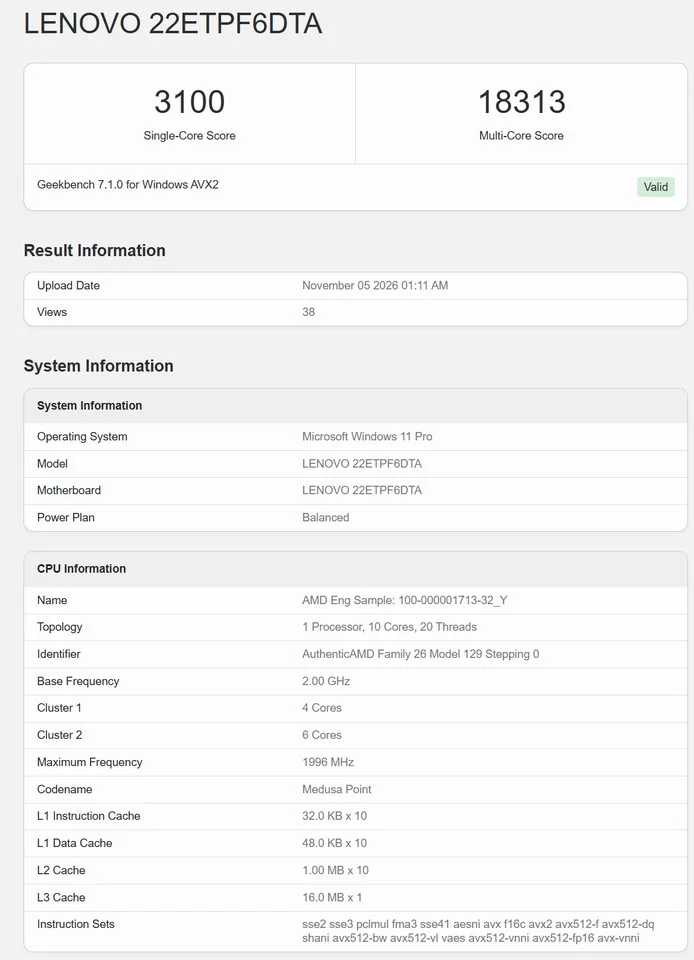
The chip appeared in a Lenovo test system with 64 GB of DDR5 memory reported at 5,188 MT/s. Geekbench recorded a 2.0 GHz base frequency and a maximum of 1,996 MHz, an internally inconsistent reading that may reflect early firmware or incomplete clock reporting rather than the processor’s eventual operating speeds.
Early benchmark results need context
The 3,100-point single-core result is slightly above Geekbench 7 averages cited for the Ryzen 9 9950X3D, Ryzen 9 9950X, and Ryzen 9 9900X. It remains below the listed Ryzen 7 9850X3D and Ryzen 9 9950X3D2 averages. In multi-core testing, Medusa Point’s 18,313 points are above the reported Ryzen AI MAX 390 average and close to the 12-core Ryzen AI MAX PRO 390 result.
These comparisons come from a single leaked engineering-sample run, not a retail laptop review. A prior Medusa Point result in Geekbench 6 cannot be compared directly with this Geekbench 7 score because the benchmark versions use different tests and scoring. Final performance will depend on production clocks, power limits, cooling, memory, and software tuning.
Mobile graphics and launch remain unconfirmed
Reports associate Medusa Point with a 10-CU integrated GPU described as RDNA 4m, potentially bringing newer graphics technology to AMD’s mobile APUs. No GPU benchmark or confirmed specification is available, so its gaming performance and generational gains are unknown. For laptop and handheld buyers, the graphics result may matter as much as the CPU score, particularly in systems without discrete GPUs.
Medusa Point is expected by some reports to feature in a future Ryzen AI mobile lineup, with CES 2027 discussed as a possible announcement window. AMD has not confirmed the product name, configurations, graphics architecture, or timing. Until official details arrive, the leak is best viewed as an early indication of Zen 6 testing—not a guide to final product performance.
Via HXL