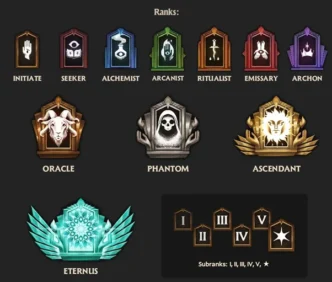
Deadlock ranks can look confusing at first glance because the game has changed how competitive matchmaking works over time. Today, your player’s rank is basically a visible badge that follows your hidden MMR, and it can move up or down as you play matches, which is why players focused on steady rank progression often explore tools and approaches like Deadlock boosting alongside improving their consistency.
This guide breaks down the ranked system, lists the medals in order, explains progression, and covers what actually affects match quality when you queue.
Deadlock’s Ranking System Explained
Deadlock used to have a separate deadlock ranked mode with limited hours and stricter rules, but the modern setup is closer to “one matchmaking pool.” In practice, it means there’s one primary matchmaking mode and your games feed into the same rating logic.
Your rank badges update when your matchmaking rating crosses a threshold. There isn’t a “wait until next week” feeling in the current approach, although Valve can still do maintenance-style adjustments to the global curve based on population changes and recalculations.
A few important things to understand about how the system feels in real games:
- If you swap to a hero you’re not comfortable with, the match can get easier because your hero specific mmr can be lower than your core mmr.
- If you queue at off hours, the system may have fewer other players to choose from, which can hurt match quality.
- Party size and skill spread matter. Wide gaps can reduce how much you gain, and the system is cautious around high mmr players grouped with new players.
If you’re looking for deadlock ranks explained in one sentence: the system tracks a hidden number (mmr), then shows you a medal-like rank that shifts as that number shifts.
All Ranks in Deadlock
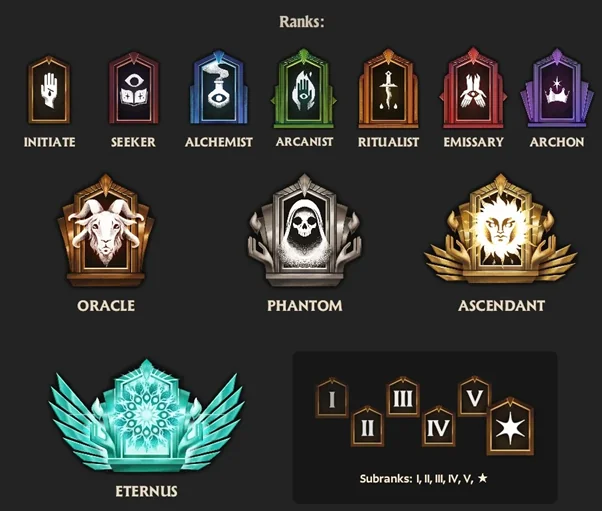
If you’re asking what are the ranks in deadlock, here’s the medal ladder from lowest to highest. (You may also see an unranked state when you don’t have enough games to display a badge.)
- Obscurus (unranked)
- Initiate
- Seeker
- Alchemist
- Arcanist
- Ritualist
- Emissary
- Archon
- Oracle
- Phantom
- Ascendant
- Eternus
That’s the clean deadlock ranks in order list most players mean when they say all deadlock ranks.
Each medal is divided into smaller steps. Depending on the UI version you’re seeing, it’s typically multiple numbered subdivisions, plus a top marker (often shown as a star). Those subdivisions are why two players can both be “Archon” but still be far apart in skill level.
A Quick Note on Distribution
Deadlock ranks threshold changes relative to the curve on the global level. Nevertheless, in most competitive ranking systems, the average player ends up being in the middle medal group, and only after reaching high tiers such as Oracle will you be able to notice a sudden shift in coordination and punishment game.
In case you wonder how you should interpret that in practice – just relax after a bad week and continue improving yourself.
Ranked Progression in Deadlock
The core of progression lies primarily in two aspects: your victories and defeats and the nature of the opposition that you have defeated.
If you have won, it is safe to say that you would earn some MMR. On the other hand, if you lose, you will lose some MMR. However, there are still other factors such as confidence level, hero you queue with, skill gap between members of the party, and the quality of the game itself.
A few rules of progression that can help in ranked matches are as follows:
- If you want to climb up the ranks, you should limit your play with heroes that have similar capabilities and are able to make equal contributions.
- The system would consider your performance history if you have picked a new hero.
- If you want to climb up your peak, you should aim to play during your peak hours as well since higher quality population is expected at those times.
Weekly Requirements and “Seven Matches” Confusion
The old way of ranked mode required seven ranked matches per week, which allowed you to see your ranked badge, and people still say “do your seven matches.” Sometimes you can find seven ranked matches or seven matches in various guides related to ranked mode.
Currently, when using the one-queue mode, you do not have to wait for updates once a week. However, as soon as your rating is crossed, the badge will be updated. Nonetheless, keeping yourself active every week makes your account better understood by the system.
How is Deadlock MMR Calculated?
Valve doesn’t publish the exact formula, so treat anyone claiming exact point values as guessing. What we do know from official-style explanations and how the system behaves:
- There is a hidden mmr behind the scenes.
- You have core mmr (your general level) plus hero specific mmr offsets.
- Your deadlock’s mmr for a hero is influenced heavily by recent history, commonly referenced as the most recent 20 matches on that hero.
- The system can weigh some matches differently if it believes the lobby quality was poor.
So how do deadlock ranks work in day-to-day play?
- Pick a hero.
- Queue into matches.
- Your performance and win or lost result pushes your mmr up or down.
- When that mmr crosses a threshold on the global curve, your medal rank updates.
Party Effects, Solo Queue, and Why Gains Can Feel Smaller
It is okay to have party queues. The algorithm will try to prevent the possibility of boosting because it will detect when one of the players in a party is much better at playing than others. When this situation happens, the game will try to reduce gain for one team depending on its spread and level.
Even though it might seem harder, the safest way to climb is solo queuing since it gives more consistent data to the matchmaker.
Match Quality, Specific Hours, and What to Expect
When it is peak time in the game, the player population becomes bigger, and matchmaker gets picky and selects the best matches. In certain times when the population is smaller, you will see that the gap in skills is bigger. In this case, the algorithm will also value that game differently from usual.
That is why two victories might give different results; it all depends on the quality of a lobby.
How to Unlock Ranked Mode in Deadlock
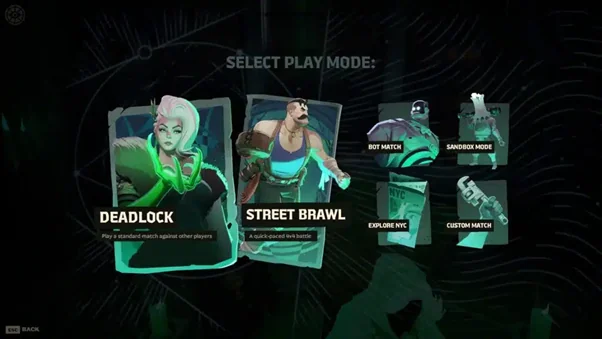
Since the game has transitioned to using one unified queue for matchmaking, ranked mode isn’t always an option you’ll have separately in Deadlock as is the case with other FPSes. However, players often ask how to unlock ranked mode since it was needed previously.
With builds that use a gate before unlocked placement, the common requirement will be to have played enough games. It’s usually stated as needing 50 matches played on your account. Then, you will unlock ranked mode and start placing through calibration games.
There were builds that also mentioned needing to participate in a number of ranked games before obtaining the first visible badge. The most common phrasing I’ve seen was having to win seven ranked matches before getting the first medal.
Leaderboards and Eligibility
Deadlock features regional leaderboards based on either region or hero. For instance, south america would have its leaderboard instead of a shared global one.
To be eligible for placement, you need to have recently completed enough playtime on the account. Hero-specific boards also feature a certain number of games played on the hero within the required time frame.
Make sure you play enough on Deadlock ahead of your week to be placed on the board.
Conclusion
In essence, Deadlock ranks are badges based on an unseen MMR score. This means that it attempts to match players appropriately and adjusts their ranking as they climb up. Learn several heroes and focus on consistency to climb, especially if you play during peak hours.
In case you are having issues with ranked progression, make sure to analyze your games to determine what mistakes you made during losses. Improve your gameplay decisions and allow the system to matchmake accordingly.