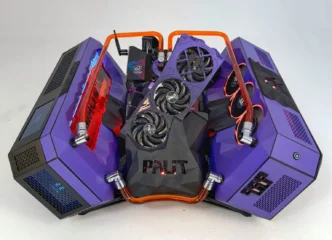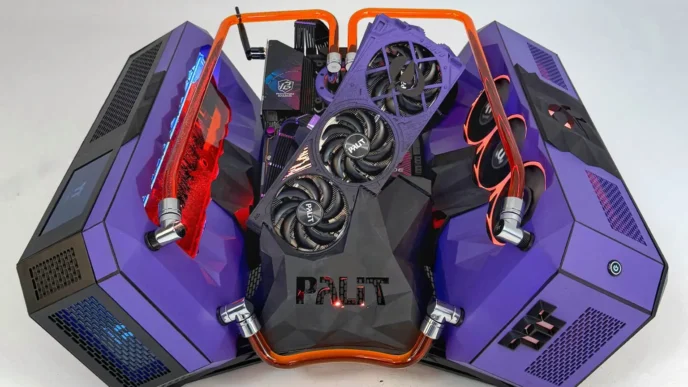

Don’t know what GPU stands for, let alone what it means? You’re not alone. GPU is an acronym that stands for ‘graphics processing unit’ and it’s an essential piece of software that is used online. It might not be something that you have heard of before but it’s almost certainly something you have engaged with, even unknowingly. It’s very rare if you haven’t because it is the foundation to almost any imagery, video, gaming or really anything visual that you see online. It’s a specialized electronic circuit that is designed to process visuals very quickly. It is super advanced and can handle and render thousands upon thousands of tasks simultaneously. This is why it is essential in gaming and that’s why casino streams look and feel so real. It’s all thanks to the advanced technology of the GPU and network upgrades. If this sounds like something interesting to you, you’ve come to the right place.
To understand where GPU is now and how real casino streams like poker rooms feel in this digital age, you need to take a step back and look at what earlier options looked like, which is exactly what this article aims to do. Then, it’s worth taking a closer look at what a GPU really is and how it shapes and operates live streaming environments. Additionally, you should spend some time taking it a step further and looking at how network upgrades as a whole have impacted the online casino market and its streaming services. There is honestly so much to unpack in this, so it’s time to get started.
Why Early Live Casino Streams Often Felt Unconvincing
Earlier generations of live casino streams struggled with technical constraints that made it very difficult for them to emulate realism. You could clearly see you were playing an online game; every lag gave that away immediately. Video feeds were often quite grainy or inconsistent and frame rates fluctuated. You could sometimes even find delays between actions and visual updates broke immersion. Even when dealers and tables were professionally staged, the transmission layer made things really tedious to look at and the whole experience didn’t feel seamless. An online casino you play on today, with a wide variety of games, endless features and menus, high-quality interfaces and overall safety and security were completely unheard of back then.
Another reason live casino streams felt strange was because of bandwidth limitations. Networks could not reliably sustain high-resolution video at low latency across large user bases. This has disastrous effects. Back then, it was expected and common but in this day and age, the quality of back then simply would not be acceptable now. Compression artifacts, buffering pauses and dropped frames were common. Encoding workloads also placed heavy strain on server-side hardware, forcing compromises in image quality or responsiveness.
From a viewer’s perspective, small disruptions in motion or timing made streams feel artificial and forced. You know that as a player, you’re highly sensitive to inconsistencies in visual flow, particularly during activities involving cards, chips and hand movements. When video delivery could not maintain coherence, the experience felt detached and you literally felt as if it wasn’t even you playing because the whole experience felt off.
The Role Of GPUs In Modern Live Streaming Environments
Graphics processing units are now central to live casino streaming pipelines. While GPUs are often associated with gaming visuals, their parallel processing capabilities are equally valuable for video encoding, scaling and real-time rendering tasks. Live casino platforms rely on continuous video capture from multiple cameras. These feeds must be processed, compressed, synchronized and distributed with minimal delay and this all works thanks to GPU processing.
Hardware-based encoding supported by modern GPUs allows platforms to maintain higher frame rates and cleaner compression. Motion remains smoother because frames are processed and delivered with greater consistency. Lighting gradients, texture details and fine movements retain clarity instead of degrading under aggressive compression. GPUs also assist with dynamic visual adjustments. Color correction, noise reduction, overlays and graphical elements can be applied in real time without imposing excessive latency.
How Network Infrastructure Changes The Perception Of Realism
Video quality alone does not determine realism. Timing behavior is equally influential; delays between player inputs and visual responses disrupt the natural rhythm of gameplay and network upgrades directly address this dimension. Higher bandwidth availability supports increased data processing, allowing video streams to keep their detail without being overly compressed and missing out on quality because of it.
With a GPU, streams remain coherent even under variable load conditions. Instead of freezing or stuttering, video flows continuously, which is a lot more enjoyable for gamers. This continuity strongly influences perceived authenticity. Smoothness often matters more than raw resolution. Plus, visual feedback aligns more closely with user actions, reinforcing the sense of being present at an active table.
Frame Rate Stability And Motion Naturalness
Human vision interprets motion through continuity rather than individual frames. Frame rate stability, therefore, has a disproportionate impact on realism. Irregular frame delivery creates subtle visual discomfort, even when average frame rates appear acceptable. GPU-accelerated encoding and improved network conditions work together to stabilize frame timing. Dealer movements, card flips and chip placements appear fluid instead of fragmented. Micro-interactions, which are abundant in casino environments, benefit the most from this stability. Naturalistic motion also improves spatial perception. Also, camera pans, zooms and transitions feel smoother, which is helpful.
Lighting, Color And Visual Depth
Live casino studios invest heavily in lighting design, yet earlier streaming limitations often masked these efforts. Compression artifacts and dynamic range constraints reduced visual richness. In fact, GPU-based processing now allows more accurate preservation of color and contrast information.
Improved encoding efficiency supports higher bit depth and better gradient handling. Lighting transitions appear softer. Reflections and shadows retain nuance. Skin tones, table textures and card surfaces look more natural. Visual depth cues also benefit. Cleaner image reconstruction and reduced noise enhance the separation between foreground and background elements. The table environment feels less flat and more dimensional.
Where Live Casino Streaming May Progress Next
Technological progress rarely stops at visual refinement. Emerging developments suggest further convergence between digital streams and physical environments. Higher refresh rate displays, improved mobile GPUs and expanding low-latency networks will likely continue, which will reduce gaps. Who knows, advances in volumetric capture, spatial audio and adaptive streaming may introduce additional layers of realism as well.
GPU has truly done a number on online casino games and streaming services. As GPU and network technologies continue advancing, it’s getting more and more difficult to find a gap between physical gaming and live casino streaming because the live games truly emulate the ‘real thing’ so well.