


1080p Game Testing
Our next set of benchmarks are all game benchmarks. These will be run and tested at 1080p (1920 x 1080) resolution. All scored here are the average FPS (frames per second) recorded.
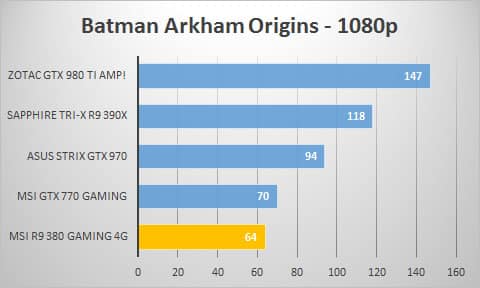
Batman Arkham Origins
In Batman Arkham Origins all of the detail settings were set to DX11 Enhanced, all features were turned on, Anti-Aliasing was set at MSAA 8X, and Hardware Accelerated Physx was turned off. We used the games built in benchmark.
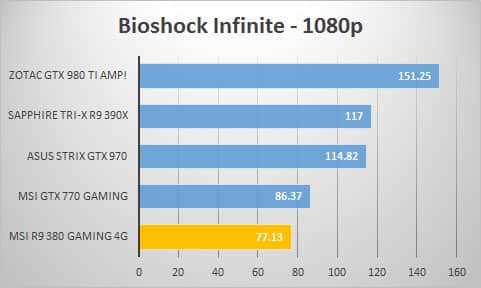
Bioshock Infinite
The game has a built-in benchmarking tool and we used the Ultra setting with Diffusion Depth of Field tuned on.
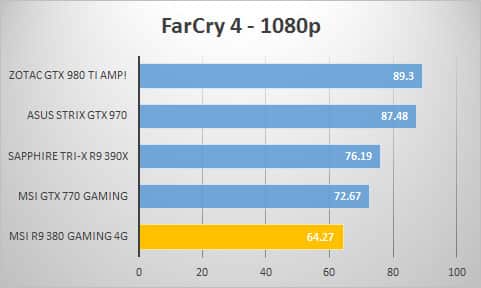
FarCry 4
In FarCry 4 there is no built in benchmark so we used Fraps to record our framerates. We play a selection of the “Propaganda Machine” mission where we leave the base camp and run up to the radio tower. We take the same path each time. Graphics were set on the “High” preset.
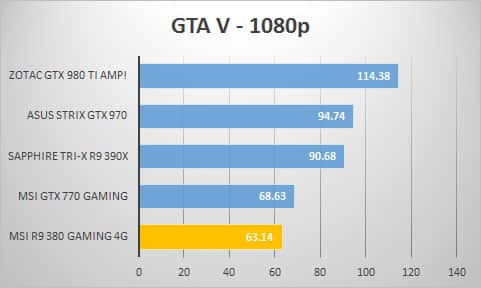
Grand Theft Auto V
We used the games built in benchmark here. All of the settings were maxed out except MSAA was turned off. Also everything in the “Advanced Graphics” section was turned off.
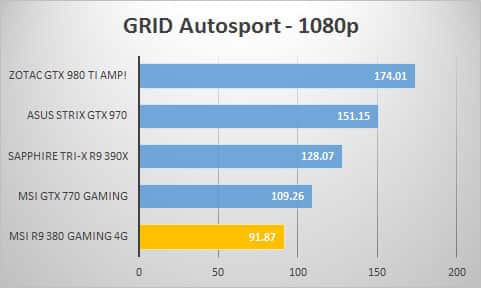
GRID Autosport
GRID Autosport also has its own built-in benchmark. We tested it using the “Ultra” setting.
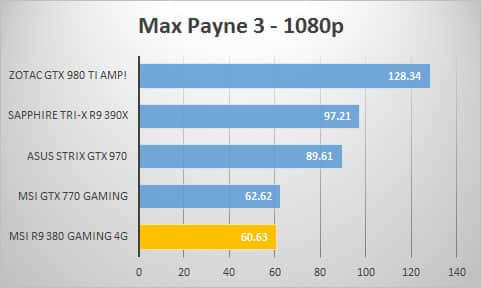
Max Payne 3
In Max Payne 3 we also used Fraps to record our framerates. We play a portion of the first mission in the game. The settings in the game were turned all the way up with the MSAA at 4x.
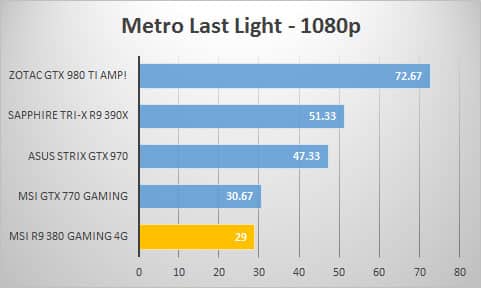
Metro Last Light Redux
Metro Last Light Redux has its own benchmarking tool. Settings we used were Quality: Very High, SSAA: On, Texture Filtering: AF 16X, Motion Blur: Normal, Tesselation: Very High, VSync: Off, Advanced Physx: Off. Scene 1 was selected and the number of runs was set at 3.


Thanks for the review! I will say other than listed in test set-up you completely missed covering the Gaming Mode (980 MHz / 5700MHz) as tested “out-of-the-box”, while the MSI Gaming App software is used to enact the OC Mode (1000 MHz / 5800 MHz). I think that would be useful to readers
and those that watched the video to provide some detail on that. Interestingly you did provide a lot of “ink” on that subject back with the MSI GTX 770 Gaming review back Oct, 2013, even providing B-M in both Gaming and OC’d. I think that would’ve been to correct way to provide a consistent position for all your reviews.
You might want to say that the idle temperature is at 52°C as that because the ZeroFrozr technology which stops the
fans when they are not needed at that point basically a full-passive mode.
I’m really disappointed you neglected to include the results of you MSI GTX 960 Gaming review from February 10th. That is the more proper comparison as it’s the Nvidia product that is it closest competitor, while 770’s have be EoL for almost a year now. Looking at both the GTX 960 review and the MSI GTX 770 you’ve appear to have change your test rig, and the B-M titles used so those older reviews weren’t transferable. That said, I have a hard time saying a loop of Heaven B-M is characteristic of gaming loads, and from other reviews I’ve seen the inference that a MSI GTX 770 Gaming is like 4.5% better than a MSI 380 Gaming (@980MHz) at load is abnormal. I mean look at the Stix 970 and the 770 with the Maxwell only using 7% less. That MSI
770 Gaming you have is some golden sample right there!
Agreed, it does seem the review misses the main characteristics of the card–which is really amazing, when you think about it…;) That’s the quickest route to web-site obscurity, imo.