


System Overview & Testing Procedures
The MSI R9 380 Gaming 4G Graphics Card was installed in our graphics card test bench without any problems at all.

This is our brand new test bench designed specifically for testing graphics cards. Check out our blog post to see what it is all about. It is made up of the following components.
Processor: Intel Core i7-5960X
Motherboard: Gigabyte X99-UD4
Graphics Card: MSI R9 380 Gaming 4G
Memory: 32GB Crucial DDR4-2133
Storage: Crucial BX100 512GB SSD
Power: Corsair HX1200i
Cooling: Corsair H80i GT
Case: Lian Li PC-T80
After getting the card installed we open up GPU-Z to check and make sure everything looks good.
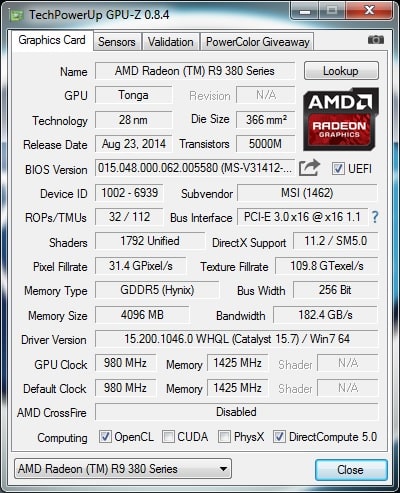
As you can see the card is running at its factory-overclocked settings of 980 MHz with the memory at 1425 MHz or 5700 MHz (GDDR5-effective). This is the default “Gaming” mode for the card. If you download the MSI Gaming App you can also run the card at “OC” mode and “Silent” mode.
For our tests we will be comparing the MSI R9 380 Gaming 4G to other graphics cards we have on hand. Please bare with us as we just built this system, as we acquire more graphics cards we will be updating the graphs in this review. The cards tested today are listed below along with their core, boost and memory speeds.
ASUS STRIX GTX 970: 1114 MHz / 1253 MHz / 7012 MHz
MSI GTX 770 Gaming: 1059 MHz / 1111 MHz / 7010 MHz
MSI R9 380 Gaming 4G: 970 MHz / 980 MHz / 5700 MHz
Sapphire Tri-X R9 390X: 1000 MHz / 1055 MHz / 6000 MHz
Zotac GeForce GTX 980 Ti AMP!: 1051 MHz / 1140 MHz / 7012
AMD Cards tested on: Catalyst 15.7
NVIDIA cards tested on: ForceWare 353.30
Benchmarking Information
With a new test bench comes a whole new set of benchmarks. We really wanted to focus more on real-world performance so we have added seven of the latest games to our benchmarking suite. Games will be run at 1080p, 1440p and 4K resolutions. Our benchmarking suite also includes synthetic tests as well.
Synthetic Tests
3DMark
– Fire Strike
– Fire Strike Extreme
– Fire Strike Ultra
3DMark 11
– Performance Benchmark
– Extreme Benchmark
Heaven Benchmark 5.0
Game Tests
Batman Arkham Origins
Bioshock Ultimate
FarCry 4
Grand Theft Auto V
GRID Autosport
Max Payne 3
Metro Last Light Redux
Other Tests
Power Consumption
– Kill-A-Watt meter
Temperatures
– GPU-Z Sensor reading
– Furmark
Noise Levels
– Galaxy Audio CM130 Sound Pressure Level Meter
Now let’s get to testing!


Thanks for the review! I will say other than listed in test set-up you completely missed covering the Gaming Mode (980 MHz / 5700MHz) as tested “out-of-the-box”, while the MSI Gaming App software is used to enact the OC Mode (1000 MHz / 5800 MHz). I think that would be useful to readers
and those that watched the video to provide some detail on that. Interestingly you did provide a lot of “ink” on that subject back with the MSI GTX 770 Gaming review back Oct, 2013, even providing B-M in both Gaming and OC’d. I think that would’ve been to correct way to provide a consistent position for all your reviews.
You might want to say that the idle temperature is at 52°C as that because the ZeroFrozr technology which stops the
fans when they are not needed at that point basically a full-passive mode.
I’m really disappointed you neglected to include the results of you MSI GTX 960 Gaming review from February 10th. That is the more proper comparison as it’s the Nvidia product that is it closest competitor, while 770’s have be EoL for almost a year now. Looking at both the GTX 960 review and the MSI GTX 770 you’ve appear to have change your test rig, and the B-M titles used so those older reviews weren’t transferable. That said, I have a hard time saying a loop of Heaven B-M is characteristic of gaming loads, and from other reviews I’ve seen the inference that a MSI GTX 770 Gaming is like 4.5% better than a MSI 380 Gaming (@980MHz) at load is abnormal. I mean look at the Stix 970 and the 770 with the Maxwell only using 7% less. That MSI
770 Gaming you have is some golden sample right there!
Agreed, it does seem the review misses the main characteristics of the card–which is really amazing, when you think about it…;) That’s the quickest route to web-site obscurity, imo.