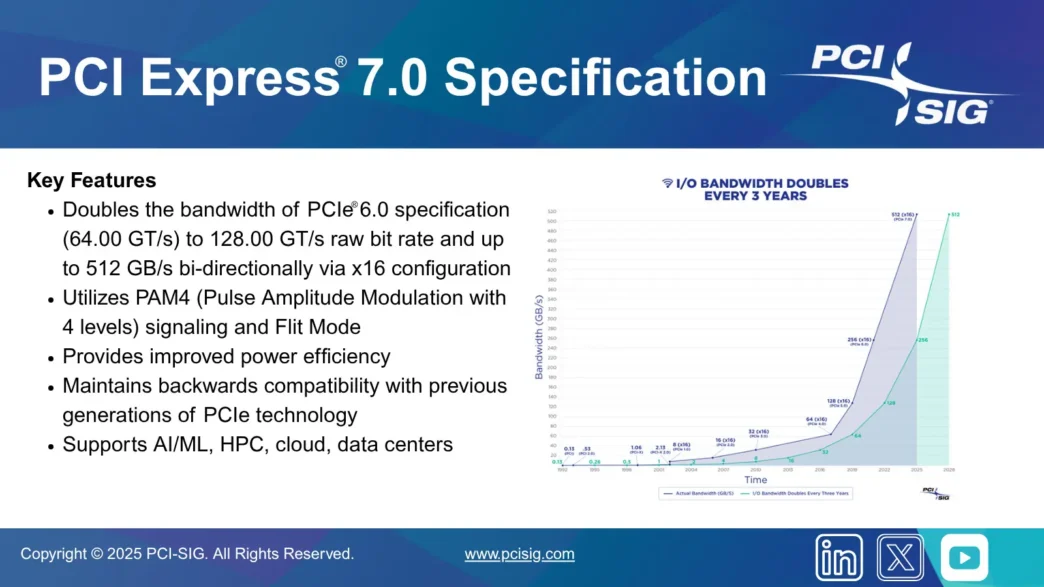
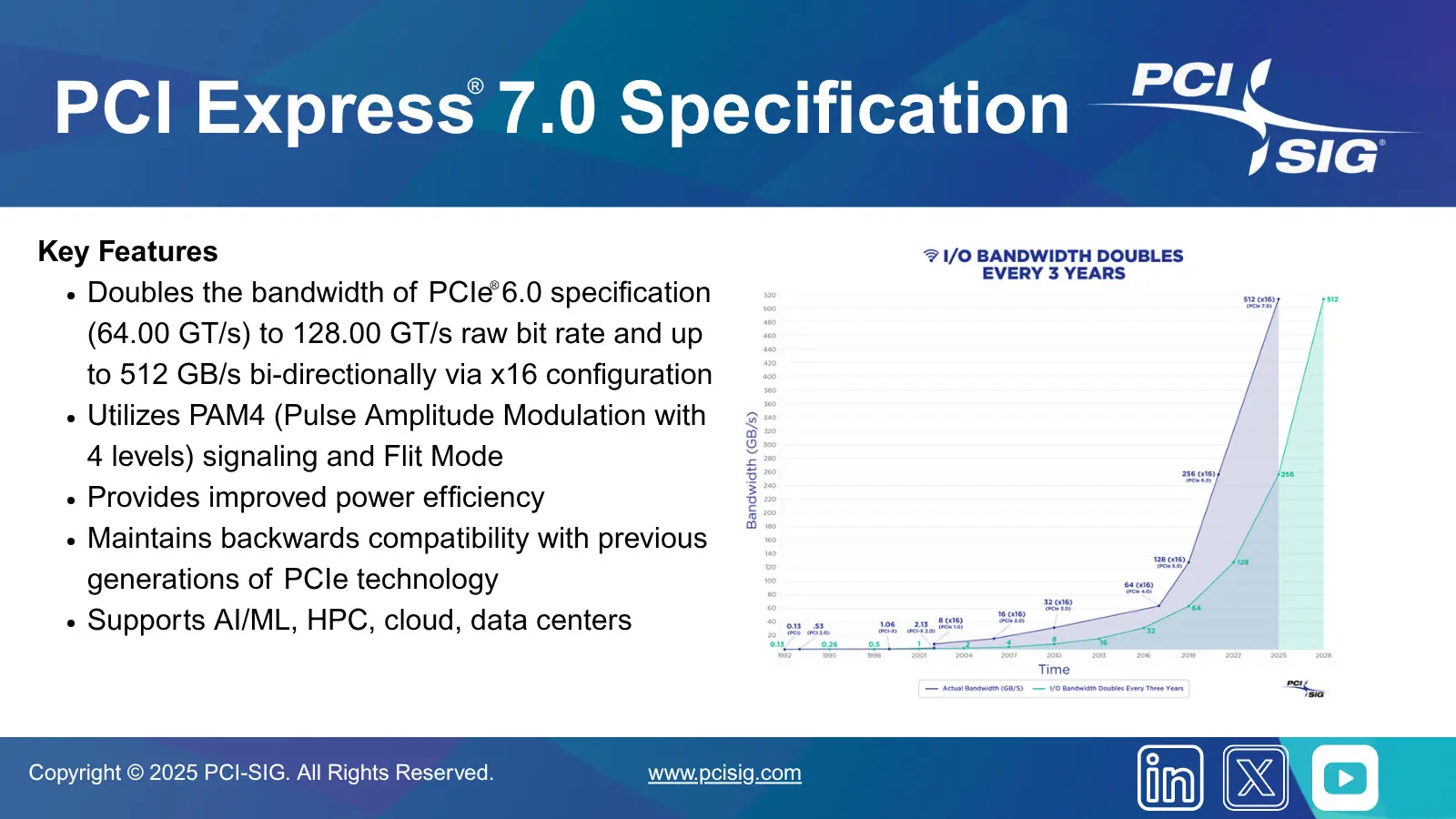
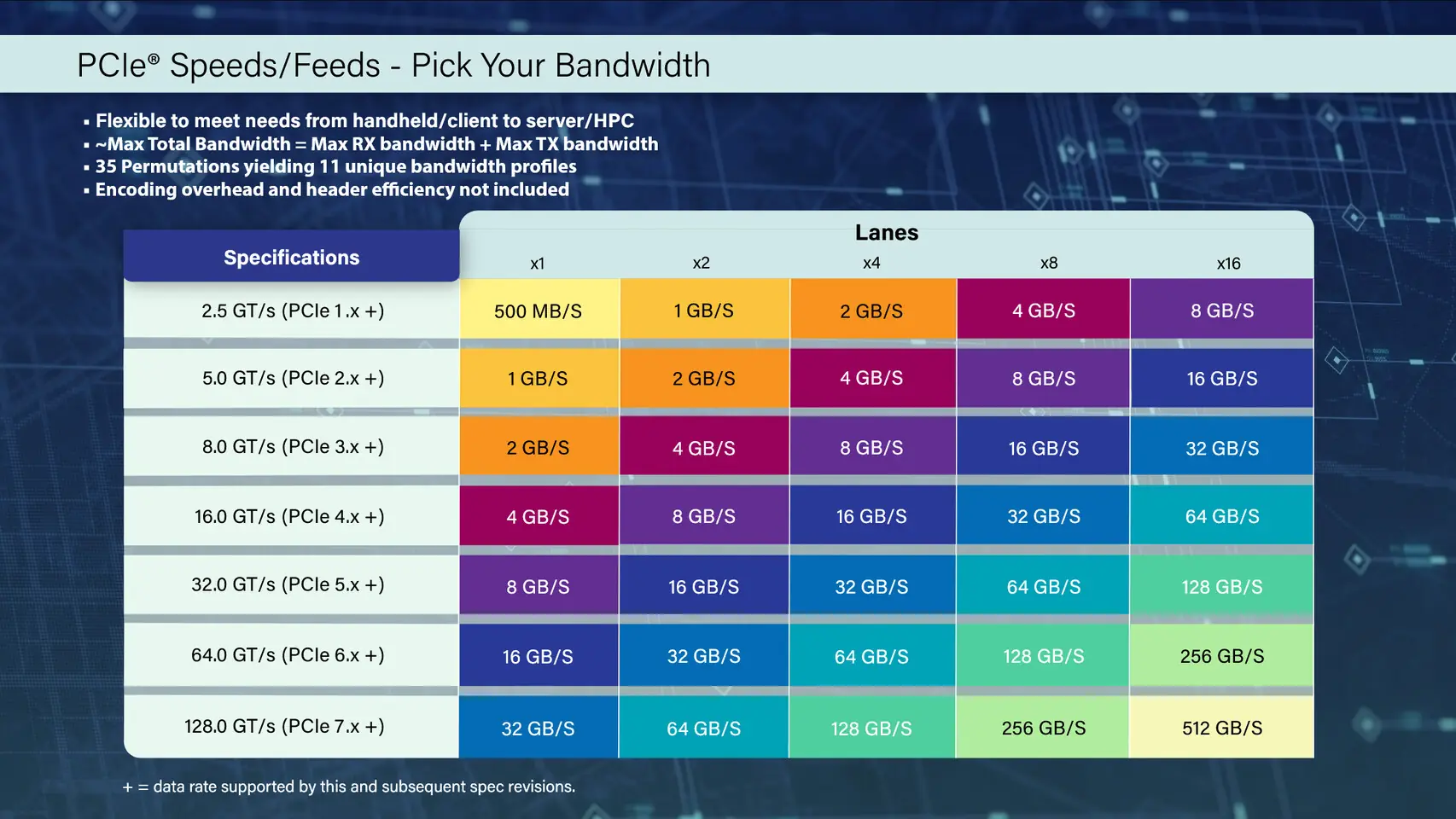
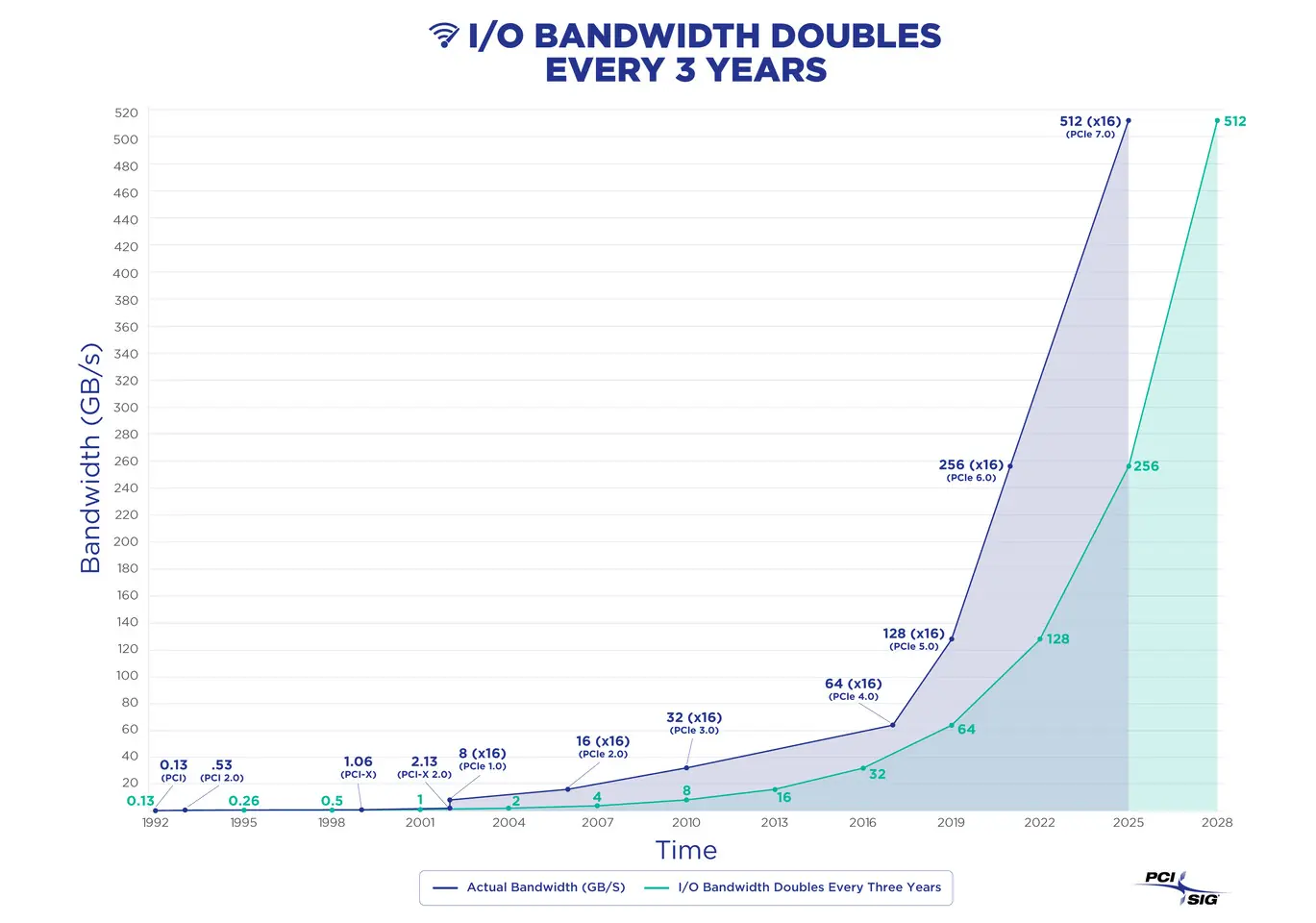
PCI-SIG has officially released the PCIe 7.0 specification, marking a significant leap in data transfer capabilities. This new standard doubles the bandwidth to 128 GT/s per lane, reaching up to 512 GB/s bi-directionally with a x16 configuration. This advancement is crucial for supporting the escalating demands of artificial intelligence, high-performance computing, and data centers.
PCIe 7.0: A Leap in Bandwidth
The PCIe 7.0 specification delivers a raw bit rate of 128.0 GT/s, effectively doubling the bandwidth of its predecessor, PCIe 6.0, and quadrupling that of PCIe 5.0. This substantial increase is vital for data-intensive applications such as AI/ML, 800G Ethernet, cloud computing, and quantum computing. The standard continues to utilize PAM4 signaling and FLIT-based encoding, first introduced in PCIe 6.0, while also focusing on improved power efficiency and maintaining backward compatibility with all previous PCIe generations.
Technical Innovations and Challenges
Achieving the 128 GT/s data transfer rate required significant engineering efforts, particularly in boosting the physical signaling rate to 32 GHz. This presented challenges in maintaining signal integrity over copper wires, leading to refinements in connector design and improved impedance control through optimized PCB materials. The specification also introduces an increased channel loss budget, moving from 32dB@16 GHz in PCIe 6.0 to 36dB@32 GHz in PCIe 7.0.
The Dawn of Optical PCIe and Future Prospects
In a groundbreaking move, PCI-SIG has also announced an Optical Aware Retimer Engineering Change Notice (ECN), amending the PCIe 6.4 and 7.0 specifications to include a retimer-based solution for optical fiber implementation. This marks the industry’s first standardized way to deploy PCIe technology over optical interconnects, enabling extended reach across racks and pods, and more compact implementations than traditional copper solutions.
- Key Takeaways:
- PCIe 7.0 doubles bandwidth to 128 GT/s per lane, up to 512 GB/s bi-directionally (x16).
- Crucial for AI, HPC, and data center applications.
- Maintains PAM4 signaling and FLIT-based encoding.
- Introduces industry-standard optical PCIe solutions.
- Pathfinding for PCIe 8.0, targeting 1 TB/s, is already underway.
While the PCIe 7.0 standard is now finalized, actual devices and platforms supporting it are anticipated to hit the market around 2028-2029, following compliance and interoperability testing. Meanwhile, PCI-SIG has already begun pathfinding for PCIe 8.0, with an ambitious goal of doubling the bandwidth again to 256 GT/s per lane, potentially reaching 1 TB/s over 16 lanes, indicating a continuous drive for higher performance in interconnect technology.
Via PCI-SIG