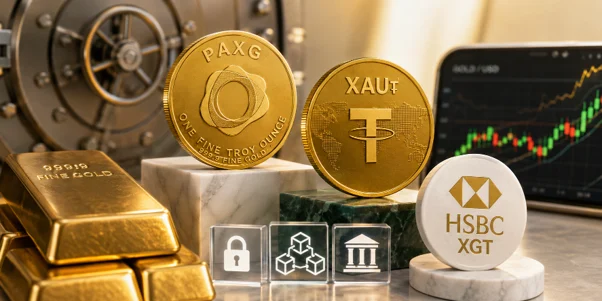
Gold has acquired a new trading layer. PAXG and XAU₮ now represent billions of dollars of physical bullion on public blockchains, while HSBC runs a separate bank-controlled model and newer projects are testing gold as DeFi collateral. The more useful question for investors is how these systems differ and what actually happens when gold starts moving through crypto markets.
What a Gold Token Actually Represents
Tokenized gold links a digital asset to physical bullion held by an issuer or custodian. The token provides a digital record of ownership or a claim on the underlying gold, depending on the product’s legal structure.
PAXG is a public blockchain token backed by physical gold. Each token represents one fine troy ounce of London Good Delivery gold stored in LBMA-accredited vaults in London. Paxos reports the underlying gold by specific bar and provides regular reserve attestations and physical verification. PAXG also trades on secondary markets and is available on multiple blockchain networks.
The practical effect is straightforward. A holder can move a fractional gold position between compatible wallets or trading venues without transporting a bar of bullion. The blockchain handles the digital transfer while the physical asset stays in custody.
Tokenized gold also fits into broader crypto portfolio management. When an investor moves liquidity between a volatile asset and a dollar-denominated one, a TON to USDT exchange through ChangeNOW can serve as the conversion step. Stablecoins can then provide the settlement layer for moving capital between crypto positions, including tokenized gold.
The structure behind the token still deserves more attention than the wallet interface. Reserve verification, legal ownership, redemption rules, custody and secondary-market liquidity determine what an investor actually owns and how easily the position can be converted.
Three Ways to Put Gold on a Ledger
The market now contains several distinct approaches. PAXG and XAU₮ operate on public blockchains, while HSBC uses a distributed ledger within its own banking infrastructure. Newer projects are taking another route by placing tokenized gold directly into DeFi markets.
PAXG: Allocated Gold on Public Blockchains
Paxos launched PAXG on Ethereum in 2019 and added Solana in June 2026. The Solana deployment gives PAXG access to another ecosystem of wallets, decentralized exchanges and applications while retaining the same reserve structure. Paxos says its Solana version uses Solana’s Token-2022 standard and maintains its existing compliance and supply-verification controls.
The move also shows why blockchain choice matters for real-world assets. The gold itself does not change when PAXG moves between networks. The surrounding liquidity and applications do.
XAU₮: Gold Within the Tether Ecosystem
Tether Gold reached a different scale in the first quarter of 2026. Tether reported 707,747 fine troy ounces of physical gold backing XAU₮ at the end of March, compared with 520,089 ounces at the end of 2025. The reported market value of the gold backing the token exceeded $3.3 billion.
The reserve is held in Switzerland and consists of London Good Delivery gold. Tether states that the gold is owned by XAU₮ token holders rather than the issuing company.
Recent tokenized gold trends also point toward a broader shift from simple digital ownership toward multichain distribution, collateral use and institutional infrastructure.
XAU₮ gained another regulatory signal in July when Abu Dhabi Global Market recognized it as an Accepted Spot Commodity. The status allows firms operating in ADGM to offer services involving XAU₮ subject to their own regulatory permissions.
HSBC: A Different Kind of Gold Token
HSBC’s Gold Token shows why the word “tokenized” can hide major structural differences.
XGT represents 0.001 troy ounce of physical gold recorded on HSBC’s distributed ledger. The product is designed around the bank’s own infrastructure and dealing arrangements rather than a public blockchain market comparable to PAXG or XAU₮. HSBC’s documentation states that investors trade the gold represented by the token through the bank, with pricing determined under the product’s own mechanism. Physical delivery is unavailable.
The model has attracted significant activity. HSBC told the Financial Times that more than $2.2 billion had been traded through the product across more than 276,000 transactions. The FCA is also examining how tokenized gold could work as collateral in wholesale markets, adding a regulatory dimension to a market that has largely developed through separate commercial models.
The comparison is useful because it separates two ideas often treated as one. A token can represent gold through a public blockchain with open secondary-market activity, or it can function as a digital record inside a bank’s controlled infrastructure.
Where On-Chain Gold Is Becoming Useful
Spot trading remains the simplest application. The more consequential development is the use of gold tokens inside other financial transactions.
Matrixdock’s XAUm is a good example. In February 2026, Matrixdock deployed XAUm natively on Solana with initial liquidity on Raydium and plans for lending-market integration. Each token represents one troy ounce of physical gold. The project specifically positions XAUm as collateral for on-chain financial activity.
Once gold enters a smart-contract environment, its role can change. A token can provide gold exposure while also serving as collateral in a lending position or interacting with decentralized liquidity.
Tether tested a related concept through Alloy, a platform that used XAU₮ as collateral for a synthetic dollar product. Tether announced in June 2026 that it would stop creating new aUSD₮ positions and wind down the offering. The case shows how collateralization can work technically while still depending on user demand, liquidity and viable market structure.
Liquidity deserves particular attention. During a sharp gold rally in late January 2026, spot gold moved above $5,100 per ounce after gaining roughly $500 overnight. Oro founder Usman Saleem described market makers rebalancing on-chain pools while traders attempted five-figure transactions against limited pool depth.
That episode gives tokenized gold a useful reality check. Blockchain settlement can operate around the clock, while the depth available around the quoted price can change substantially during volatile sessions.
What Investors Should Compare
Tokenized gold sits beside several established forms of gold exposure, each with different ownership and settlement mechanics.
| Instrument | Ownership / settlement model | Main strength | Main constraint |
| Physical bullion | Direct ownership of metal | Direct control over the asset | Storage and physical settlement |
| Gold ETF | Securities-market exposure | Deep established infrastructure | Brokerage and securities-market structure |
| Gold futures | Derivative contract | Professional liquidity and leverage | Margin and expiry mechanics |
| Public-chain gold token | Blockchain token linked to bullion | Transferability and composability | Issuer, custody and liquidity risk |
| Bank-issued gold token | Permissioned ledger and bank dealing | Fractional ownership within bank infrastructure | Dependence on issuer and trading terms |
The market is also starting to behave more like the gold market it represents. Chainalysis analyzed $40.5 billion in tokenized-gold trading volume and found that the relationship between tokenized-gold volume and GLD volume had historically been weak. From Q2 2025, the 45-day rolling correlation moved above 0.70 and stayed above that high-correlation threshold through Q1 2026.
That change matters because early tokenized-gold activity was heavily influenced by crypto-specific liquidity cycles. Stronger correlation with traditional gold trading suggests that macro factors affecting bullion are gaining greater influence over on-chain activity as the market grows.
Regulation could determine how far that process goes. The FCA is discussing a framework for tokenized gold and has been seeking views on its potential use as collateral in wholesale markets. The UK initiative reflects competition between London, Shanghai and Hong Kong for the next generation of gold-market infrastructure.
For investors and analysts, the work becomes partly operational. AI can help compare reserve disclosures, monitor wallet activity, track liquidity and flag unusual flows. Human review still needs to cover custody agreements, redemption rights, issuer structure and regulatory documents because those details determine the legal and economic substance behind the token.
Base Scenario
The base case is a larger market built around PAXG and XAU₮, with additional blockchain deployments and gradual institutional participation. Gold tokens gain more trading venues and collateral applications while their connection to traditional gold-market activity becomes stronger.
Optimistic Scenario
The stronger case combines regulatory clarity with deeper DeFi liquidity and institutional collateral use. Products such as PAXG, XAU₮, XAUm and bank-issued gold tokens could serve different parts of the same broader market, with public-chain assets handling programmable settlement and bank infrastructure serving regulated institutional flows.
Stress Scenario
The main stress point is liquidity and counterparty structure. A sharp gold reversal, crypto deleveraging event or issuer-related problem could expose the difference between physical reserves and the liquidity available for the token itself. The Oro episode offers a small-scale example of how quickly pool depth can become an operational issue during extreme price movements.
Conclusion: Gold Gets a Second Trading Layer
Tokenization gives gold a digital settlement mechanism without changing the underlying commodity. PAXG and XAU₮ show how public blockchains can connect physical bullion with crypto markets, while HSBC demonstrates a more controlled banking model and XAUm shows where tokenized gold can move next inside DeFi.
For investors, the gold price is only the starting point. Reserve quality, legal ownership, redemption, custody, liquidity, blockchain design and regulatory treatment determine the quality of the tokenized position.
FAQ
What is tokenized gold?
Tokenized gold is a digital asset linked to physical bullion through an issuer or custodian.
Is PAXG backed by physical gold?
Yes. Each PAXG represents one fine troy ounce of London Good Delivery gold held in LBMA-accredited vaults.
What is XAU₮?
XAU₮ is Tether Gold, a digital asset backed by physical gold. Tether reported more than 707,000 fine troy ounces of backing at the end of Q1 2026.
Can tokenized gold trade on public blockchains?
Yes. PAXG operates on Ethereum and Solana, while other gold tokens use additional blockchain networks.
Can gold tokens be used as collateral?
Yes. Matrixdock designed XAUm for on-chain liquidity and collateral applications, with Solana lending integrations planned after its February 2026 launch.
Does every gold token offer physical redemption?
Redemption depends on the product. PAXG provides redemption mechanisms under Paxos’ terms, while HSBC Gold Token provides fractional ownership through the bank’s ledger and does not provide physical delivery.
Is HSBC Gold Token the same as PAXG?
No. HSBC uses its own distributed ledger and bank-mediated trading structure. PAXG operates as a public-chain token with secondary-market trading.
Why does liquidity matter for tokenized gold?
Physical backing establishes the relationship with bullion. Market liquidity determines how efficiently investors can trade the token around its current value.
Could regulation accelerate tokenized-gold adoption?
Regulatory clarity could make institutional use easier, particularly if tokenized gold gains recognition as collateral. The FCA is examining this area in the UK, while XAU₮ received Accepted Spot Commodity status in ADGM in July 2026.
Disclaimer
This article is provided for informational purposes only and does not constitute financial, investment, legal or tax advice. Tokenized gold involves market, custody, liquidity, technology, issuer and regulatory risks. Readers should conduct independent research and consult qualified professionals before making financial decisions.