


A new set of community-developed tools lets owners of many NVIDIA GeForce RTX cards modify VBIOS settings and load them through the graphics driver, without rewriting the card’s firmware chip. The developer says testing raised an RTX 5080’s power limit from 360W to 500W, though higher limits bring significant stability and hardware risks.
Key takeaways
- The tools target GeForce RTX 50-, 40- and 30-series cards, with some support for professional GPUs.
- Windows loads the modified VBIOS through a driver registry override; Linux uses modified NVIDIA open kernel modules.
- Developer tests included an RTX 5080 at 500W and an RTX 5090 at as much as 800W.
- Memory timings cannot be changed through this method, and laptop GPU support is limited.
The approach changes what the driver and GPU use at startup, rather than permanently flashing a modified image to the card. That makes it distinct from conventional VBIOS flashing, but it does not make power or voltage modifications risk-free.
How the VBIOS tools work
The tool set includes an editor for adjusting power and voltage ceilings, current limits, fan channels, and core and memory offset ranges. Because editing breaks the original NVIDIA signature, the resulting image cannot be written to the card using standard flashing tools.
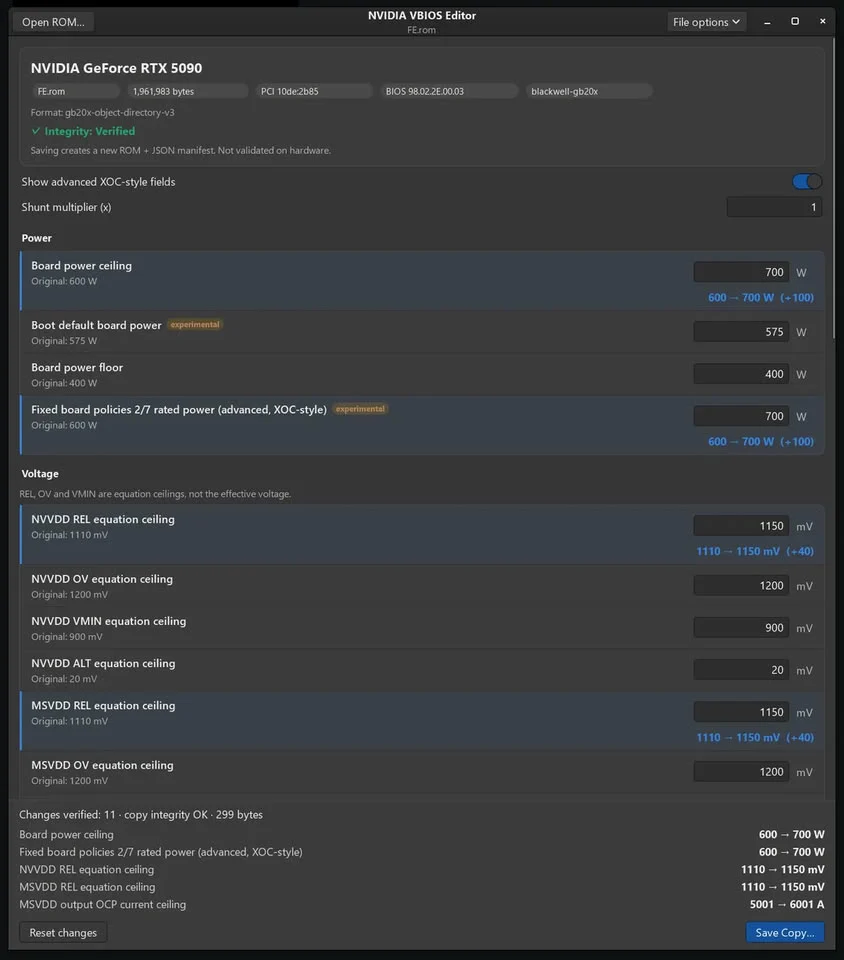
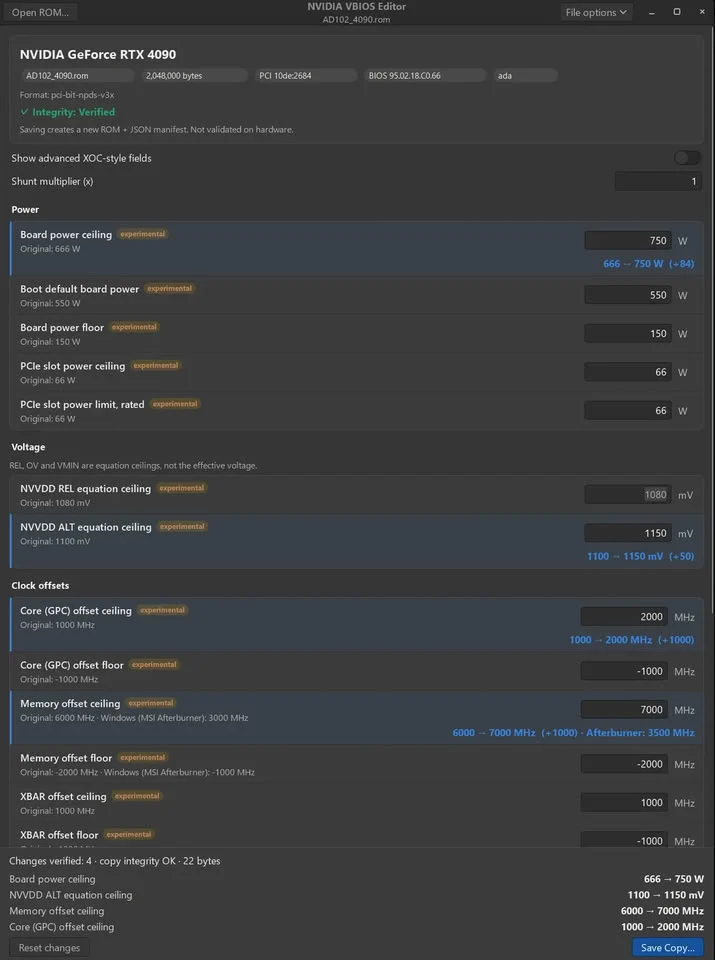
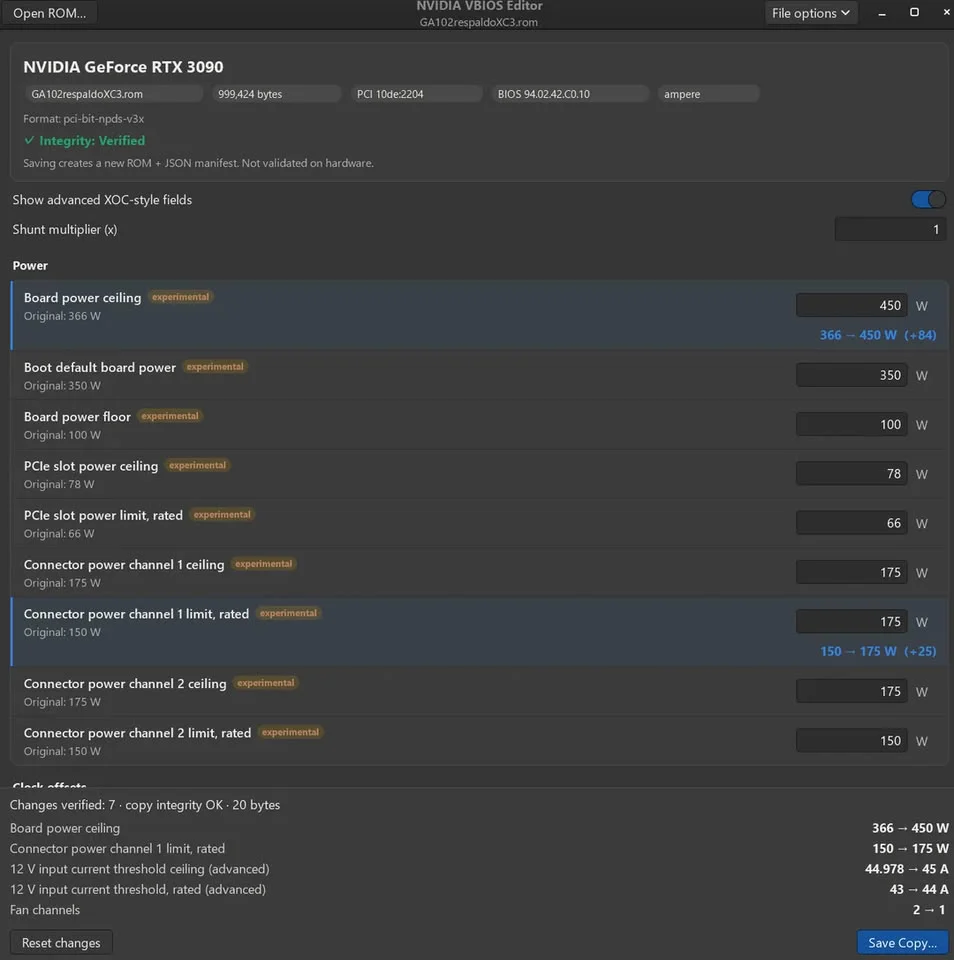
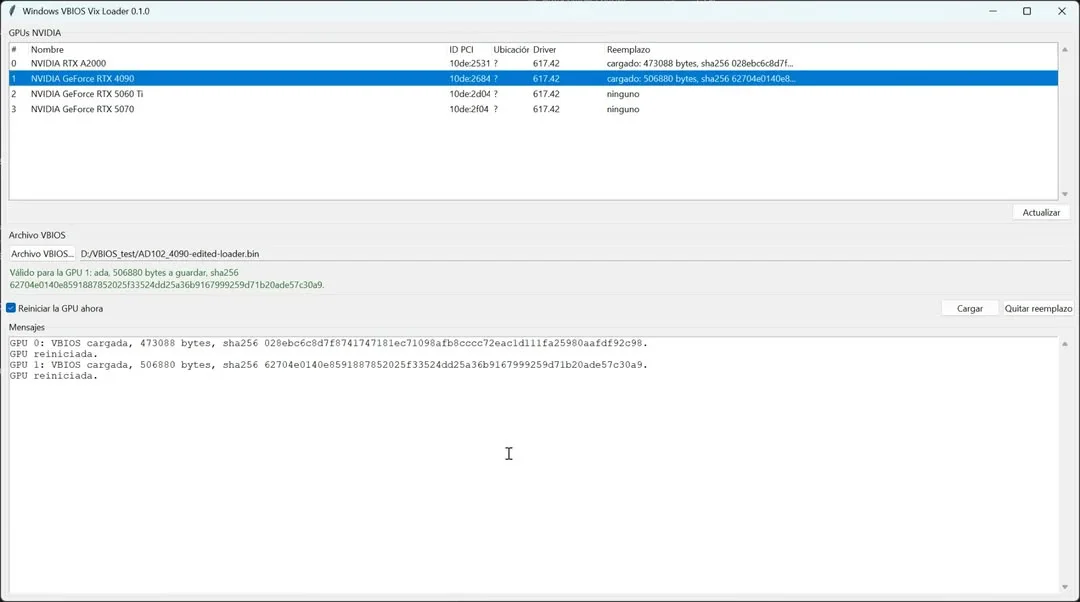
On Windows, a loader places the custom image in the GPU’s driver registry settings, then restarts the graphics device. It requires Windows 10 or 11 and NVIDIA driver version 616.56 or later. The Linux loader instead modifies the startup path for NVIDIA’s open kernel modules so the GSP firmware starts with the edited image. Fedora 43 is the Linux distribution reported as tested on physical hardware so far.
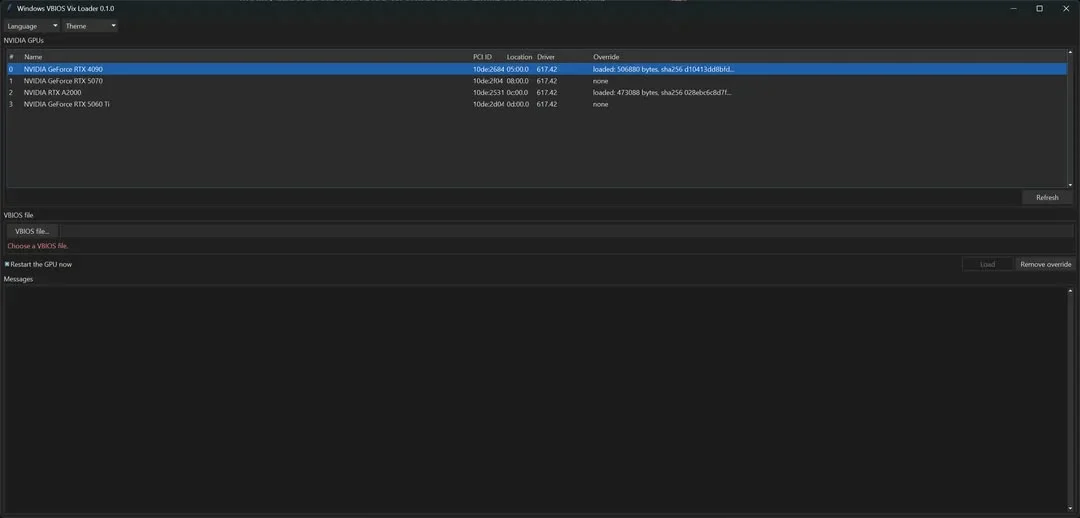
Reported power-limit increases
The developer’s reported tests include raising an RTX 5080’s limit from 360W to 500W, an RTX 5060 Ti’s from 185W to 300W, and an RTX 5090’s from 600W to as high as 800W. An RTX 4090 example showed its limit increasing from 550W to 671W, a figure confirmed using NVIDIA’s nvidia-smi utility. These are developer-reported results, not guarantees that every card will support the same settings or operate reliably at them.
The editor can also expand tuning ranges, but a larger available offset does not mean a GPU can run stably at that frequency. The tools do not change memory timings, which the card reads directly from its physical flash chip. Laptop RTX 40-series cards are not supported for editing at this time, while mobile support varies by generation.
Compatibility and risks
For PC enthusiasts, the tools offer more control than standard software tuning, including the option to reduce voltage or set lower power limits. But raising limits can increase heat and electrical load, cause instability, or damage hardware; avoiding a physical flash does not remove those risks. NVIDIA could also block the loading method in a future driver update.
Users considering experimentation should keep an original VBIOS backup and test on a GPU that is not driving their display. Compatibility depends on the specific card and software configuration, and the reported maximums should be treated as experimental rather than recommended operating targets.