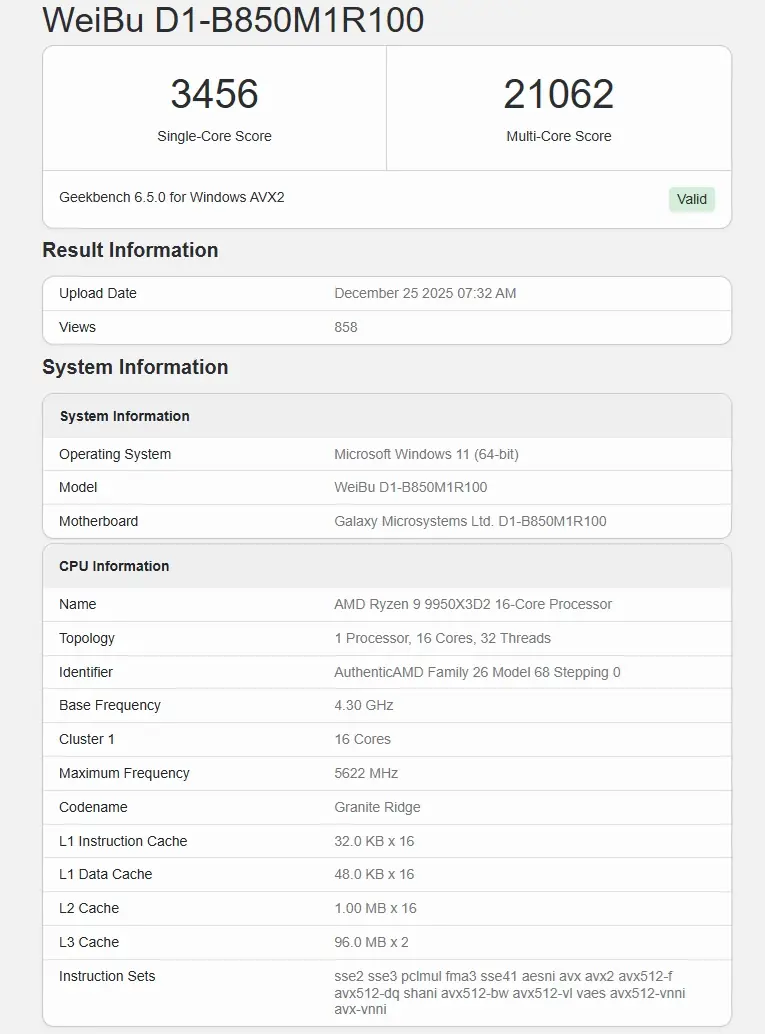
Leaked benchmark results for the unreleased AMD Ryzen 9 9950X3D2 processor have surfaced, offering a glimpse into its specifications and performance. This new CPU is expected to feature AMD’s 3D V-Cache technology on both of its core chiplets (CCDs), potentially setting a new standard for AM5 socket processors.
Key Takeaways
- Dual 3D V-Cache: The Ryzen 9 9950X3D2 reportedly features 192MB of L3 cache, achieved by stacking 96MB of 3D V-Cache on each of its two CCDs.
- Performance: Initial benchmarks in PassMark and Geekbench show performance comparable to the existing Ryzen 9 9950X3D, with slight variations likely due to clock speeds and testing conditions.
- Simplified Design: Unlike previous hybrid X3D models, this dual-cache design eliminates the need for complex workload allocation between cache-enabled and non-cache-enabled CCDs.
- Potential Launch: The appearance of these benchmarks suggests the processor may be nearing its official launch, possibly around CES 2026.
Unveiling the Dual-Cache Design
The most significant revelation from the leaked benchmarks is the Ryzen 9 9950X3D2’s dual 3D V-Cache configuration. This means that both of the CPU’s 8-core CCDs will be equipped with AMD’s stacked cache technology, totaling an impressive 192MB of L3 cache. This approach differs from previous X3D processors, which typically had 3D V-Cache on only one CCD, potentially simplifying game and application performance by ensuring all cores benefit from the larger cache.
Benchmark Performance Insights
Early benchmark results from PassMark and Geekbench indicate that the Ryzen 9 9950X3D2 performs closely to its non-dual-cache counterpart, the Ryzen 9 9950X3D. In PassMark, the CPU achieved a multi-core score of 71,585 and a single-core score of 4,716.
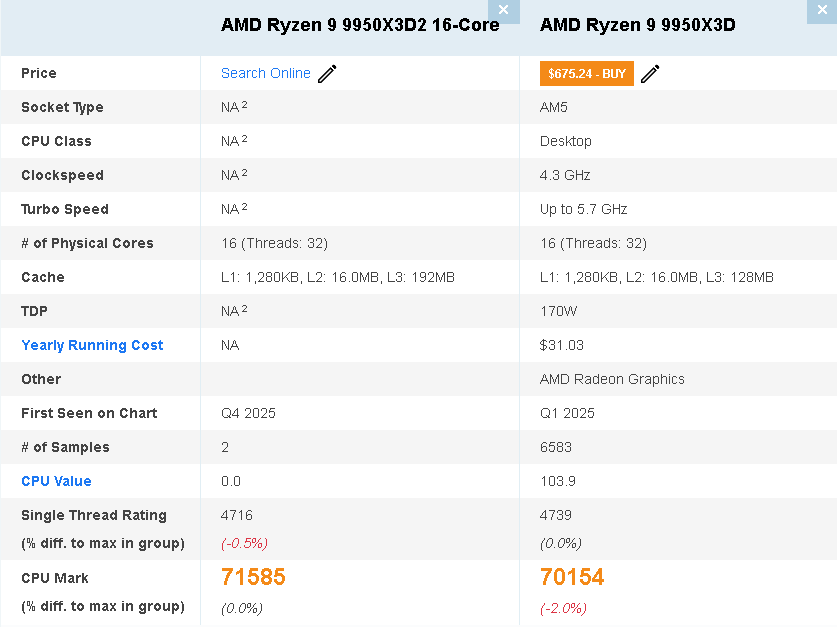
Geekbench results show a single-core score of 3,456 and a multi-core score of 21,062. While these scores are competitive, they are not significantly higher than the 9950X3D, which may be attributed to slightly lower boost clock speeds (reported at 5.6 GHz for the 9950X3D2 compared to 5.7 GHz for the 9950X3D) and the synthetic nature of these benchmarks, which may not fully leverage the dual-cache advantage.
Potential Implications and Future Outlook
The dual-cache design could offer benefits beyond gaming, potentially improving performance in specific professional applications that can utilize the expanded cache across all cores. While the exact impact on gaming performance is yet to be determined, the elimination of the “hybrid” CCD configuration could lead to more consistent results. Reports also suggest a potential TDP of 170W, which is lower than some earlier rumors, though this could be subject to change. With CES 2026 on the horizon, AMD may officially unveil the Ryzen 9 9950X3D2 and provide further details on its specifications and availability.
Via @x86deadandback, @Olrak29_