As email authentication requirements become stricter in 2026, organizations can no longer rely on basic DNS checks alone to protect their domains from spoofing, phishing, and deliverability failures. Modern DMARC reader tools help businesses transform complex DMARC XML reports into clear, actionable insights that improve SPF and DKIM alignment, strengthen domain compliance, and boost inbox placement across providers like Gmail, Yahoo! Mail, and Microsoft Outlook. This article compares the best DMARC reader tools in 2026 — including MxToolbox, dmarcian, Zoho, and EasyDMARC — evaluating their parsing accuracy, reporting dashboards, automation features, API integrations, scalability, and compliance capabilities to help businesses choose the right solution for long-term email security and deliverability success.
What a DMARC Reader Does in 2026 (RUA vs RUF): Deliverability and Compliance
A modern dmarc reader in 2026 is an essential part of every organization’s email security arsenal, serving as the gateway to proactive DMARC management and policy enforcement. At its core, a DMARC reader translates the raw, often cryptic, dmarc xml report files sent by mailbox providers (reporters), such as Google, Yahoo, Microsoft, and Amazon, into actionable, human-readable insights. These reports support two key formats: RUA (Aggregate Reports) and RUF (Forensic Reports).
RUA dmarc aggregate reports provide statistical data on all messages passing or failing spf authentication and dkim authentication under your domain—crucially enabling organizations to monitor authentication rates, check for DMARC alignment, and reveal unauthorized or misconfigured sources. An effective dmarc report analyzer and xml parser converts these aggregate xml datasets into digestible dashboards, often using an xml to human converter interface.
RUF reports deliver granular, message-level insights—critical for diagnosing sophisticated spoofing attempts, though they are less widely supported for privacy reasons. Both report types, when processed through a capable dmarc management platform, empower teams to fine-tune their dmarc policy (none, quarantine, reject), optimize their email delivery, and ensure strict domain compliance. Properly parsed and monitored DMARC data is now directly tied to improved email deliverability—especially as Gmail and Yahoo Mail continue to tighten their enforcement standards.
Evaluation Criteria for DMARC Reader Tools
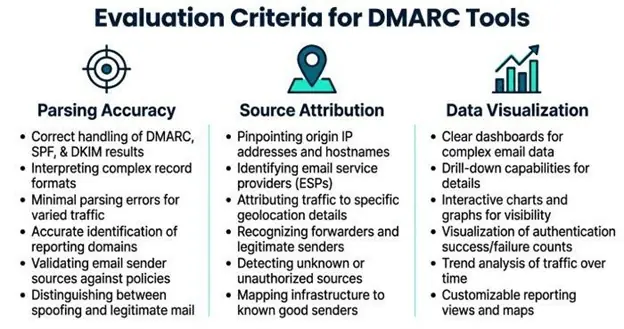
Choosing the right dmarc tools hinges on criteria that extend well beyond basic parsing. Leading solutions in 2026 should be evaluated based on:
Parsing Accuracy
A top-tier dmarc reader must demonstrate flawless xml format parsing accuracy. The tool should consistently extract correct senders, SPF results, DKIM signatures, and authentication failures from every dmarc xml report—regardless of the reporters’ (Google, Yahoo, Amazon, etc.) implementations. Inaccurate parsing can lead to missed threats or broken compliance tracking.
Source Attribution and Identification
Effective dmarc aggregate reports are only as valuable as their source insight. Email source identification and IP address tracking are vital, enabling admins to determine which services (Microsoft 365, bulk mailers, transactional providers) are sending legitimate versus unauthorized mail. Tools featuring a source viewer or detailed “detail viewer” enhance this process by mapping complex flows back to individual providers or delegated systems.
Visualization and Reporting
The best dmarc report analyzer platforms provide comprehensive data visualizations, transforming dense aggregate xml inputs into dynamic charts. User-friendly dashboards help organizations monitor message volume, chart authentication rates, identify trends, and easily pinpoint deliverability issues. This process often deploys an xml to human converter framework for truly human readable results.
Alerts, Monitoring and Diagnostics
For real-time response, integrated alert central, monitoring, and diagnostic workflows are required. These features automatically flag new failed sources, negative trends in email health, or changes in domain compliance—often leveraging advanced rules to drive actionable results.
Integrations and API Flexibility
A robust dmarc management platform should offer seamless integration with other security systems, such as SIEMs, MSP dashboards, or leading helpdesks. API Reference documentation is crucial for linking DMARC insights to broader corporate tooling—enabling reporting automation, custom policy response, and third-party audits.
Privacy and Data Handling
DMARC data frequently contains sensitive routing and authentication metadata. It’s essential that the selected solution ensures data privacy, offering clear guidance on how dmarc data providers store, process, and retain information, especially RUF (forensic) data.
Cost and Scalability
The tool’s pricing model, scalability limits, and licensing rules should fit your deployment services needs. Capabilities must address SMB entry points as well as MSPs, large IT agencies, educational or healthcare consortia, and enterprise, with no bottlenecks in message volume monitoring.
Head-to-Head: MxToolbox vs Dmarcian vs Zoho vs EasyDMARC
MxToolbox
MxToolbox remains a stalwart in the email authentication tooling space for 2026. Their dmarc reader component integrates with MxToolbox’s ecosystem of diagnostic modules—MX Lookup, DMARC Inspector, SPF Surveyor, DKIM Inspector, and DKIM Validator. Parsing and xml to human converter capabilities are strong, enabling clear, human readable dashboards of dmarc aggregate reports.
Strengths:
- Deep multi-protocol diagnostics (SPF, DKIM, MX, DMARC alignment)
- Excellent dmarc xml report parsing and visualization
- Built-in DMARC Record Wizard for easy record setup and modification
- Comprehensive alerting and monitoring
Gaps:
- Advanced integrations and API access require premium tiers
- Can be costlier at high message volumes
Dmarcian
dmarcian is a specialist dmarc management platform known for parsing accuracy and granular forensic inspection. Its platform excels as a dmarc report analyzer, breaking down each dmarc xml report into rich, human readable detail. The Domain Audit, Source Viewer, and Delivery Center modules greatly assist in pinpointing new, potentially malicious reporters.
Strengths:
- Market-leading xml parser and forensic source mapping
- Domain audit and actionable results dashboards
- Extensive self-help via DMARC Academy and DMARC Dictionary
- Powerful integrations with SIEMs and MSP tools
Gaps:
- Visualization, while robust, may be less “beginner-friendly” than other platforms
- Customization can be complex for smaller teams
Zoho
Zoho brings DMARC reporting into its multi-function security suite, highly suitable for organizations already standardized on Zoho’s ecosystem. The dmarc reader supports baseline dmarc aggregate reports analysis and provides accessible visualization for routine email reports. Integrations with Zoho’s incident response and app automation are points of differentiation.
Strengths:
- Smooth integration with broader Zoho suite (CRM, email, desk)
- Simple onboarding for SMB and educational use
- Visualizations suitable for non-specialists
Gaps:
- Parsing and forensic capability less granular than specialist platforms
- Limited customization for API Reference and external SIEM linkage
EasyDMARC
Designed for hassle-free rollouts, EasyDMARC is a cloud-first dmarc management platform lauded for its dmarc report analyzer, API-first integrations, and easy “setup dmarc record” wizard. High scores for parsing and xml to human converter usability—favored by MSPs and fast-growth IT agencies.
Strengths:
- User-friendly dashboards and xml parser accuracy
- Scalable message volume support and competitive pricing
- Well-documented API Reference for automation/workflow integration
- Rapid onboarding and “one-click” domain compliance status
Gaps:
- Fewer advanced investigation tools for seasoned security analysts
- Some features require add-ons at enterprise scale
Pricing, Scalability, and Support: Recommendations by Use Case
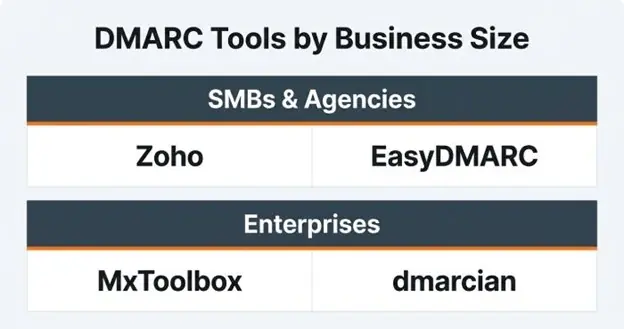
For SMBs and IT Agencies:
- Zoho offers the best native integration and value for mixed-infrastructure environments, especially in Financial Services and Educational Services.
- EasyDMARC delivers robust automation, ease of onboarding, and budget-friendly entry points for agencies managing multiple domains.
For Enterprises and Large-Scale Senders:
- MxToolbox and dmarcian both scale to very high message volume without performance bottlenecks—vital for Healthcare or Financial Services handling sensitive authentication data.
- dmarcian especially shines for MSPs and organizations requiring advanced diagnostic and deployment services.
Scalability Factors:
- Consider data retention duration (especially for RUF data).
- Test support responsiveness around critical periods (e.g., after changes to dmarc record or large marketing sends).
- Ensure sufficient API Reference documentation exists for planned integrations.
Pricing varies by tier and domain volume, but all platforms now offer both free trial tiers and multi-tenant models.
Implementation Roadmap and Decision Checklist
From DNS Setup to Ongoing Monitoring
- Domain Audit and DMARC Record Creation
Use a tool like dmarc.io or built-in DMARC Record Wizard to craft initial policy (p=none), ensuring SPF and DKIM are configured with correct dmrc record. - Initial Data Collection
Let your chosen dmarc reader collect RUA dmarc aggregate reports. Verify parsing fidelity in your dmarc report analyzer: ensure correct ip address, authentication results, and message volume reporting from all mail receivers. - Source Attribution and Policy Tightening
Analyze headers and use source viewer/detail viewer to trace all authentication flows (e.g., SPF Surveyor, DKIM Inspector). Identify unauthorized senders and enforce policy modifications to quarantine or reject as needed. - Visualization and Alert Tuning
Harness alert central and custom notification rules, refining thresholds around failed authentication rates or unexpected email source identification events. - Ongoing Enforcement and Monitoring
Regularly monitor domain compliance status, run periodic domain audit, and use dmarc domain checker, dmarc inspector, and mx lookup tools for diagnostics and real-time troubleshooting. - Review and Evolve
Revisit integration with your broader security stack using platform API Reference and pursue ongoing training via resources like DMARC Academy, ensuring staff stays current as dmarc data providers and sender policies evolve.
By anchoring your strategy in the strengths of your selected DMARC reader and leveraging the most precise xml parser technology available, you will maintain heightened email security, meet growing compliance mandates, and optimize long-term deliverability.