Final Thoughts on the ASUS ROG Astral RTX 5080
As we talked about in our first GeForce RTX 5080 review this card could be considered a let-down to a lot of gamers. Typically we would like to see an 80-series card perform the same if not better than the 90-series card from the previous generation, and simply the RTX 5080 does not. In raw performance it is slower than a RTX 4090, and only about 12% faster in 1440p gaming and 16% faster at 4K compared to an RTX 4080 Super.
The saving grace of the RTX 5080 is going to be the improvements of DLSS with the introduction of DLSS4. Previously with DLSS3 you would essentially get double the frame rate as it would generate a single new frame. With DLSS4 you can now generate 2 or even 3 frames, which brings your frame rate to levels you’ve likely never seen before in certain titles. This is for sure a game-changer, especially if the main game you play supports it. We were able to test this with Cyberpunk 2077 and you can see how well the scaling works.
The interesting thing about the RTX 5080 is that at its current price and performance level there really is no other competition. It is faster than the Radeon RX 7900 XTX and offers a more compelling software suite. AMD will eventually come out with the Radeon RX 9070 XT, but it again won’t be at this performance level. So if you want a card at this performance level and price point it really is the only option.
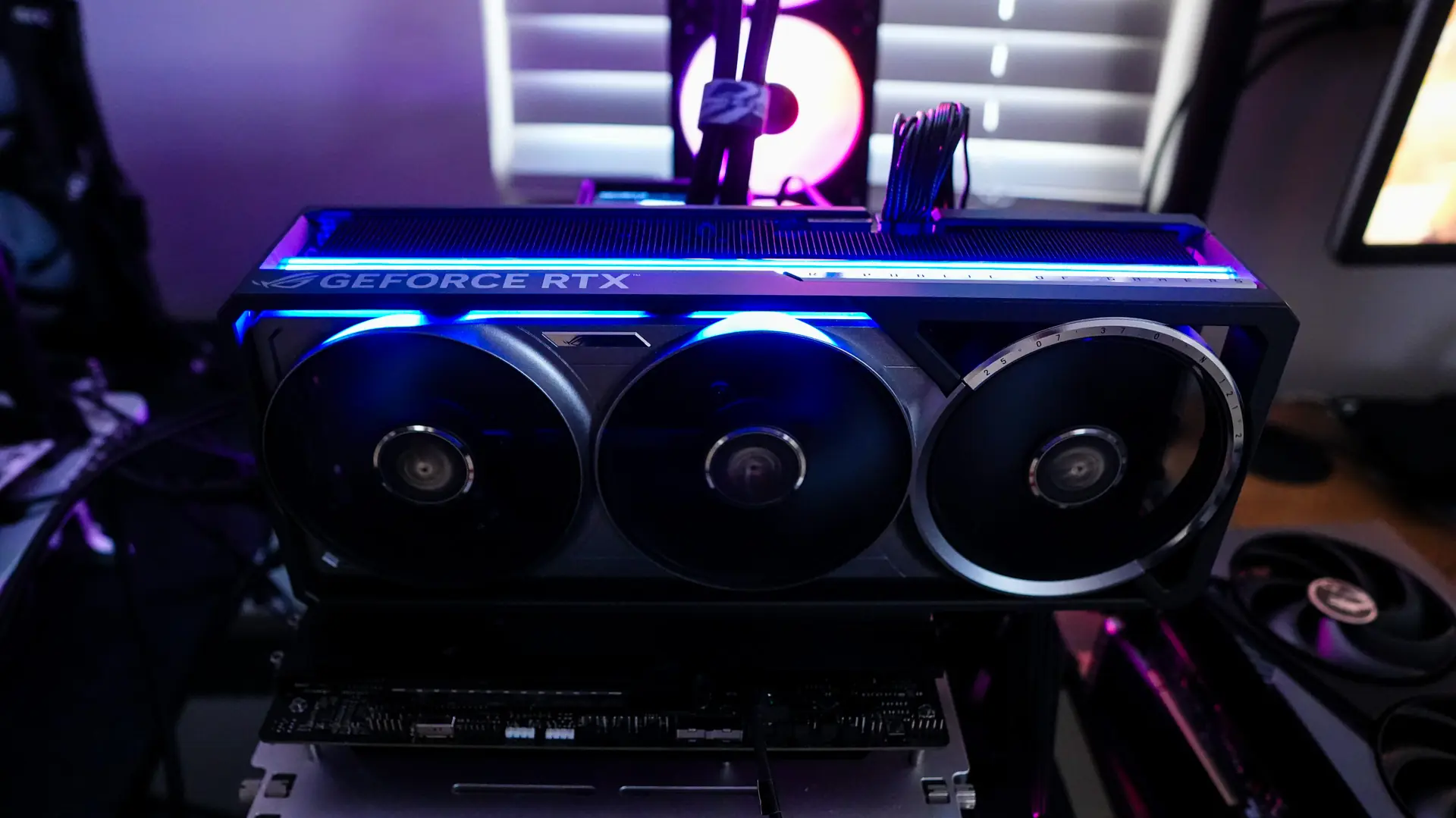
So let’s talk about ASUS’s Astral card specifically. This will be their highest-end card and it is quite interesting that in the 5080 series we haven’t seen a Strix card from them. I would expect that is coming? Being the highest-end card ASUS really pulled out all of the stops here. The card is massive and just screams quality. The all-metal design of the card really puts it on another level. Other cards may have a metal backplate, but here even the shroud itself is metal. Another thing that stands out about this card is how ASUS has made the heatsink matte black, its just different from what we’ve seen before.
Talking about what’s different ASUS has added a 4th fan to this card. This definitely helped as you could see in the thermal performance of the card, although noise levels were a bit loud. You can of course use the switch on the card to put it in quiet mode if it is too loud for your liking. You can’t forget many of the under “under the hood features” like the extra thermal pad for the 12VHPWR power connection, the fact you can actually monitor each pin on that connector via the GPU Tweak III software, as well as all of the temperature sensors on the card, and the PCB coating. Finally you have an increased power limit on the card and the factory overclock. With a GPU boost of 2760 MHz it is the highest clocked RTX 5080 we’ve taken a look at and you can see in our results that is going to get you a few more FPS in games.
Now here is the bad part, the price. When the ROG Astral RTX 5080 launched it was priced at $1499, which is was already a pretty excessive markup on the $999 MSRP of the RTX 5080 Founders Edition. Since the launch we’ve seen the price increase at a whopping $1649! We’ve seen this increase not only from ASUS, but also MSI. I am not sure if this is to prepare for possible tariffs or just for the scarcity of RTX 50 series cards at the moment. Even at the $500 markup it is hard to justify the price when that $500 can go quite far towards more memory, a higher capacity SSD, and more.
There is no doubt this card is going to be one of the best RTX 5080’s you are going to be able to find, but it is really hard to stomach the price. And that is just kind of where we are at. ASUS is not completely to blame here, take from that what you will. I do feel like they put everything into this card and it has features you just won’t find on other flagship RTX 5080’s.
Pros:
– High-end design with all metal parts
– 12VHPWR live pin monitoring + extra thermal pad
– 4 cooling fans
– High overclock (2760 MHz) & increased power limit
– PCB coating
– At least some cool accessories
– Matte design on the heatsink
– Additional HDMI port
Cons:
– Price
– A bit loud