AI coding tools now generate a working React Native app from a prompt. Founders describe the screens they want, and platforms such as Lovable, Bolt, and Cursor return a running iOS and Android build in days, no development partner involved. For validating an idea or showing investors a live product, the approach fits.
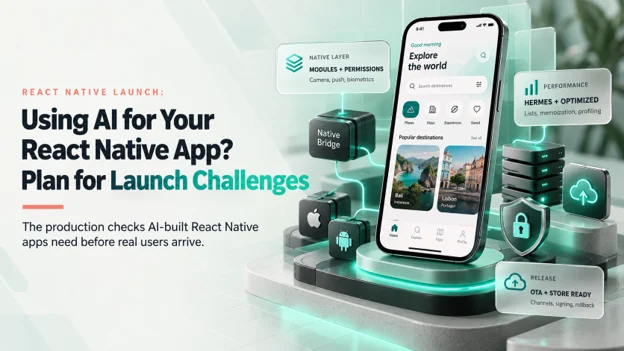
React Native runs JavaScript on top of a native layer, and the parts that decide whether an app survives store review and the first month of real use sit in that native layer. This article covers the launch challenges specific to an AI-built React Native app and the checks that close them.
Where AI Coding Tools Help, and Where They Stop
AI generators write JavaScript and JSX well, producing components, navigation, and styling that match the prompt. For a single-user walkthrough that output looks finished.
What they skip is the work around the JavaScript: native module setup, release configuration, store metadata, performance tuning, and tests. None of it shows on one phone, so the gaps stay hidden until the app reaches an audience.
Six React Native Launch Challenges AI Code Skips
The gaps cluster in predictable places for React Native, each with a known production fix.
1. The Native Layer Beyond JavaScript
Camera access, push notifications, biometrics, and background tasks all need native modules and platform permissions. AI-built apps often assume a feature works from JavaScript alone, then fail on a device.
A team confirms which capabilities need native code, chooses between Expo and a bare workflow, and declares the permissions each platform requires.
2. Performance on Real Devices
A list that scrolls smoothly with ten items stutters with a thousand. Generated code tends to render long lists with plain array maps and re-render whole screens on small state changes.
Production work replaces those with virtualized lists, memoized components, and the Hermes engine, then profiles on a low-end Android device.
3. Release Channels and Over-the-Air Updates
React Native supports over-the-air JavaScript updates through tools such as EAS Update, but native changes still need a new store build. AI output rarely sets up release channels, version gates, or a rollback path.
Teams configure these so a bad update can be pulled without a fresh review cycle.
4. Offline Behavior and Unreliable Networks
Mobile users lose signal and switch networks mid-session. An app tested only in a fast preview has no plan for a request that hangs or fails.
Offline states, timeouts, and retry logic keep the app usable, and payment or booking calls need idempotency so a retried request does not charge a customer twice.
5. Secrets Inside the JavaScript Bundle
A React Native bundle is readable once extracted from the app package, so any API key shipped in the JavaScript is exposed. Generated apps often place keys in the client and call a hosted database directly.
Production teams move sensitive calls behind a server, enforce access rules at the data layer, and keep secrets out of the bundle.
6. Store Review and the Build Pipeline
Apple and Google reject builds over signing errors, missing privacy disclosures, undeclared permissions, and unsupported OS targets. AI tools do not produce provisioning profiles, store listings, or a build pipeline.
A team sets up signing, an automated build such as EAS Build, and the required metadata before the first submission.
A React Native Launch Checklist
Before an AI-built React Native app opens to real users, a team can confirm each gap is closed with the items below.
| React Native Launch Checklist |
| ☐ Native modules and platform permissions verified on real devices |
| ☐ Expo vs bare workflow chosen for the app’s native needs |
| ☐ Lists virtualized, components memoized, and Hermes enabled |
| ☐ Profiled on a low-end Android device, not only a simulator |
| ☐ Over-the-air update channels and a rollback path configured |
| ☐ Offline, timeout, and retry behavior defined for each flow |
| ☐ Idempotency keys applied to payments and bookings |
| ☐ API keys removed from the JavaScript bundle |
| ☐ Access rules enforced on the server and at the database layer |
| ☐ Signing, store metadata, and privacy disclosures completed |
| ☐ Automated tests covering sign-up, checkout, and other critical paths |
5 US React Native Engineering Partners for a Production-Ready Launch
Some teams close these gaps in-house. Others bring in engineers who work in React Native daily. Companies that offer mobile app development services at this stage pair React Native experience with store and performance work, and several let you hire React Native developers as a dedicated team.
The US firms below fit that profile.
1. GeekyAnts
GeekyAnts is an AI-Powered Digital Product Engineering & Consulting Company. It has worked in React Native since partnering with Meta on the framework in 2016 and has built more than 300 React Native applications, with core contributors on the team.
The company maintains the open-source libraries NativeBase and gluestack, the latter a React Open Source Awards winner in 2024. That library work, plus backend, QA, and DevOps under one roof, suits a prototype that now needs native depth and a clean store release.
Clutch rating: 4.9 from 120 reviews
Address: GeekyAnts Inc, 315 Montgomery Street, 9th and 10th floors, San Francisco, CA, 94104, USA
Phone: +1 845 534 6825, Email: [email protected], Website: www.geekyants.com/en-us
2. The BHW Group
The BHW Group is an Austin-based software development company founded in 2005, with a strong focus on mobile and web application development.
React Native is one of its core mobile technologies, and the company also provides product strategy, UX design, backend engineering, and continued post-launch support.
Clutch rating: 5.0 from 24 reviews
Address: 1400 Lavaca Street, Suite 100, Austin, TX 78701, USA
Phone: +1 512 220 0035
3. AppZoro Technologies
AppZoro Technologies is an Atlanta-based development firm founded in 2014, with mobile app development as its largest service line alongside custom software, IoT, and web work.
React Native and cross-platform delivery sit within that mobile focus, and a team of 10 to 49 fits startups extending an early build toward real devices, store approval, and hardware integrations.
Clutch rating: 4.7 from 23 reviews
Address: Atlanta Tech Village, 3423 Piedmont Rd NE, Suite 320, Atlanta, GA 30305, USA
Phone: +1 678 462 4034
4. INTERSOG
INTERSOG is a Chicago-based software engineering firm founded in 2005, with services across mobile, AI development, application testing, and IT staff augmentation.
Its testing and augmentation model gives a team with a working React Native build extra engineering and QA capacity before a wider release. Beyond Chicago, the firm runs offices in Austin, Guadalajara, and Vancouver.
Clutch rating: 4.7 from 12 reviews
Address: 220 N Green St, 2nd Floor, Chicago, IL 60607, USA
Phone: +1 833 468 3776
5. Bottle Rocket
Bottle Rocket is a Dallas-area digital product agency founded in 2008, with mobile app development as its largest service line alongside AI consulting and digital strategy.
For a consumer React Native app, the agency also offers app marketing, extending its role past launch into acquisition and retention.
Clutch rating: 4.6 from 5 reviews
Address: 14841 Dallas Parkway, 8th Floor, Addison, TX 75254, USA
Phone: +1 214 310 1800
Conclusion
AI coding tools have shortened the path from an idea to a working cross-platform prototype. The path from that prototype to an app the stores approve and users trust runs through the native layer, where generated code is thinnest. Permissions, performance on low-end hardware, update channels, network handling, secret storage, and store compliance all sit outside a demo.
Teams that plan for the launch treat the generated app as a validated design and a set of requirements. They confirm native features, profile on real devices, move secrets off the client, and set up signing and updates before opening sign-ups. Working through those checks first costs less than a rejected build or a public failure afterward.