


Gigabyte Z170N-Gaming 5 Overview
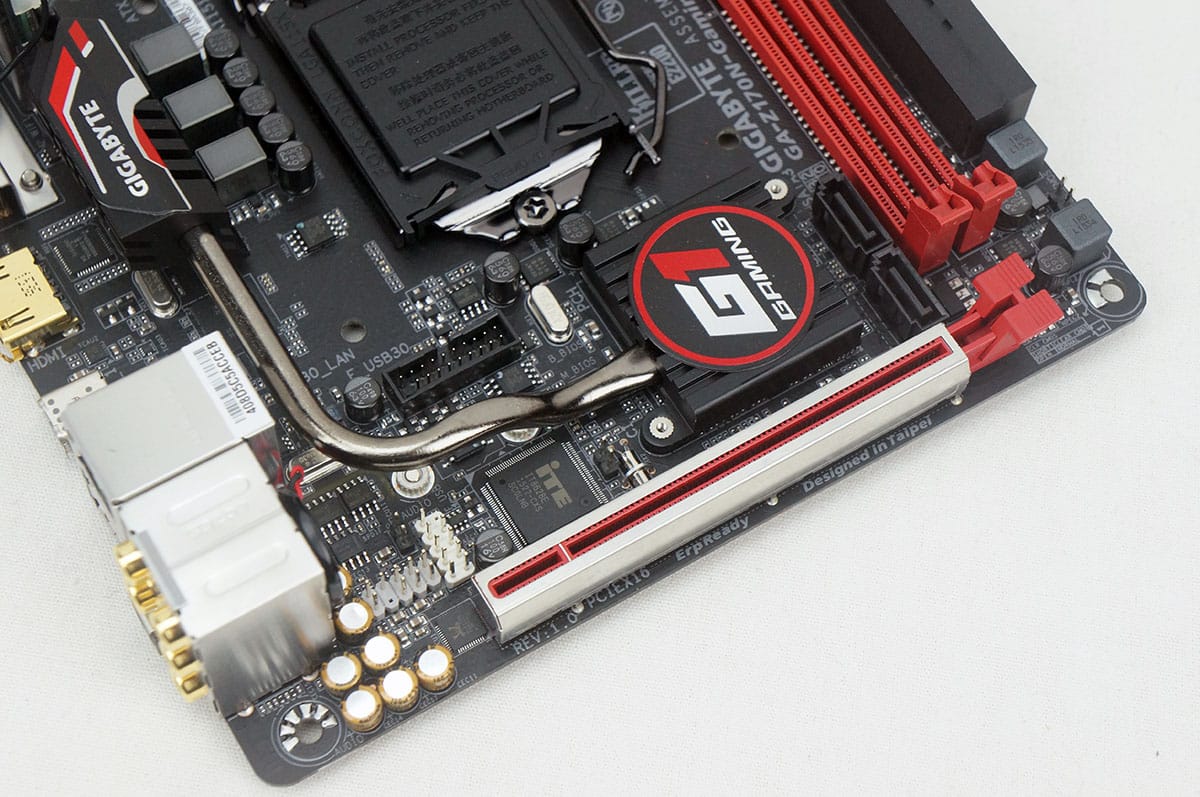
The Z170N-Gaming 5 is a mini-ITX motherboard so it is very small. If you didn’t know all mini-ITX motherboards are 17.0cm x 17.0cm. This is a G1 Gaming motherboard so it follows the black and red color design that we’ve seen on other current G1 Gaming boards. There is even a G1 Gaming logo on one of the heatsinks.
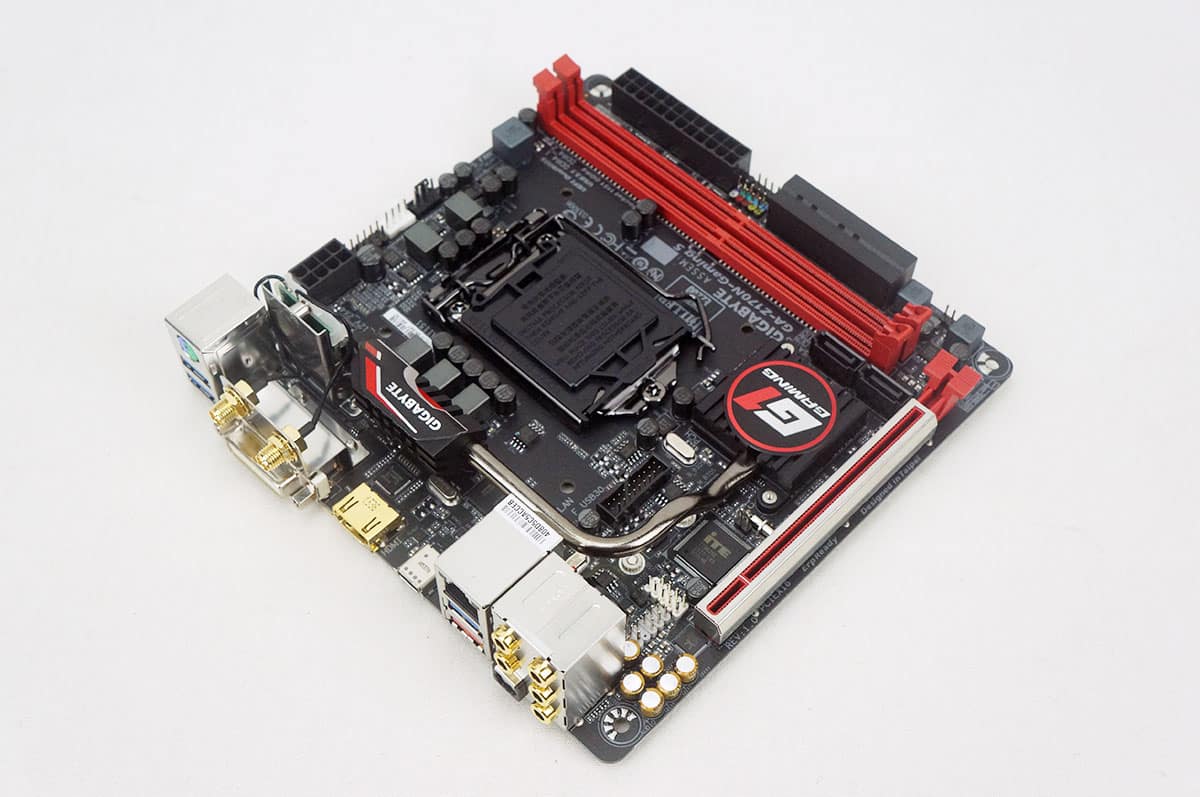
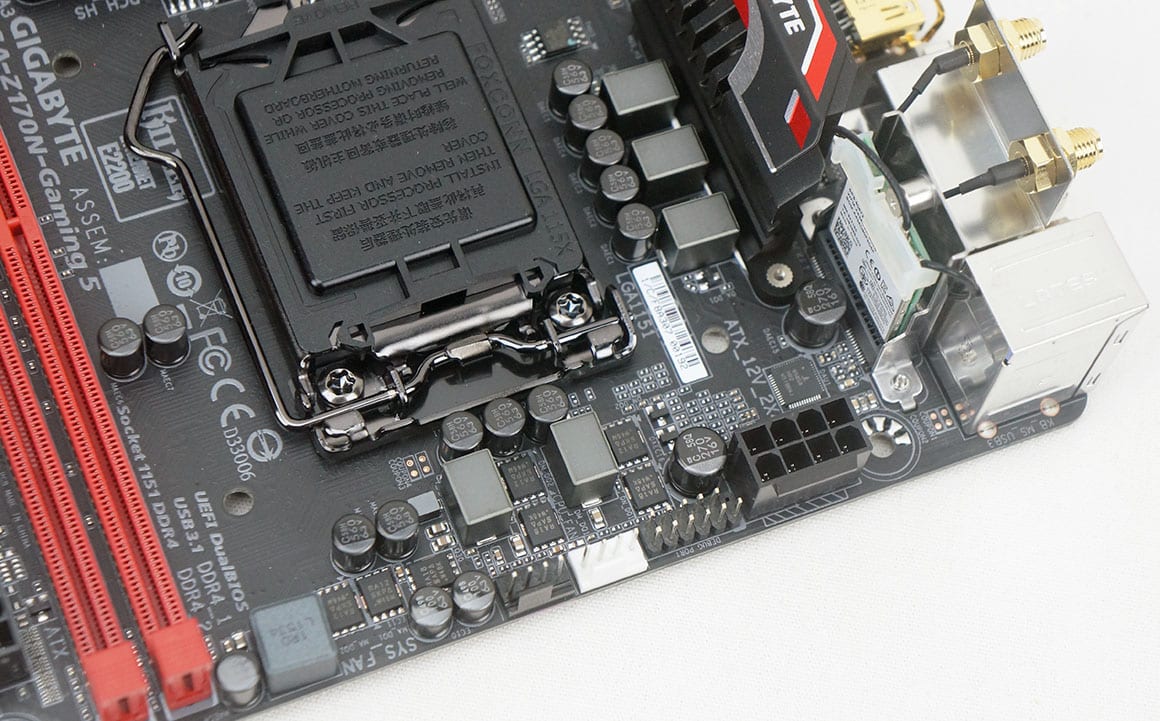
Starting at the center of the board we have the Intel 1151 socket, which supports Intel’s 6th generation Core Skylake processors. Conditioning the CPU is a 5-phase VRM. The power delivery components are covered by a small heatsink, which connects to the PCH heatsink by a pretty hefty heatpipe. All around the board you will see long lifespan durable 10K black solid caps.
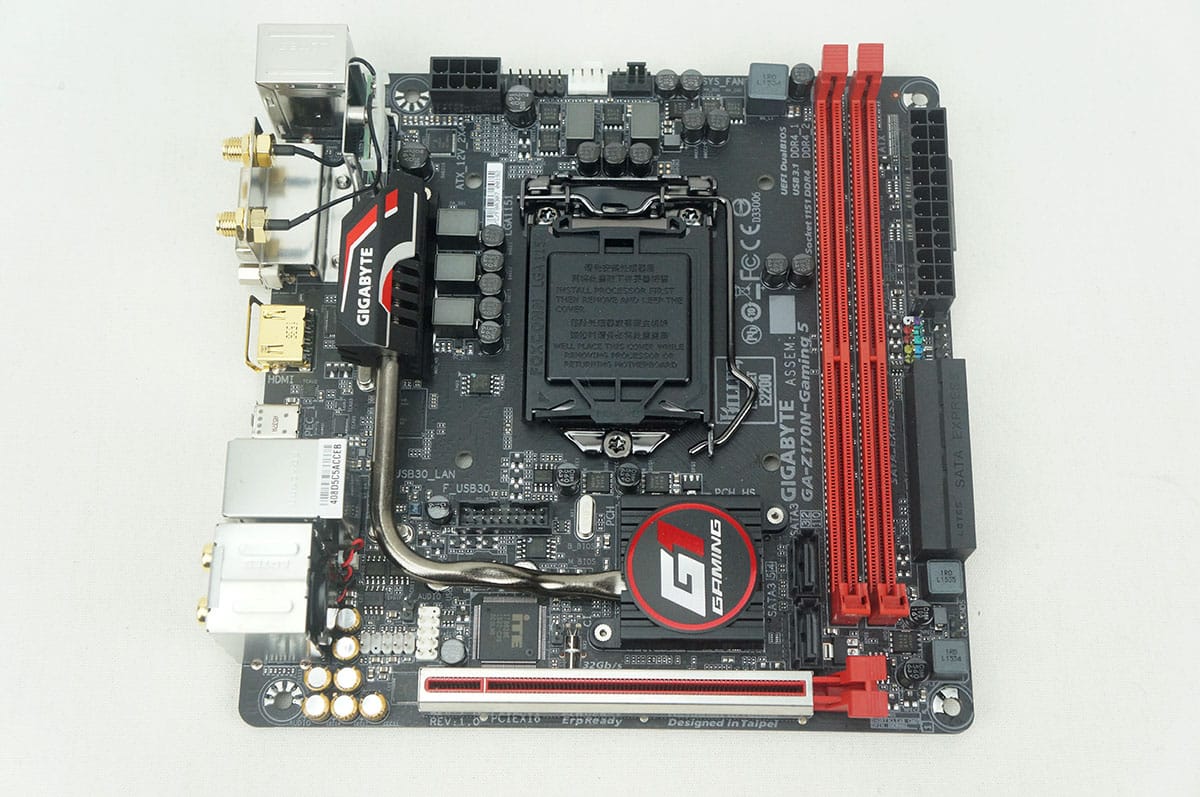
Above the CPU socket we find the 8-pin EPS connector, a 4-pin CPU fan header, and a 4-pin system fan header.
Moving over to the far end of the motherboard you have your 24-pin ATX power connector, front panel headers, two SATA Express ports, and a clear CMOS jumper. Keep in mind that if you don’t plan on using SATA Express that opens up four SATA 6GB/s ports. I never like to see clear CMOS jumpers these days, buttons are just so much easier for the user, but I can see why Gigabyte went with a jumper here. Behind the ports you have your two DDR4 DIMM slots. The board supports up to 32 GB of DDR4-3300 (O.C.) memory.
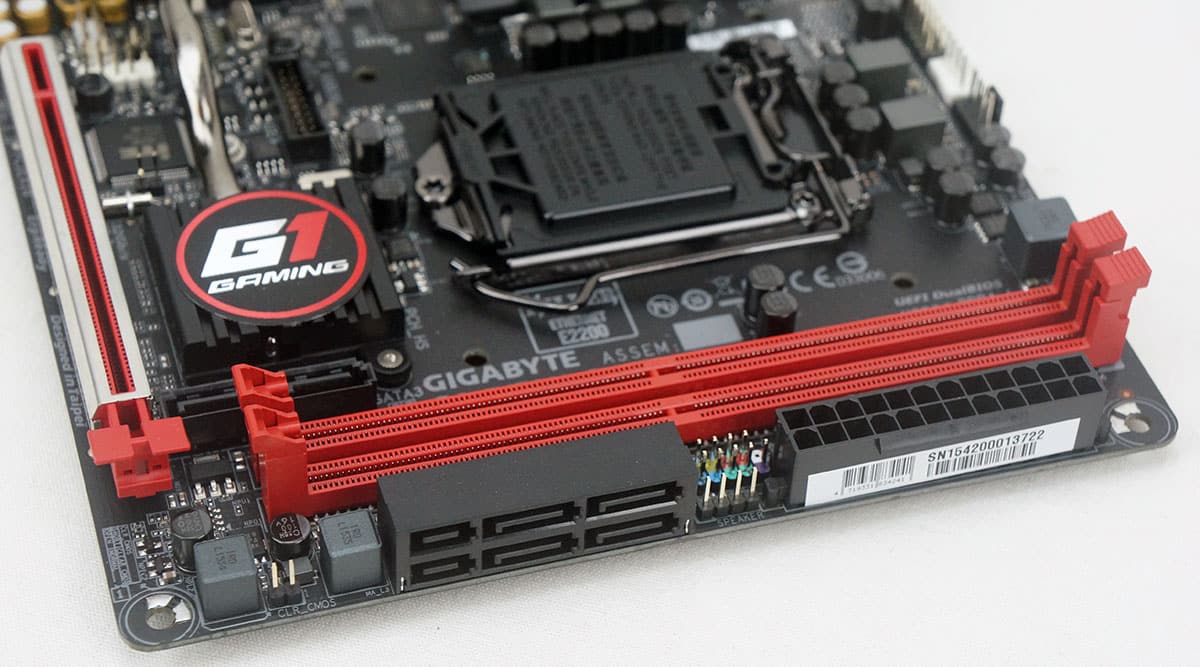
Right behind the DDR4 DIMM slots are two SATA 6GB/s ports. So if you count the ones on the SATA Express ports you have a total of six SATA 6GB/s ports. Along the bottom of the board is the PCI-Express 3.0 x16 slot. This of course is the only PCI-Express slot on the board. Gigabyte has added their metal shielding to the slot, which reinforces and protects the PCI slot. Above the slot to the left are headers for front panel audio and USB 2.0. Moving up a little bit there is a USB 3.0 header as well.
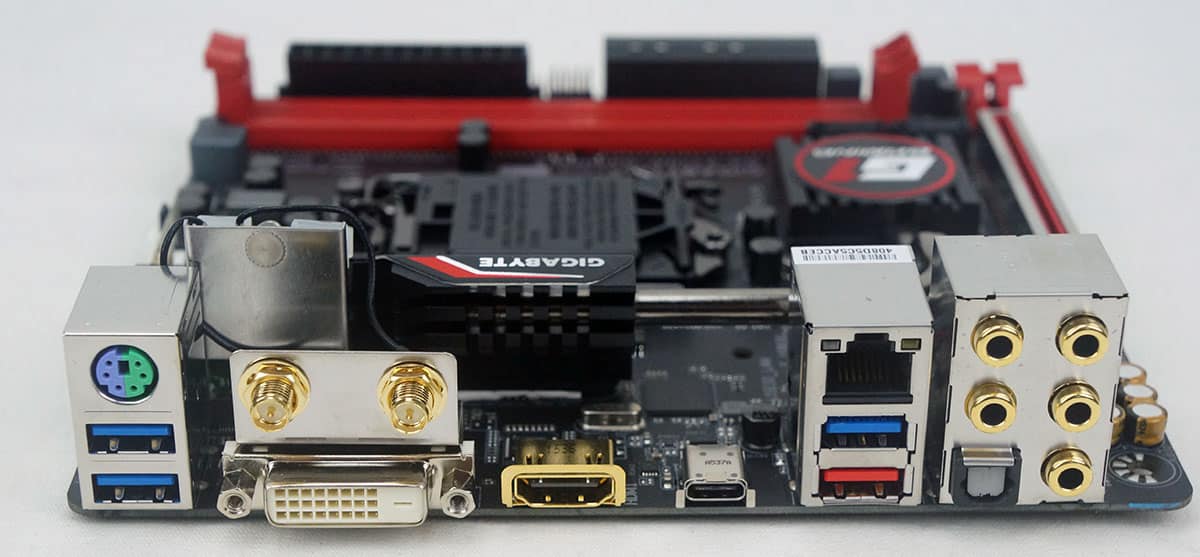
Looking at the rear I/O, from left to right you have a combination PS/2 port, two USB 3.0 ports, antenna connectors for the WiFi and Bluetooth, DVI, HDMI, USB 3.1 Type-C, Gigabit Ethernet powered by Killer’s E2200 chip, a third USB 3.0 port, a USB 3.1 Type-A port (red), and your audio connections. The audio connections as well as the HDMI port are gold plated.
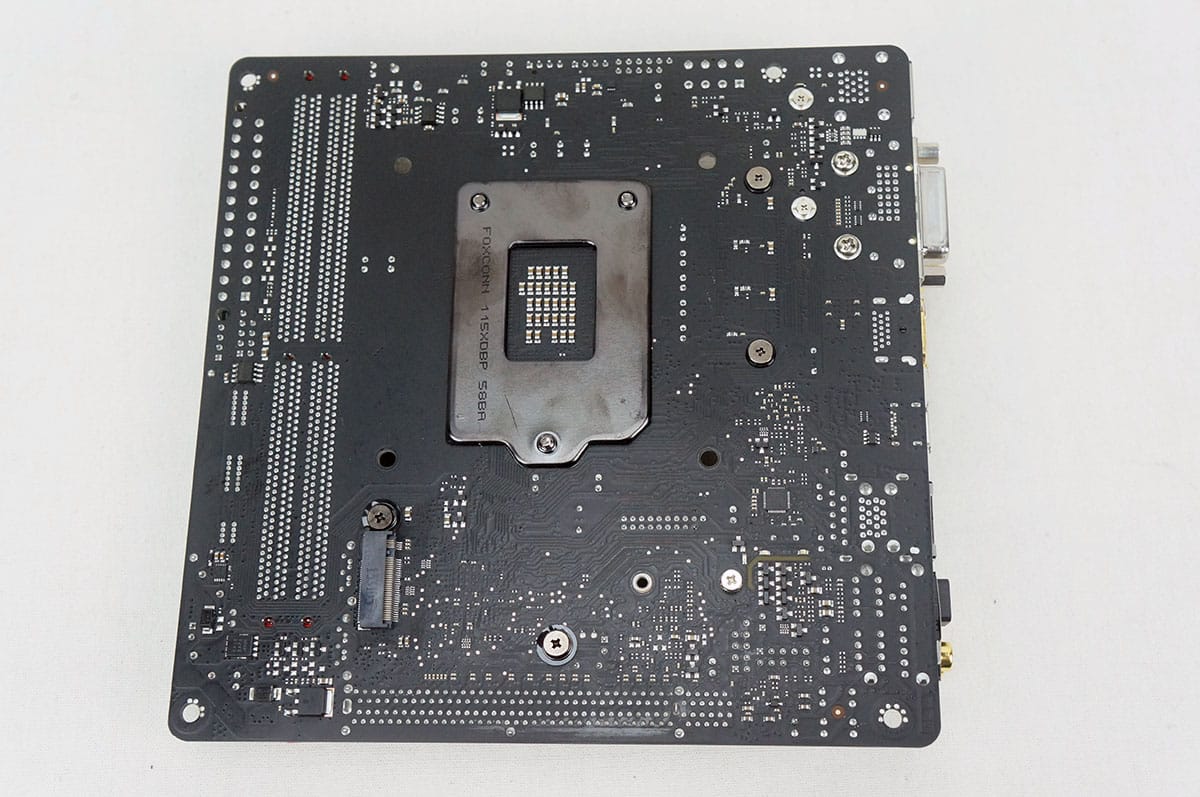
Flipping the board over we find the M.2 slot. This is a PCI-Express 3.0 x4 slot so you get up to 32 Gb/s of bandwidth! This slot means that you can have an M.2 SSD installed and don’t even have to worry about any other drives.

But how is the Wifi on it? I can see that you tested the LAN but what I’m really looking for is information on how good is the built-in wifi adapter.
I haven’t done any kind of testing of anything specific, but I was able to play Rocket League over the wi-fi in a busy hospital, so it can’t be terrible.
They’re marketing to a clueless audience. You can’t build a good gaming rig in most if not all ITX cases because they don’t have good enough airflow for mid to high end CPU and video cards. Then again a decent video card will be full height so the case at least has to accommodate that unless you get some kind of right angle riser board or cable involved, which means there would be enough space to stuff a 120mm fan on the side, cutting a hole for it if the case didn’t have a mount there already.
Besides the better than avg. integrated audio, this board makes more sense to me as a NAS or fileserver board, where you use the integrated video which otherwise is more of a waste of I/O panel space than a benefit, and stuff an SATA RAID card into the 16X PCIe slot, then underclock the CPU to reduce cooling and power consumption, EXCEPT the problem with this is that the board is bound to cost at least twice as much as other boards that are almost as capable for that purpose, and a multi-drive 3.5″ HDD capable case tends not to be ITX so the size reduction basically only takes away a few PCIe slots that could be used for any features the board lacked and still come in under the cost of the Z170N.
In the end I suspect that Gigabyte thinks they can make gamers pay more for less, that they don’t have any common sense or something, lol. However I wouldn’t mind this board for a HTPC if the video could do 4K @ 60Hz, but it can’t even do a lowly 30Hz:
Quote Gigabyte Product Page: “Integrated Graphics Processor-Intel® HD Graphics support:
1 x DVI-D port, supporting a maximum resolution of 1920×1200@60 Hz
1 x HDMI port, supporting a maximum resolution of 4096×2160@24 Hz
* Support for HDMI 1.4 version.
are audio connections rca or 3,5mm jack input?
The USB 3.0 connector on the motherboard is placed in the wrong place. I ruined my connector once I attached my CPU cooler.
Node 304. 1050 Ti 4GB. SF450 PSU. One SSD. One HDD. Skylake i5. 16GB RAM. With this setup, you can literally build a shoebox for a grand and change that will run anything pre-2015 at 1080P with decent framerates. And the cooling will be pretty decent, too, since the CPU and GPU together won’t pull more than 140W combined and the total theoretical maximum power draw will be less than 250W. Hell, I’m planning this exact build for my birthday since my laptop’s measly 840M is long obsolete.
I LOL’d at NAS board. I have this board with i7 6700k OC’d to 4.6GHz, a GTX 1080 installed, in a silverstone RVZ01 case. CPU temp never exceeds 65C at gaming for hours.
You must be living under a rock or sumthing mate!
WHAT????????????????
Node 304 with a 1070 here. What the hell are you talking about, dude? With a Noctua U12 I never exceed 62°C in game.
Admit it, little child: you know jack squat about rig building. FFS, go back to playing on your Xbox One and leave gaming builds to adults: you’re pathetically embarassing…
Do not waste time with him, he probably owns a Vibox prebuilt PC or something of equally abysmal quality.
You’re an idiot.