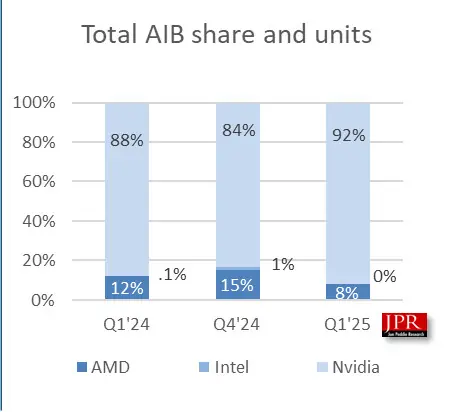
NVIDIA has solidified its dominance in the AIB GPU market, capturing an astounding 92% share in Q1 2025. This significant increase comes at the expense of competitors AMD and Intel, who saw their market shares decline to 8% and 0% respectively, according to recent data from Jon Peddie Research.
NVIDIA’s Unprecedented Market Share
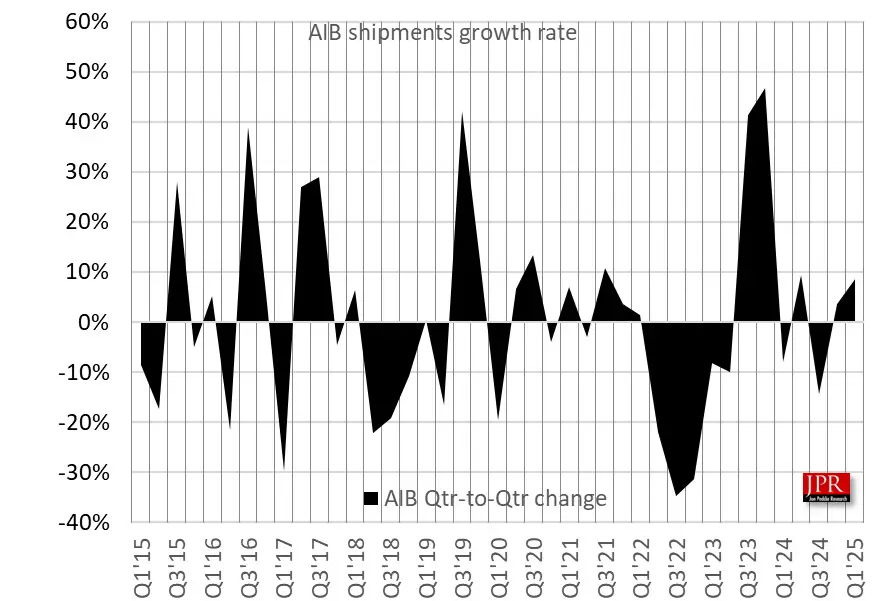
NVIDIA’s market share in the AIB (Add-in Board) GPU sector surged by 8.5% in the first quarter of 2025, reaching an impressive 92%. This substantial growth is attributed to the successful launch of its RTX 50 series GPUs. In contrast, AMD’s share plummeted by 7.3% to just 8%, while Intel’s market presence in this segment completely vanished, dropping by 1.2% to 0%.
Competitor Performance
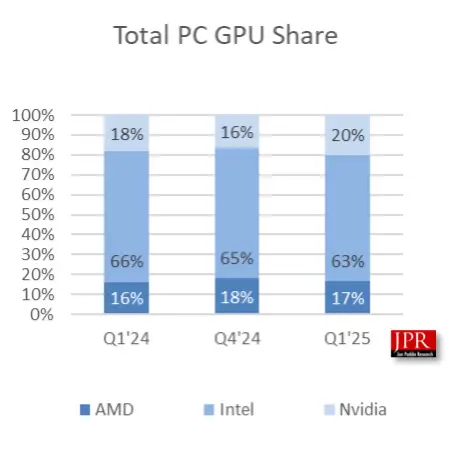
Despite launching its new Battlemage series B GPUs in Q4 2024, Intel failed to gain traction in the AIB GPU market. AMD followed with its RDNA 4 lineup in late Q1 2025, but it was not enough to stem the tide against NVIDIA’s overwhelming lead. The overall PC GPU market experienced a 12% decline compared to the previous quarter, with 68.8 million units sold. The CPU market also saw a decrease, with 61.9 million units shipped.
Key Takeaways
- NVIDIA’s AIB GPU market share reached 92% in Q1 2025.
- AMD’s share dropped to 8%, and Intel’s to 0% in the AIB GPU market.
- The overall PC GPU market saw a 12% quarter-over-quarter decrease.
- NVIDIA’s RTX 50 series contributed significantly to its market dominance.
- Intel’s Battlemage GPUs did not impact market share positively.
Broader Market Trends
The AIB market reached 9.2 million units in Q1 2025, while desktop CPU shipments decreased to 17.8 million units. Jon Peddie Research forecasts a compound annual growth rate of -10.3% for the AIB market from 2024 to 2028. The overall PC GPU market, including integrated GPUs, also saw a decline. Interestingly, data center GPUs experienced a 9.6% growth, primarily driven by the increasing demand for AI applications. In the CPU market, AMD has been steadily gaining ground against Intel in the desktop segment, now holding 40.31% compared to Intel’s 59.69% according to the May 2025 Steam Hardware Survey.