


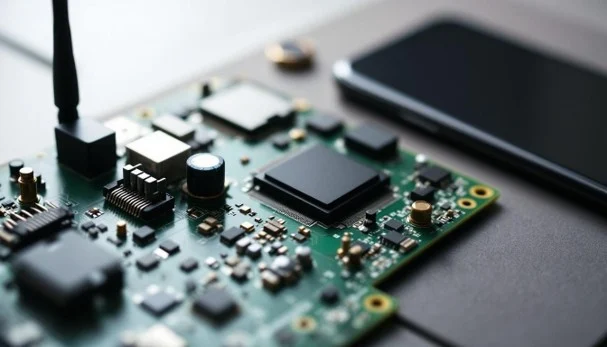
Broadcom’s BCM47755 is a small chip that listens to two satellite signals at once. The company announced it on September 21, 2017, at the ION GNSS+ conference in Portland, Oregon, as the first mass-market receiver to use both L1 and the newer L5. IEEE Spectrum reported that it promised phones 30-centimeter accuracy, against the 5 meters common then. The chip locks on with L1 and refines its fix with L5, whose short pulses suffer far less from reflections off buildings, and a move to a 28-nanometer process helped cut its power draw by about half.
What the operating system gets from all that is a position and a measure of doubt. Android hands apps a horizontal accuracy radius in meters, which Google’s documentation defines as the distance within which there’s a 68% chance the device really sits. For years that radius mostly decided whether a map showed a car on the highway or on the road beside it.
It now settles something with money attached. A US sportsbook has to confirm that a customer is physically inside a state where it holds a license before the account can bet or take up a promotion, and operators hire specialists for the check. One of them, GeoComply, said in a July 2026 post that the 2026 Super Bowl produced 81.4 million geolocation checks on game day alone. In a June 2016 overview, the same company had put its volume at over 60 million transactions a year.
Satellites alone rarely place a phone indoors
The 30-centimeter figure assumed open sky. Broadcom’s Manuel del Castillo told IEEE Spectrum that a city’s narrow window of sky showed six or seven of the roughly 30 L5 satellites then in orbit, a count he called “pretty good.” Walls and roofs block much of what’s left. A phone that trusted satellites alone would lose its fix every time its owner walked into a train station or an office lobby.
So phones blend sources. Google’s fused location provider, part of Google Play services, combines GPS with Wi-Fi and other signals and hands an app one answer, and the accuracy radius grows or shrinks as the mix changes. Cell towers add a coarser reading still.
Android also tells an app something about where a fix came from. Since API level 18, an app has been able to ask whether a location was supplied by a test provider, the kind developers use while building map features. The current method is called isMock, and Google’s reference page warns that such a location “may not be related to the actual location of the device.” Any app that needs a real position can read that flag and treat the fix accordingly.
A desktop PC has to be located another way
Microsoft’s support page for the Windows location service says a PC can draw on GPS, nearby wireless access points and routers, cell towers and the IP address. A typical desktop build has no GPS receiver and no cellular modem on its board. That leaves two sources, the Wi-Fi card and the network address.
Sportsbook websites fill the gap with an installed program. theScore Bet’s help page says the company is “required to verify your physical location during use,” and that on desktop it does this through GeoComply, its third-party location service. A first-time user gets a prompt to install the GeoComply plug-in, with separate installers for Mac and Windows, and the browser needs its own location permission too. The same page warned desktop Firefox users that version 144 would ask them to grant Local Network Access before any location data could be retrieved.
The reason for that machinery is written into the offers themselves. An “Age and location” entry follows each of the five welcome offers on the sports betting promos page, and that one sentence decides who may take an offer up. Each entry names a minimum age, 21 on most of them (the bet365 entry allows 18 in D.C.), and requires physical presence in a legal state where that operator is licensed.
The plug-in handles the second half of the sentence. GeoComply’s 2016 overview said its software “collects Wifi, GPS, GSM, and IP location data” from a device and cross-references them, so no single source settles the answer by itself. On a desktop, the richest of those sources is usually the wireless card.
A motherboard’s Wi-Fi module hears networks it never joins
ThinkComputers’ July 2026 review of the ASRock B850 Challenger WiFi White lists 802.11be Wi-Fi 7 and Bluetooth among the board’s features, and the Wi-Fi antennas came in the box beside the SATA cables and stickers. The builder screws them onto the rear panel to reach a router. On a machine like that, the wireless module is also the nearest thing the PC has to a location sensor.
It locates by listening. Routers broadcast their presence, and a scan collects the hardware address of each access point in range, its BSSID, along with how strong the signal is. Joining a network isn’t required; positioning systems gather identifiers from every access point a device can hear.
Microsoft is open about its side of this. When location services are on, it says, Windows sends nearby access points, routers, cell towers and the IP address to Microsoft after stripping data that identifies the person or device. Its database may include the MAC address of someone’s router and of neighboring network devices.
A tower wired only by Ethernet, with no wireless card fitted, gives a check far less to work with. Of the sources on Microsoft’s list it has the IP address, which describes the network a connection leaves through and says much less about the room the computer sits in.
Every signal can mislead, so the checks compare them
A Wi-Fi scan turns into a coordinate through a lookup. As Krebs on Security explained in May 2024, Google’s positioning system takes a device’s list of nearby BSSIDs and their signal strengths and replies with a computed position, and it needs at least two access points to produce one. Each of the other signals has a weak spot of its own.
| Signal | What the device reads | What can mislead it | What the check does then |
| Satellites | Timing signals on L1, plus L5 on newer chips | Walls, roofs and reflections off tall buildings | Leans on the radio signals around the device |
| Wi-Fi scan | Each nearby access point’s BSSID and signal strength | Too few mapped access points nearby | Weighs the lookup against the other sources |
| Cell network | The towers within reach of the phone or modem | Coverage areas far wider than one building | Treats it as a rough area |
| IP address | The public address the connection leaves through | VPNs and proxies that route traffic elsewhere | Blocks wagering until they’re closed, per theScore Bet |
| Running software | Programs open beside the location check | Remote desktop tools that let another machine drive the PC | Fails the check while they run, per theScore Bet |
GeoComply’s 2016 overview named proxy, VPN, malware and “enhanced remote desktop detection” among its tools. theScore Bet’s help page names a humbler culprit. Zoom, running alongside the location check, has caused problems for some users.
A system that compares sources treats a conflict between them as evidence. A Wi-Fi scan that places a laptop in one state while its IP address exits in another is the kind of mismatch cross-referencing can expose, and the overview pitched its multi-source method for that sort of fraud detection.
A passed check holds for the moment it ran
Returning desktop users at theScore Bet are asked to allow the check again through a browser pop-up, so a pass is a snapshot. A laptop that clears the check in one licensed state can fail it after a drive across a state line, and the promotion on that account stays bound by the same “Age and location” sentence wherever the laptop ends up.
A post on X is another matter. Twitter removed precise geotags from most posts in June 2019, and one from LineUps on X reads the same on both sides of that state line.
Time puts its own pressure on the systems. GeoComply’s July 2026 post said its traffic can sit flat and then “spike 10x in the next second,” and it wrote that when a goal is scored, “the market moves in seconds.” Millions of fans, by its account, open their apps when a big game kicks off and again “when something changes the course of play.”
Super Bowl game day, with its 81.4 million checks, was the largest case the post described. The company said it runs roughly three times its usual count of server instances at Super Bowl levels, and that the 2026 World Cup, spread over six weeks of games, had come in below that peak by early July.
A line that moves in those seconds gives a different price. That price still carries the operator’s margin, and a stake placed at it can be lost like any other.
Windows lists every app that has asked where the PC is
Windows keeps the controls in one place. Its Location page in Settings lists the apps that have asked for location, and Microsoft says apps requesting Wi-Fi APIs that can reveal a position appear there too. So in Microsoft’s own accounting, a Wi-Fi scan is location data. Turning the service off has a cost, since Microsoft says some apps may then lose access to information about Wi-Fi networks. Router owners get a separate choice, because Microsoft runs an opt-out for anyone who wants an access point’s MAC address kept out of its location database.
Someone who opens a sports app mostly for scores and highlights can decline the prompt and see what still works. Someone who wagers in a licensed state accepts the check along with the account, and the narrower choice left is whether to leave the permission and the plug-in in place between sessions or switch them off after the final whistle. theScore Bet’s help page doesn’t say how long a sportsbook keeps the location data from each check. That answer belongs in each operator’s privacy policy, which a customer can open before the first click on Allow.