As cyber threats scale in complexity and volume, procurement officers, CIOs, and IT directors face an enterprise authentication crossroad: Should you rely on software-based authenticators or commit to physical hardware?
For years, software-based Multi-Factor Authentication (MFA) via mobile push apps or SMS codes was marketed as the ultimate compromise between scalability and security. However, with the rise of automated Adversary-in-the-Middle (AiTM) phishing kits and relentless “push bombing” attacks, the illusion of software security has vanished.
Today, evaluating authentication solutions is no longer just an operational decision—it is a critical exercise in corporate risk management. This guide breaks down the financial and operational trade-offs of modern authentication architectures to help procurement and IT leaders select the right FIDO2 hardware for their enterprise stack.
Software SaaS vs. Physical Hardware: The Procurement Reality
When comparing cloud-managed authenticator apps against dedicated physical hardware, IT buyers must weigh three key variables: phishing resistance, operational friction, and overall cost of ownership.
| Feature | SaaS / Mobile Authenticator Apps | Physical FIDO2 Hardware Keys |
| Phishing Resistance | Vulnerable: Session tokens can be proxied via AiTM phishing | Absolute: Cryptographic private keys never leave physical silicon |
| Hardware Dependency | Dependent on personal or company smartphones (BYOD risk) | Standalone, air-gapped physical authenticators |
| Offline Performance | Requires active cellular data or Wi-Fi connection | 100% offline authentication capable |
| Lifecycle Cost | Low upfront costs; high hidden costs from helpdesk tickets | Capital expenditure upfront; zero vulnerability liability |
While SaaS software apps appear cheaper during initial vendor negotiations, their vulnerability to remote exploitation carries exponential downstream risk. Physical FIDO2 security keys eliminate this remote attack surface entirely by anchoring digital identities in unphishable physical hardware.
4 Crucial Features to Look for in a FIDO2 Security Key
Not all physical security keys are created equal. Buying the wrong hardware can lead to high deployment friction and unexpected lifecycle management costs. When evaluating FIDO2 key vendors, enterprise buyers should insist on four critical capabilities:
1. Multi-Protocol Wireless & Wired Connectivity
Modern hybrid workforces operate across a maze of devices—from desktop workstations without Bluetooth, to sleek laptops with limited USB ports, to mobile tablets. A future-proof security key must support flexible connection modes. Look for keys that offer wired USB options alongside wireless Bluetooth and NFC capabilities, allowing seamless tap-to-sign-in performance across both desktop and mobile environments.
2. On-Board Power Capabilities
Legacy security keys rely strictly on passive power drawn directly from a USB port or NFC reader. For mobile or remote workers attempting to authenticate via wireless protocols, passive keys can introduce connectivity lag or failure. Choosing a key with an internal battery ensures dependable wireless authentication across any workstation setup without draining the host device.
3. Remote Firmware Upgradability (OTA Updates)
The historical bane of hardware deployments has been product obsolescence. Once a traditional security token leaves the warehouse, its firmware is frozen. If a new cryptographic protocol emerges or a firmware bug is discovered, IT departments are forced to execute painful, expensive hardware recalls. Procurement teams should prioritize devices that support Over-the-Air (OTA) updates, allowing administrators to deploy security patches and firmware updates remotely while the hardware stays in the field.
4. Plug-and-Play Integration with Existing SSO
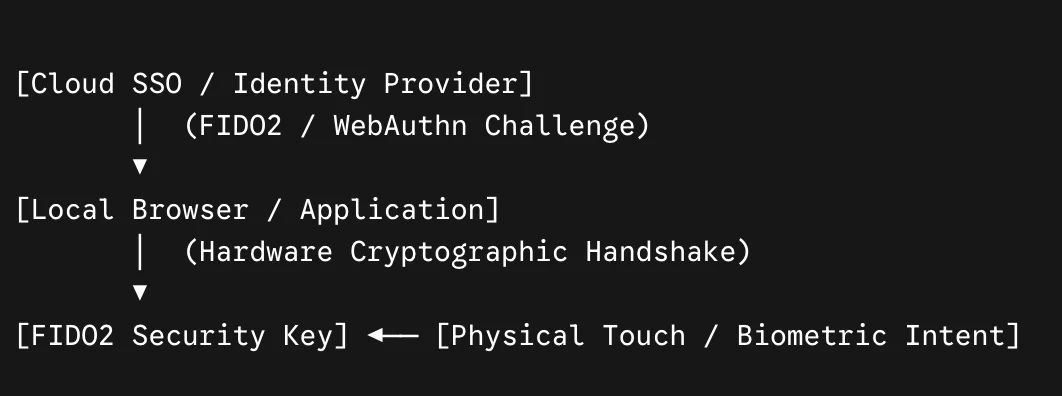
A security key is useless if it requires complex middleware or custom code. Hardware must natively interface with standard FIDO2/WebAuthn identity protocols, guaranteeing out-of-the-box compatibility with central identity providers like Microsoft Entra ID, Okta, and Ping Identity.
Why TokenCore™ Sets the Standard for Enterprise Hardware
For procurement teams and IT architects selecting the hardware path, TokenCore™ represents the benchmark in physical authentication performance.
Designed to deliver plug-and-play simplicity alongside uncompromised hardware security, TokenCore™ solves the traditional pain points of hardware key deployment:
- Wireless Flexibility Meets Universal USB: TokenCore™ products feature built-in Bluetooth and NFC for frictionless wireless authentication across mobile and desktop endpoints, while offering classic USB connectivity for traditional workstation setups.
- Battery-Powered Independence: Unlike passive keys that suffer from intermittent wireless signals, TokenCore™ hardware is battery-powered, ensuring continuous, reliable performance across all wireless access points.
- OTA Updates Minimzing Product Recall: TokenCore™ directly addresses lifecycle management concerns with seamless Over-the-Air (OTA) updates. IT leaders can push firmware enhancements and protocol patches remotely, ensuring the hardware evolves alongside your security stack without costly product replacements or user disruptions.
- Tamper-Proof, Offline Cryptography: TokenCore™ nodes and keys generate air-gapped cryptographic credentials that only release upon a physical touch, guaranteeing that software-based phishing tools are stopped dead in their tracks.
Final Decision: Securing the Corporate Perimeter
Software-based MFA served its purpose in an earlier era of cybersecurity. However, against automated phishing tools and sophisticated credential theft, software apps leave enterprise perimeters exposed.
By investing in physical, FIDO2-certified security hardware, organizations can eliminate remote identity fraud, streamline the login experience, and protect their technology investments for years to come. TokenCore™ offers the exact combination of wireless convenience, battery independence, and remote updates that modern enterprise procurement requires.