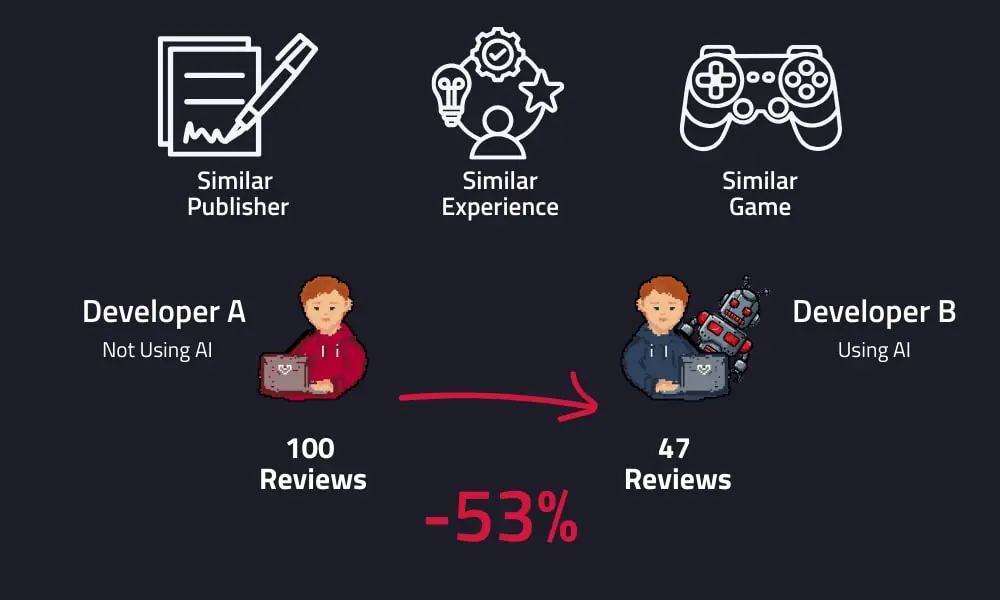
A recent analysis by Game Oracle suggests that the integration of generative AI in video game development is causing a visible “AI stigma” among consumers. By evaluating Steam review data, researchers discovered that games explicitly disclosing the use of AI content received approximately 53% fewer reviews, signaling a substantial decline in player engagement and units sold.
Key takeaways
- Games that disclose AI usage receive roughly 53% fewer reviews than comparable titles.
- Established, large-scale studios experience the most significant drops in sales and reputation when utilizing AI.
- Median positive review scores for AI-assisted titles trail behind human-centric games, sitting at 84.6% compared to 88.3%.
The rise of the AI stigma
For many gamers, the inclusion of generative AI is perceived as a shortcut that compromises the artistic integrity and effort expected from the gaming industry. As major publishers experiment with AI to streamline asset creation, dialogue, and animations, the community has responded with growing resentment. This reaction creates a difficult environment for developers, where the promise of increased production efficiency is overshadowed by a perceived lack of soul or human creativity. Anecdotal evidence from recent high-profile game releases further illustrates that players are increasingly vigilant, often identifying and criticizing AI-generated elements within hours of a launch.
Impact on major studios
While AI-assisted tools might offer functional benefits, the data indicates that major studios are the most vulnerable to the negative shift in public perception. The research found that while smaller developers may lean on AI to make projects viable that otherwise would not exist, larger studios suffer disproportionately. These high-budget projects are held to higher standards, and the “AI label” often correlates with a sharp drop in consumer trust and subsequent sales performance. Essentially, for top-tier publishers, the transition to AI tools currently acts as a liability rather than a competitive advantage.
Understanding the methodology
Since Steam does not publicly disclose exact sales figures, analysts used the number of user reviews as an industry-standard proxy to estimate commercial performance. The study analyzed nearly 10,000 game releases from the past year. By accounting for variables such as publisher backing, genre, and developer experience, researchers were able to isolate the impact of AI disclosure. The findings suggest that when comparing two similar games—one utilizing AI and one developed through traditional workflows—the AI-integrated title consistently captures significantly less player attention, ultimately hindering its success in an increasingly crowded marketplace.
Via Game Oracle