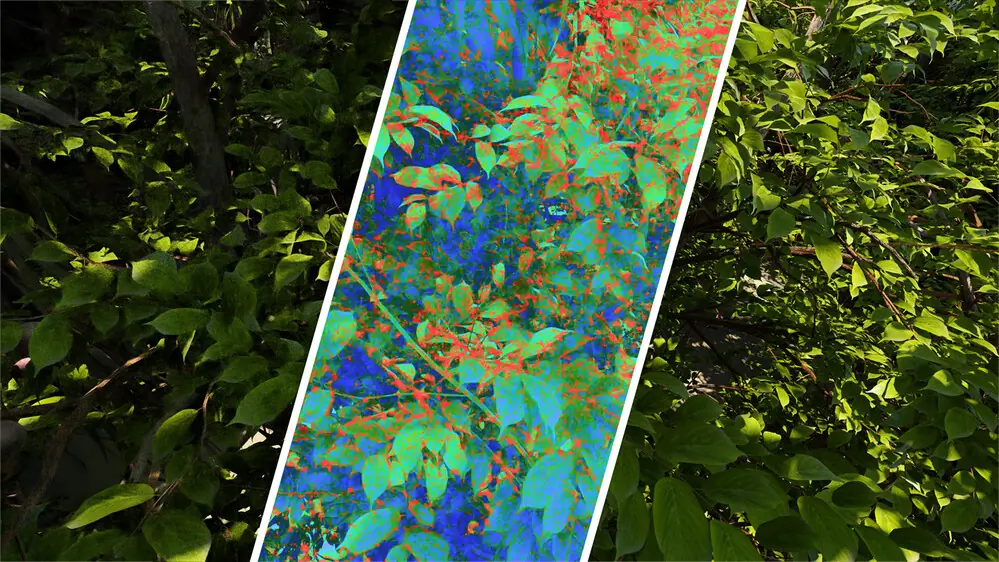
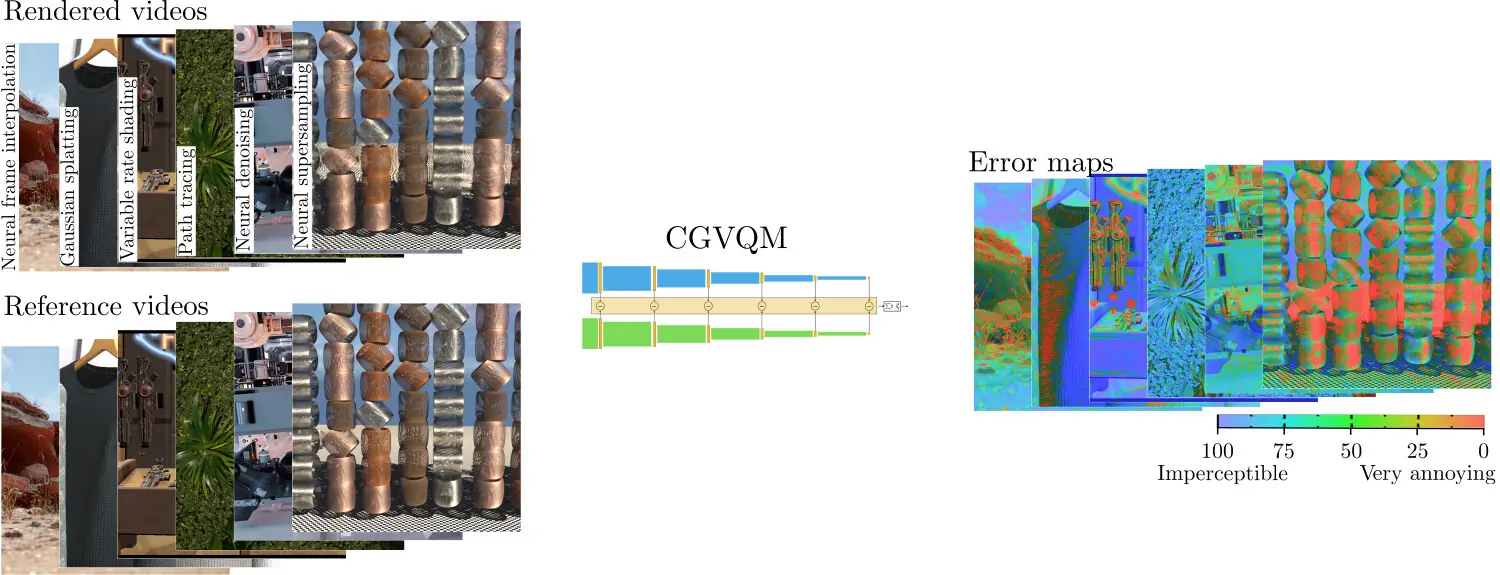
Intel has launched the Computer Graphics Visual Quality Metric (CGVQM), the first open-source AI metric tailored for real-time game visuals. With human-like accuracy, CGVQM analyzes frames from modern rendering pipelines—supersampling, path tracing, frame generation—and produces detailed error maps. Available on GitHub, it integrates with Vulkan and popular engines, enabling developers to assess and optimize image quality on the fly.
Key Takeaways
- CGVQM-5 rivals human evaluations and outperforms existing full-reference metrics.
- CGVQM-2 offers a lightweight, faster variant with competitive accuracy.
- Both produce visual error maps to pinpoint artifacts like ghosting or flicker.
- Integration via GitHub, Vulkan hooks, and engine plugins simplifies adoption.
A New Benchmark For Real-Time Graphics
Intel’s Computer Graphics Visual Quality Metric (CGVQM) addresses a longstanding challenge: objectively scoring modern game frames. Traditional measures like PSNR fall short in real-time contexts, where artifacts stem from techniques such as DLSS, frame interpolation, Gaussian splatting, and adaptive shading. CGVQM fills this gap with an AI-driven solution calibrated against human judgments.

Under The Hood: How CGVQM Works
- Dataset Creation: The CG-VQD comprises 80 three-second clips from 15 3D scenes, each rendered with up to six techniques (neural supersampling, path tracing, etc.).
- Human Ground Truth: Volunteers rated distortions (ghosting, flicker, aliasing) on a perceptual scale.
- Model Architecture: A 3D ResNet-18 backbone extracts spatial and temporal features.
- Fine-Tuning: Channel-wise weights are calibrated to align predictions with human scores.
- Output: Quality scores and error heatmaps highlight problem areas in each frame.
Variants For Speed And Accuracy
| Variant | ResNet Blocks Used | Highlights |
|---|---|---|
| CGVQM-5 | 5 | Near-human accuracy; top overall score |
| CGVQM-2 | 2 | Lightweight; faster inference |
Developers can choose the full-feature CGVQM-5 for offline analysis or CGVQM-2 to embed directly into build pipelines and live previews.
Integration And Workflow Benefits
- GitHub Repository: Clone and build as a PyTorch application.
- Engine Plugins: Prebuilt hooks for Unreal Engine; Vulkan integration samples.
- Automated Testing: Integrate into CI/CD pipelines to catch regressions early.
- Visual Debugging: Error maps guide artists to specific artifacts without full user studies.
Future Directions
Intel’s researchers highlight several avenues for improvement:
- Transformer Architectures: Explore spatio-temporal transformers for richer context.
- Optical Flow Integration: Incorporate motion vectors to refine temporal consistency.
- Expanded Dataset: Add more scenes, engines, and distortion types.
- Cross-Platform Plugins: Support for Unity, DirectX, and other APIs.
By offering CGVQM as an open-source tool, Intel empowers studios and middleware providers to adopt a standardized, scalable approach to image quality assessment, raising the bar for real-time graphics fidelity.
Via Tom’s Hardware