


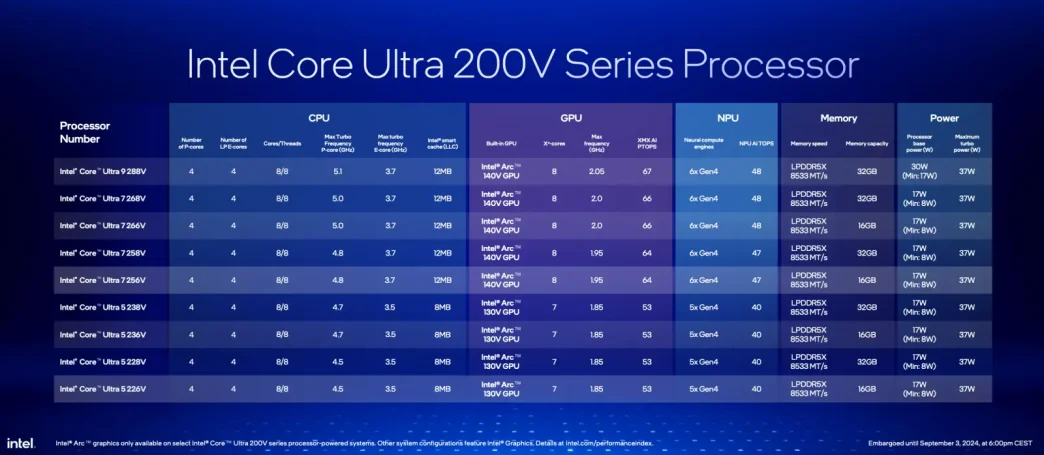
The competition to build the most advanced AI-powered PC processors heats up with the introduction of Intel’s Core Ultra 200V. At Computex in June, it was revealed that these “Lunar Lake” laptop chips would include a robust neural processing unit capable of 48 TOPS (tera operations per second) for AI tasks. Additionally, they are expected to come with up to 32GB of built-in memory, enhancing performance and reducing power consumption. Today, at the IFA trade show in Germany, Intel provided an even deeper insight into its upcoming AI-focused PC hardware.
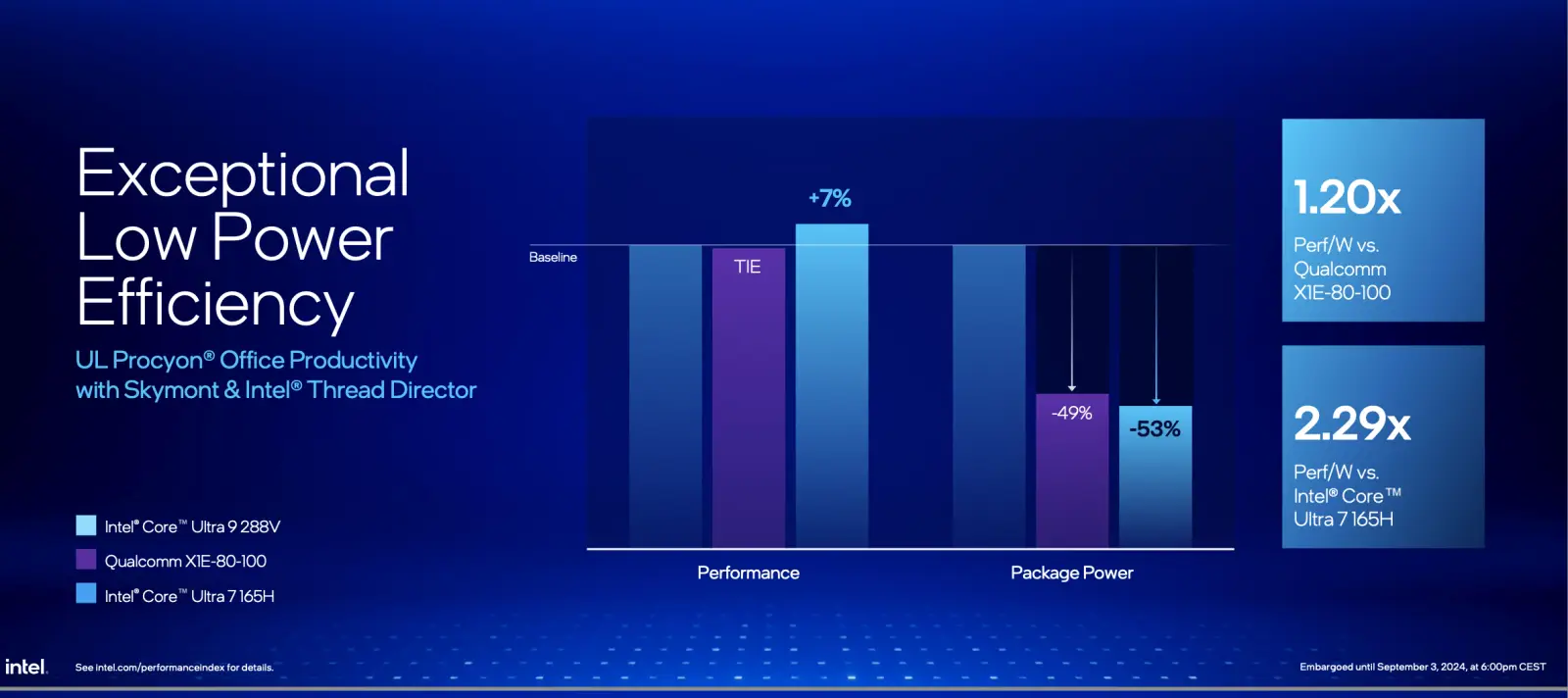
Intel claims that the Core Ultra 200V will be “the most efficient x86 processor ever,” boasting up to 50 percent lower on-package power consumption. The processor features memory integrated directly on the chip and has doubled both the cache and core count for its “Low Power Island” to 4MB and 4 cores, respectively, to handle less demanding tasks. Thanks to the new Xe2 built-in GPU, performance per watt has more than doubled for general use and gaming. For instance, Intel asserts that the Core Ultra 200V consumes 35 percent less power and delivers 32 percent faster performance compared to the previous generation.
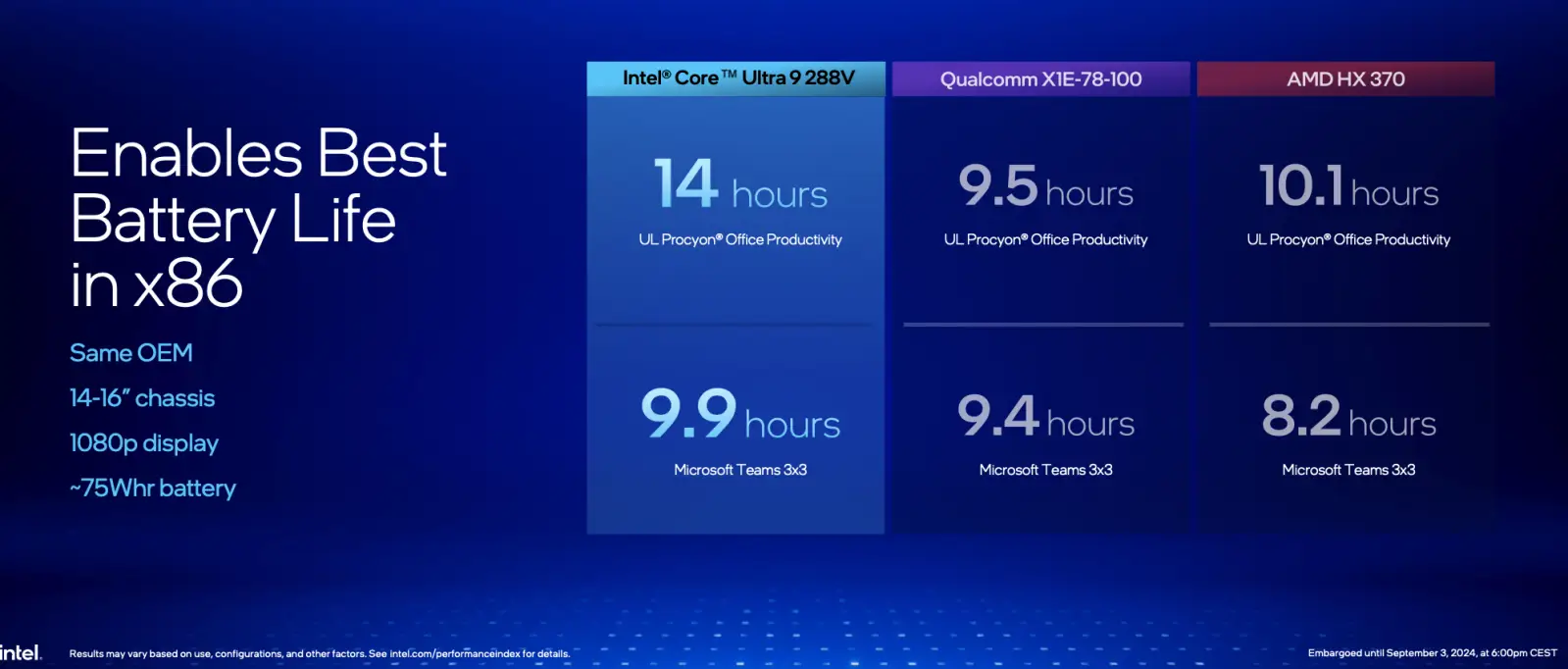
Intel appears to be targeting Qualcomm directly, as Qualcomm’s Arm-based Snapdragon chips have generally been known for their superior power efficiency compared to x86 processors. Intel even asserts it has an advantage in battery life. In a test using the same laptop model, the Core Ultra 7 268V achieved 20.1 hours on the UL Procyon Office Productivity benchmark, outperforming the Qualcomm X Elite chip, which lasted 18.4 hours. However, the Snapdragon system still excelled in the Microsoft Teams 3×3 test, with a battery life of 12.7 hours, compared to 10.7 hours for the Intel 268V.
The Core Ultra 200V represents a significant shift from Intel’s traditional x86 processor design. Notably, Intel has abandoned its Hyperthreading technology, which previously enabled a single CPU core to handle multiple task threads simultaneously. Instead, the new chips are optimized for single-threaded performance. Intel claims that the Core Ultra 200V’s P-cores (performance cores) are 14 percent faster than the previous generation, while the E-cores (efficiency cores) show a substantial 68 percent improvement in speed.
In contrast to Qualcomm’s Snapdragon chips, Intel’s Core Ultra 200V processors can seamlessly run legacy x86 software without encountering issues like emulation slowdowns or Arm compatibility problems. While the Snapdragon X Elite chips have shown strong performance on devices like the Surface Pro and XPS 13 Copilot+, they still face challenges with Windows on Arm, such as difficulties running games with robust anti-cheat systems like Fortnite. For those concerned about compatibility with older software or games, opting for an x86 processor might be the more reliable choice for the next few years.
Although the Core Ultra 200V series is capped at 8-core, 8-thread processors, Intel claims it offers up to three times the performance per thread compared to its previous chips. Additionally, Intel boasts that its new Xe2 GPU is 32 percent faster than its predecessor, 68 percent faster than Qualcomm’s 12-core X Elite chip, and 16 percent better than AMD’s HX 370. The Xe2 GPU also enhances AI capabilities with an extra 67 TOPS of compute performance, supplementing the NPU’s 48 TOPS.
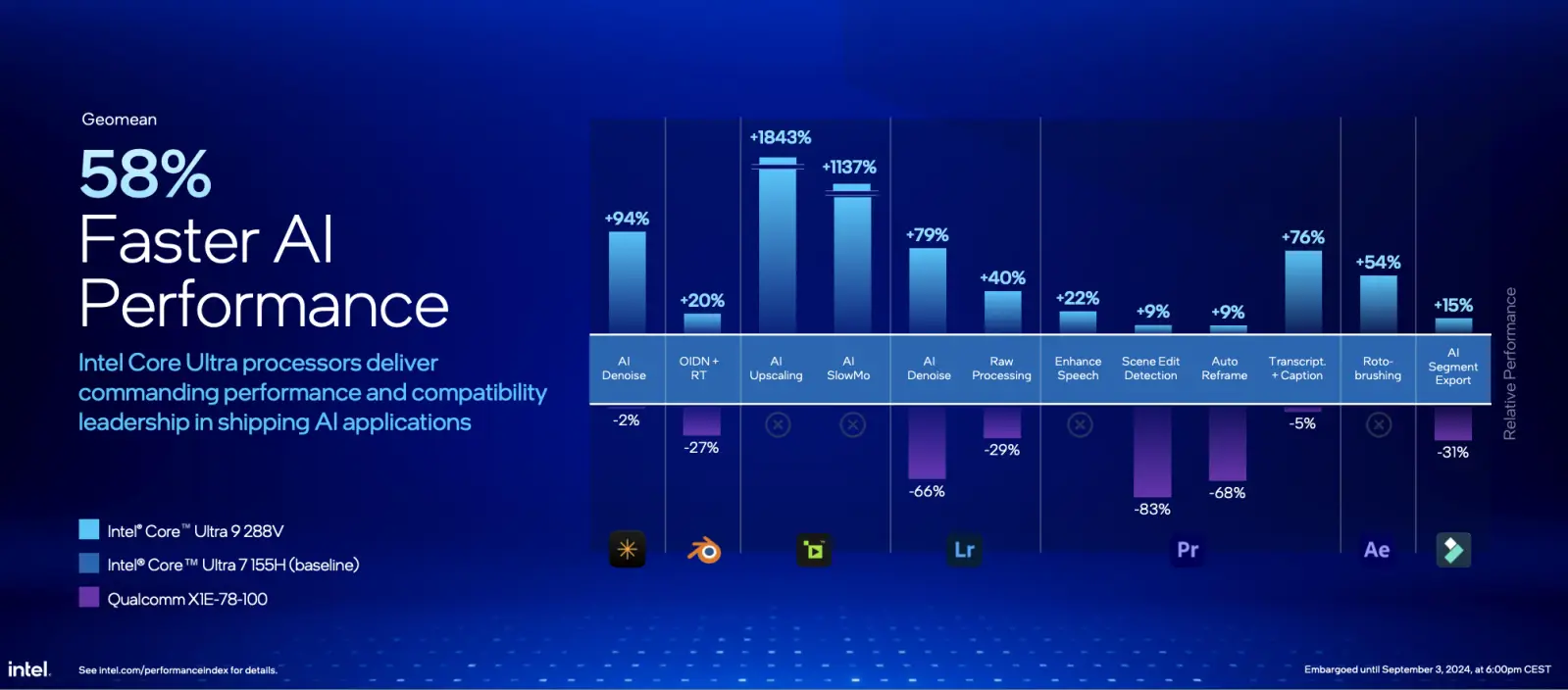
Intel asserts that the Core Ultra 9 288V’s NPU offers 79 percent faster denoising in Adobe Lightroom compared to its previous chip. In contrast, the Snapdragon X Elite 78-100 is reportedly 66 percent slower than Intel’s last generation. While these claims highlight Intel’s significant performance improvements, independent testing will be necessary to verify these figures. Nonetheless, Intel is clearly confident in its performance advantages.
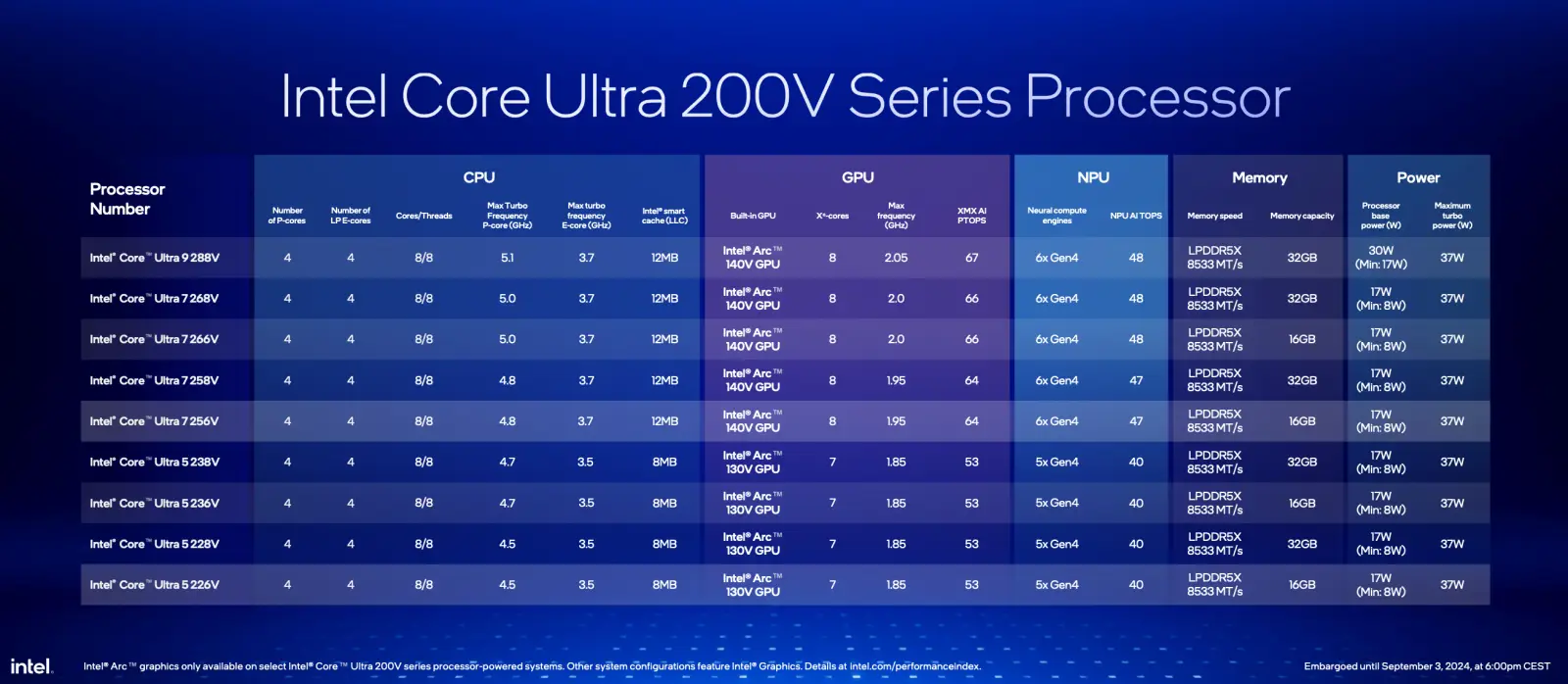
The Intel Core Ultra 200V series is topped by the Ultra 9 288V, which features eight cores (4 performance and 4 efficiency) and can reach up to 5.1GHz Max Turbo speeds on the performance cores. This high-end model is equipped with the most powerful 8-core Xe2 Arc 140V GPU and 32GB of RAM. All 200V chips have 8 cores, but their GPU, NPU, and RAM configurations vary. For instance, the entry-level Core Ultra 226V comes with a 7-core Arc GPU, a 40 TOPS NPU, and 16GB of RAM.
Similar to Apple’s M-series chips, the Core Ultra 200V’s built-in memory is not upgradeable, which could be a drawback given the recent introduction of easily upgradeable LPCAMM2 memory for notebooks. However, it’s worth noting that Intel isn’t limiting users to a fixed 8GB of RAM. Systems featuring the Intel Core Ultra 200V will be available starting September 24th from major manufacturers such as Dell, ASUS, and Acer.


