The past few days have begun to offer some insights into what we can expect from AMD’s next-generation GPU architecture, RDNA4. Although it’s clear that this architecture won’t heavily target the enthusiast market, the details of the GPU specifications are still being gradually uncovered.
Kepler_L2 recently confirmed that the upcoming Radeon RX graphics cards with RDNA4 architecture, likely the RX 8000 series, will offer three different memory configurations: 256-bit with 20 Gbps, 256-bit with 18 Gbps, and 192-bit with 19 Gbps. These GPUs are expected to continue using GDDR6 memory, as seen in the previous generation.
Memory bandwidth is only one part of AMD’s specifications. Another crucial element is the size of the Infinity Cache, a significant cache that has played a major role in the RDNA2 and RDNA3 launches.
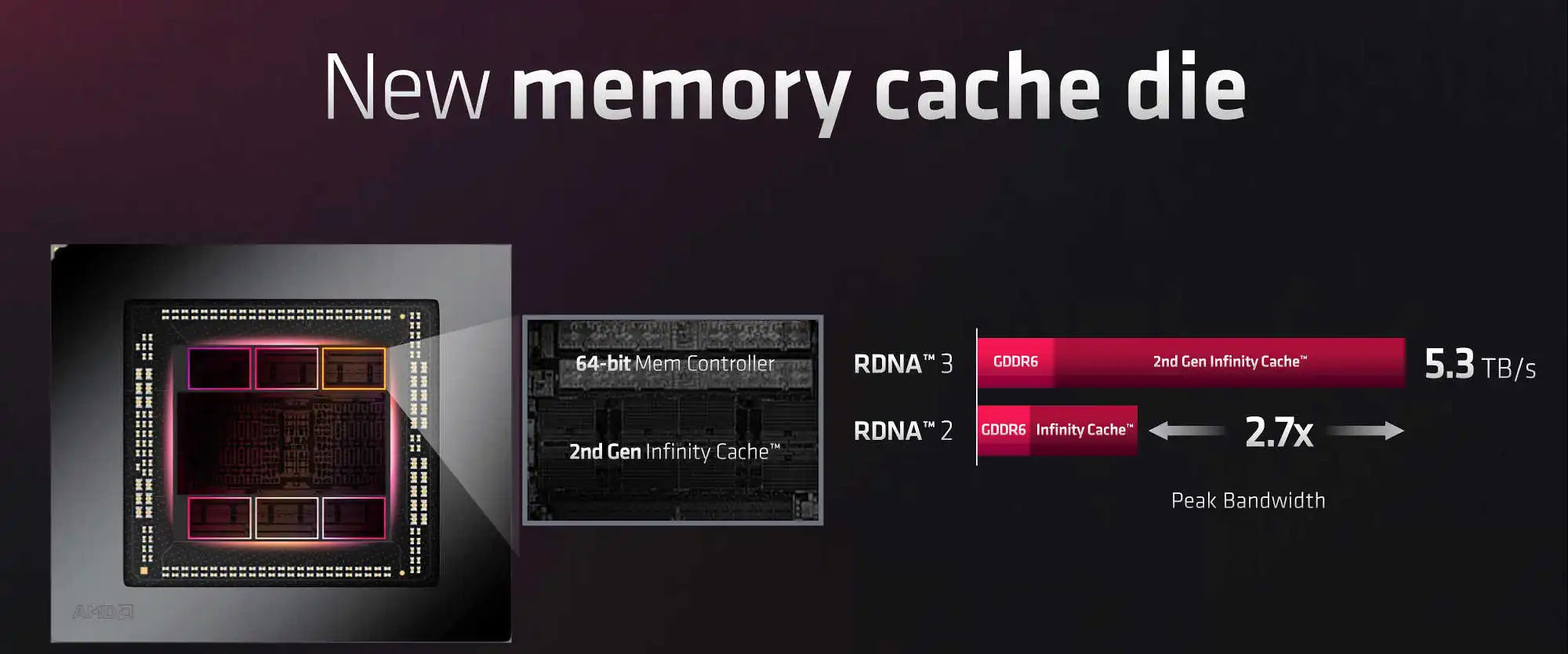
The current generation of GPUs provides Infinity Cache sizes ranging from 32MB (Navi 33) to 96MB (Navi 31). The upcoming Navi 44 and 48 GPUs, which could be seen as successors to Navi 33 and Navi 32, respectively, may likely retain similar Infinity Cache capacities.
According to Kepler, AMD will use 64MB and 48MB Infinity Cache configurations for the memory setups previously mentioned. The 64MB configuration would align with the full Navi 32, such as in the RX 7800 XT.
With RDNA3 GPUs, AMD introduced a second-generation Infinity Cache, so it’s likely that RDNA4 will feature even more advanced technology. However, a key difference is that the planned RDNA4 GPUs won’t utilize an MCM (Multi-Chip-Module) design, meaning the memory controllers and Infinity Cache will be integrated on a single die rather than being on separate dies.
AMD has not yet announced the official launch date for its RDNA4 GPUs, but it’s anticipated that these next-generation discrete GPUs could be released early next year.
64
64
48— Kepler (@Kepler_L2) August 27, 2024